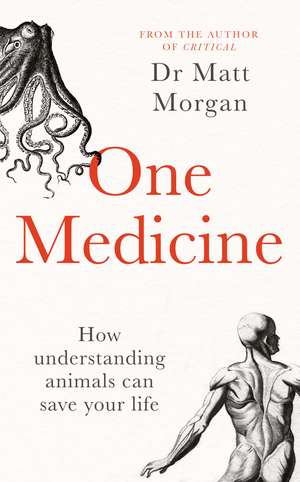
One Medicine: How understanding animals can save our lives
Autor Dr Matt Morganen Limba Engleză Paperback – 2 mar 2023
O scenă tensionată într-o unitate de terapie intensivă: un pacient se luptă pentru viață după un incident banal cu câteva firimituri de biscuiți, în timp ce, dincolo de fereastră, un stol de păsări brăzdează cerul în deplină siguranță. Această juxtapunere între fragilitatea umană și reziliența naturală declanșează o investigație fascinantă care transformă volumul One Medicine într-o dramatizare captivantă a interdependenței dintre specii. Considerăm că abordarea lui Dr Matt Morgan depășește granițele unui tratat științific, oferind o perspectivă cinematică asupra modului în care regnul animal deține cheile pentru vindecarea bolilor umane.
Ne-a atras atenția modul în care autorul navighează între studii de caz clinice și observații biologice uluitoare. De la inima de 150 kg a unei balene cu cocoașă, esențială pentru înțelegerea insuficienței cardiace, până la anatomia complexă a cangurilor care a rafinat tehnicile de fertilizare in vitro, narațiunea ne poartă printr-un laborator global al evoluției. Narativul amintește de Zoobiquity de Barbara Natterson-Horowitz prin intensitatea cu care reconstituie legătura profundă și adesea ignorată dintre medicina veterinară și cea umană.
În contextul operei sale, One Medicine reprezintă o evoluție naturală de la temele explorate în Critical. Dacă în lucrările anterioare precum A Second Act, Morgan se concentra pe relatările pacienților care s-au întors din pragul morții, aici el extinde cadrul de investigație. El nu mai privește doar în interiorul spitalului, ci caută soluții în mecanismele de supraviețuire ale creaturilor care înfruntă condiții extreme, demonstrând că medicina „umană” a fost, în esență, întotdeauna una zoologică.
Preț: 78.37 lei
Preț vechi: 94.87 lei
-17%
Carte disponibilă
Livrare economică 20 noiembrie-02 decembrie
Livrare express 31 octombrie-06 noiembrie pentru 43.53 lei
Specificații
ISBN-10: 1471173089
Pagini: 288
Dimensiuni: 153 x 234 x 20 mm
Greutate: 0.36 kg
Ediția:Export/Airside
Editura: Simon&Schuster
Colecția Simon & Schuster UK
V-ar putea interesa
-
 Preț: 189.74 lei
 -
 How Animals Heal UsJay GriffithsPreț: 168.40 lei
 -
 -14%Preț: 131.06 lei151.76 lei
 -
 -10%Preț: 228.27 lei254.60 lei
 -
 -26%Preț: 58.69 lei79.29 lei
 -
 Oh's Intensive Care ManualJonathan M. Handy-28%Preț: 697.98 lei971.29 leiRecomandat
 -
 Doctors by NatureJaap de RoodePreț: 160.71 lei
 -
 BreakthroughWilliam Pao-5%Preț: 190.53 lei200.55 lei
 -
 Animal Biology and Care, 4th EditionEmily Jewell-5%Preț: 383.54 lei403.73 lei
 -
 Preț: 70.67 lei
 -
 Preț: 84.75 lei
 -
 Beyond Supervet: How Animals Make Us The Best We Can Be: An inspiring gift for animal loversProfessor Noel Fitzpatrick-28%Preț: 47.60 lei66.10 lei
 -
 The Arrogant Ape: And A New Way To See HumanityChristine Webb-25%Preț: 92.37 lei123.57 lei
 -
 -28%Preț: 57.81 lei80.02 lei
 -
 Extremes: How Far Can You Go to Save a Life?Kevin Fong-30%Preț: 66.09 lei93.83 lei
 -
 -11%Preț: 70.74 lei79.35 lei
 -
 -24%Preț: 72.24 lei95.44 lei
 -
 One Midsummer's DayMark Cocker-30%Preț: 65.31 lei93.72 lei
 -
 Love, Animals, and MiraclesBernie S. SiegelPreț: 174.18 lei
 -
 The Book of Animal Secrets: Nature's Lessons for a Long and Happy LifeDavid B. Agus M.D.-18%Preț: 114.25 lei138.49 lei
 -
 -18%Preț: 118.47 lei144.67 leiRecomandat
 -
 When Life Gives You LemursTim HusbandPreț: 106.88 lei
 -
 What Sheep Think About the WeatherAmelia ThomasPreț: 123.15 lei
 -
 Living with BirdsLen HowardPreț: 120.28 lei
 -
 30 Animals That Made Us SmarterPatrick Aryee-17%Preț: 102.25 lei123.92 lei
 -
 The Book of Animal Secrets: Nature's Lessons for a Long and Happy LifeDavid B. Agus M.D.-17%Preț: 59.82 lei72.27 lei
De ce să citești această carte
Recomandăm această carte oricărui cititor curios să descopere cum natura a rezolvat deja problemele medicale cu care noi ne confruntăm astăzi. One Medicine nu este doar o lectură despre biologie, ci o pledoarie pentru empatie și colaborare între specii. Veți câștiga o înțelegere profundă a modului în care supraviețuirea unei balene sau a unei girafe este direct legată de viitorul tratamentelor pentru inima sau plămânii noștri.
Despre autor
Dr Matt Morgan este un renumit medic consultant în terapie intensivă și un comunicator de știință pasionat, recunoscut pentru capacitatea sa de a traduce complexitatea medicală în povești umane vibrante. Autor al volumelor de succes Critical și A Second Act, el își folosește experiența vastă din prima linie a spitalelor britanice pentru a explora limitele vieții și ale rezilienței. Lucrările sale sunt apreciate pentru onestitate și compasiune, oferind cititorilor o fereastră unică către lumea medicală, unde știința se întâlnește cu miracolul cotidian al supraviețuirii.
Descriere scurtă
Notă biografică
Recenzii
Descriere
It all started with a Hob Nob. As Dr Matt Morgan, an intensive care consultant, examined a patient who had suffered a cardiac arrest after inhaling some biscuit crumbs, he saw a flock of birds fly past the window. They must inhale objects all the time when flying, how do they survive? he thought to himself. This began an investigation that spanned continents, species and millennia.
For animal science has so much to teach us about human medicine. While some of the overlaps and parallels are obvious – we know how much DNA we share with primates, the first pig heart has been transplanted into a human – there is so much more that we have learnt from the animal world. For example, studying kangaroos, in particular the female’s three vaginas, has improved in-vitro fertilisation success rates. Watching how a giraffe breathes can help save the life of someone struggling with asthma. Investigating why birds that live in the frozen Arctic circle don’t freeze to death led to advances with treating hypothermia. Getting a ECG on the 150kg heart of a humpback whale was instrumental to keeping patients with cardiac failure living longer.
We owe animals so much, it’s time to focus on examining how they live and what we still have to learn from them. Better shared understanding of how our species coexists with millions of others can lead to untold medical advances, help both humans and animals and improve the world for all creatures from single-celled bacteria to a 30,000 kg whale. Who knows, maybe a kiss from a frog will save your life?