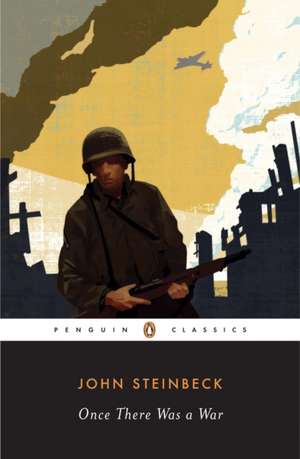
Once There Was a War
Autor John Steinbeck Editat de Mark Bowdenen Limba Engleză Paperback – sep 2007
Preț: 91.33 lei
Carte disponibilă
Livrare economică 21 noiembrie-05 decembrie
Specificații
ISBN-10: 0143104799
Pagini: 208
Dimensiuni: 132 x 197 x 13 mm
Greutate: 0.16 kg
Ediția:Revizuită
Editura: Penguin Publishing Group
V-ar putea interesa
-
 WarSebastian JungerPreț: 71.05 lei
-
 WolfpackRoger MoorhousePreț: 143.50 lei
-
 A Russian JournalJohn SteinbeckPreț: 96.54 lei
-
 The Moon is DownJohn Steinbeck-19%Preț: 57.24 lei70.83 lei
-
 A Russian JournalJohn Steinbeck-18%Preț: 75.70 lei92.84 lei
-
 America and Americans and Selected NonfictionJohn SteinbeckPreț: 107.38 lei
-
 The Grapes of WrathJohn Steinbeck-24%Preț: 55.78 lei73.18 lei
-
 ABC Practical Guide to Dog TrainingSteven AppelbaumPreț: 97.31 lei
-
 With the Old BreedE B SledgePreț: 64.05 lei
-
 Strangers in TimeDavid BaldacciPreț: 73.69 lei
-
 DispatchesMichael Herr-34%Preț: 56.80 lei85.73 lei
-
 Going to the WarsMax Hastings-33%Preț: 63.18 lei93.84 lei
-
 Voices of VictoryGeraint JonesPreț: 123.77 lei
-
 The Recollections Of Rifleman BowlbyAlex Bowlby-25%Preț: 53.91 lei72.09 lei
-
 World War II Memoirs: The European Theater (LOA #385)Elizabeth D. Samet-18%Preț: 272.74 lei333.22 lei
-
 On the Ground: My Life as a Foreign CorrespondentBrian Stewart-18%Preț: 119.16 lei145.50 leiRecomandat
-
 The People's WarJohn WillisPreț: 232.05 lei
-
 There's No HomeAlexander BaronPreț: 65.22 lei
-
 The Human KindAlexander BaronPreț: 64.70 lei
-
 The Human ComedyWilliam SaroyanPreț: 102.19 lei
Recenzii
-Chicago Tribune
Notă biografică
After marriage and a move to Pacific Grove, he published two California books, The Pastures of Heaven (1932) and To a God Unknown (1933), and worked on short stories later collected in The Long Valley (1938). Popular success and financial security came only with Tortilla Flat (1935), stories about Monterey’s paisanos. A ceaseless experimenter throughout his career, Steinbeck changed courses regularly. Three powerful novels of the late 1930s focused on the California laboring class: In Dubious Battle (1936), Of Mice and Men (1937), and the book considered by many his finest, The Grapes of Wrath (1939). The Grapes of Wrath won both the National Book Award and the Pulitzer Prize in 1939.
Early in the 1940s, Steinbeck became a filmmaker with The Forgotten Village (1941) and a serious student of marine biology with Sea of Cortez (1941). He devoted his services to the war, writing Bombs Away (1942) and the controversial play-novelette The Moon is Down (1942).Cannery Row (1945), The Wayward Bus (1948), another experimental drama, Burning Bright(1950), and The Log from the Sea of Cortez (1951) preceded publication of the monumental East of Eden (1952), an ambitious saga of the Salinas Valley and his own family’s history.
The last decades of his life were spent in New York City and Sag Harbor with his third wife, with whom he traveled widely. Later books include Sweet Thursday (1954), The Short Reign of Pippin IV: A Fabrication (1957), Once There Was a War (1958), The Winter of Our Discontent (1961),Travels with Charley in Search of America (1962), America and Americans (1966), and the posthumously published Journal of a Novel: The East of Eden Letters (1969), Viva Zapata!(1975), The Acts of King Arthur and His Noble Knights (1976), and Working Days: The Journals of The Grapes of Wrath (1989).
Steinbeck received the Nobel Prize in Literature in 1962, and, in 1964, he was presented with the United States Medal of Freedom by President Lyndon B. Johnson. Steinbeck died in New York in 1968. Today, more than thirty years after his death, he remains one of America's greatest writers and cultural figures.
Descriere
'Do you know it, do you remember it, the drives, the attitudes, the terrors and, yes, the joys?' Thus Steinbeck introduces his collection of poignant and hard-hitting dispatches for the New York Herald Tribune when the Second World War was at its height. He begins in England, recounting the courage of the bomber crews, the tragic air-raids and the strangeness of the British, before being sent to Africa and joining a special operations unit off the coast of Italy. Eating, drinking talking and fighting alongside the soldiers, Steinbeck's empathy for the common man is always in evidence in these pieces, and he never fails to evoke the human side of an inhuman war.
'If you have forgotten what the war was like, Steinbeck will refresh your memory. Age can never dull this kind of writing.'
Chicago Tribune