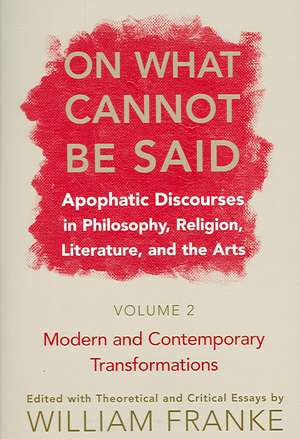
On What Cannot Be Said
Editat de William P. Frankeen Limba Engleză Paperback – apr 2007
Considerăm că acest prim volum din On What Cannot Be Said – Apophatic Discourses in Philosophy, Religion, Literature, and the Arts. Volume 1. Classic Formulations reprezintă o resursă indispensabilă pentru înțelegerea modului în care gândirea occidentală s-a raportat la „nespus”. William Franke propune o selecție riguroasă de texte care acoperă o arie vastă, de la filosofia greacă (Platon, Damascius) și textele biblice, până la misticismul medieval și renascentist reprezentat de figuri precum Marguerite Porete sau Tereza de Ávila. Subliniem faptul că nu este doar o simplă colecție de fragmente, ci o construcție teoretică solidă, susținută de eseuri introductive care ghidează cititorul prin labirintul teologiei negative și al limitelor de dicțiune. Fanii volumului Mystical Languages of Unsaying de Michael A. Sells vor recunoaște aceeași atenție la paradoxurile limbajului mistic, aplicată aici într-un context mult mai larg, care include nu doar religia, ci și estetica și ontologia. Reținem că această lucrare continuă preocuparea autorului pentru intersecția dintre literatură și divin, temă centrală și în A Theology of Literature, însă aici accentul cade pe rădăcinile istorice ale imposibilității numirii absolutului. Stilul este unul academic, dar marcat de o sensibilitate poetică, reflectând efortul constant al minții umane de a „ataca” inarticulatul prin intermediul cuvintelor. Este o lectură cu un ritm dens, care cere reflecție, transformând fiecare capitol într-o meditație asupra modului în care tăcerea devine, paradoxal, cel mai elocvent discurs.
Preț: 351.17 lei
Carte tipărită la comandă
Livrare economică 03-17 iulie
Specificații
ISBN-10: 0268028834
Pagini: 490
Dimensiuni: 152 x 229 x 29 mm
Greutate: 0.65 kg
Ediția:1
Editura: University of Notre Dame Press
V-ar putea interesa
-
 The Christian GodRichard Swinburne-15%Preț: 359.35 lei421.50 lei
 -
 Providence and the Problem of EvilRichard Swinburne-18%Preț: 335.81 lei408.55 lei
 -
 -34%Preț: 570.17 lei861.29 lei
 -
 Does God's Existence Need Proof?Richard Messer-41%Preț: 182.28 lei306.47 lei
 -
 God, Value, and NatureFiona Ellis-34%Preț: 778.28 lei1173.90 lei
 -
 -34%Preț: 661.94 lei1003.25 lei
 -
 God and GoodnessHugh Rice-37%Preț: 218.91 lei348.43 lei
 -
 Evidence for GodKeith WardPreț: 80.67 lei
 -
 Knowing the Unknowable GodC. S. C. David B. BurrellPreț: 185.66 lei
 -
 Conversations With GodNeale Donald Walsch-28%Preț: 55.29 lei77.30 lei
 -
 Friendship with God: An uncommon dialogueNeale Donald Walsch-27%Preț: 73.34 lei100.18 lei
 -
 -26%Preț: 1095.13 lei1477.92 lei
 -
 -27%Preț: 227.29 lei310.36 lei
 -
 Praising GodRuth C. DuckPreț: 133.16 lei
 -
 The Jesus MysteriesPeter GandyPreț: 78.43 lei
 -
 I Am With You: The Archbishop of Canterbury's Lent Book 2016Rev Kathryn Greene-McCreight-28%Preț: 48.96 lei68.21 lei
 -
 -22%Preț: 360.25 lei461.06 lei
De ce să citești această carte
Pentru cercetătorii și pasionații de filosofie și teologie, acest volum oferă fundamentul istoric al discursului despre inexprimabil. Cititorul câștigă o perspectivă panoramică asupra modului în care marii gânditori ai lumii au navigat granița dintre limbaj și tăcere. Este un instrument esențial pentru oricine dorește să înțeleagă rădăcinile teologiei negative și influența sa asupra criticii literare moderne, oferind claritate într-un domeniu marcat prin definiție de ambiguitate.
Despre autor
William Franke este un distins universitar și specialist în literatură comparată și filosofie a religiei, cunoscut pentru cercetările sale aprofundate asupra tradițiilor apofatice. Opera sa explorează frecvent modul în care adevărul religios și cel filosofic sunt revelate prin literatură, așa cum demonstrează lucrări precum Dantologies sau Don Quixote’s Impossible Quest for the Absolute in Literature. Prin abordarea sa interdisciplinară, Franke a devenit o voce autoritară în dialogul dintre gândirea occidentală și cea orientală, investigând limitele reprezentării lingvistice și modul în care poezia și misticismul reușesc să comunice ceea ce rațiunea pură nu poate cuprinde.
Descriere scurtă
“Any writer worth his salt knows that what cannot be spoken is ultimately the thing worth speaking about; yet most often this humbling awareness is unsaid or covered up. There are some who have made it their business, however, to court failure and acknowledge defeat, to explore the impasse of words before silence. William Franke has created an anthology of such explorations, undertaken in poetry and prose, that stretches from Plato to the present. Whether the subject of discourse is All or Nothing does not matter: the struggle of speech to name the unnameable is the same. This ambitious two-volume undertaking demonstrates a preoccupation as old as Western civilization itself: the limits of language and the virtue of being at a loss for words. How long we have been raiding the Inarticulate!” —Peter S. Hawkins, Boston University