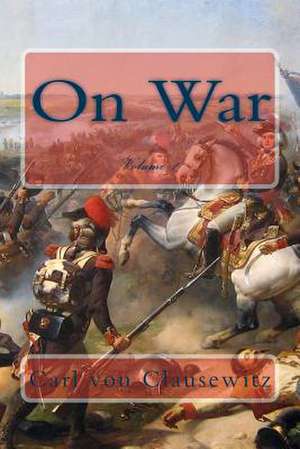
On War
Autor Carl Von Clausewitz Traducere de J. J. Grahamen Limba Engleză Paperback
Bazându-ne pe ediția revizuită de la Princeton University Press, descoperim în On War nu doar un manual de tactică, ci o lucrare de filozofie politică aplicată care a definit gândirea militară modernă. Reținem că această ediție, editată de Michael Howard și Peter Paret, oferă claritatea necesară unui text care a rămas neterminat la moartea autorului. Putem afirma că relevanța tratatului rezidă în capacitatea lui Carl Von Clausewitz de a integra experiența brută a câmpului de luptă din epoca napoleoniană într-un sistem coerent de gândire politică. Structura cărții este riguroasă, pornind de la definirea naturii războiului în Cartea Întâi — unde sunt explorate concepte precum „fricțiunea” sau „geniul militar” — și avansând către teoria strategiei în Cartea a Treia. Analiza sa asupra forțelor morale și a superiorității numerice rămâne un punct de referință în curriculumul academiilor militare contemporane. Lucrarea extinde cadrul propus de On War Volume I cu date noi din perspectiva editorilor asupra contextului istoric prusac, oferind un aparat critic ce include glosar și bibliografie. Față de alte scrieri ale autorului, precum Der Feldzug von 1815 in Frankreich, care se concentrează pe cronica unei campanii specifice, On War sintetizează observațiile din întreaga sa carieră, transformând evenimentele istorice în principii universale. Abordarea sa este analitică, evitând rețetele fixe și punând accent pe adaptabilitate în fața incertitudinii.
Preț: 102.84 lei
Carte tipărită la comandă
Livrare economică 05-19 decembrie
Specificații
ISBN-10: 1494738112
Pagini: 272
Dimensiuni: 152 x 229 x 14 mm
Greutate: 0.37 kg
Editura: CREATESPACE
V-ar putea interesa
-
 The Art of WarSun TzuPreț: 28.01 lei
 -
 The Campaigns of NapoleonDavid G. Chandler-16%Preț: 396.70 lei474.53 lei
 -
 The Proper Study Of MankindIsaiah Berlin-34%Preț: 154.42 lei232.27 lei
 -
 On WarCarl Clausewitz-28%Preț: 77.44 lei108.10 lei
 -
 Clausewitz: A Very Short IntroductionMichael Howard-20%Preț: 56.59 lei70.58 lei
 -
 A Study of History: Volume I: Abridgement of Volumes I-VIArnold J. Toynbee-22%Preț: 152.66 lei195.30 lei
 -
 A Study of History: Volume II: Abridgement of Volumes VII-XArnold J. Toynbee-24%Preț: 143.84 lei189.87 lei
 -
 Military Strategy: A Very Short IntroductionAntulio J. Echevarria IIPreț: 69.23 lei
 -
 On Strategists and Strategy: Collected Essays, 2014-2024Lawrence Freedman-18%Preț: 138.14 lei167.47 lei
 -
 -20%Preț: 160.98 lei200.55 leiRecomandat
 -
 Why War?Richard OveryPreț: 93.17 lei
 -
 War and PowerPhillips Payson O'BrienPreț: 122.53 lei
 -
 Preț: 167.25 lei
 -
 The Crooked Timber of HumanityIsaiah BerlinPreț: 138.56 lei
 -
 Against the CurrentIsaiah BerlinPreț: 144.19 lei
 -
 Freedom and Its BetrayalIsaiah BerlinPreț: 162.25 lei
 -
 The Power of IdeasIsaiah BerlinPreț: 164.47 lei
 -
 Reading ClausewitzBeatrice HeuserPreț: 123.57 lei
 -
 Clausewitz's on WarHew StrachanPreț: 110.42 lei
 -
 On the German Art of WarBruce CondellPreț: 140.70 lei
 -
 Preț: 140.69 lei
 -
 Niccolò Machiavelli''s The Art of WarNiccolo MachiavelliPreț: 57.62 lei
 -
 The History of the Peloponnesian WarRobin Waterfield-26%Preț: 207.30 lei279.54 lei
 -
 Preț: 137.32 lei
 -
 The Art of War and PeaceDavid KilcullenPreț: 192.51 lei
 -
 Rebooting ClausewitzChristopher Coker-16%Preț: 137.68 lei164.22 lei
 -
 The 33 Strategies Of WarRobert Greene-16%Preț: 123.93 lei147.95 lei
De ce să citești această carte
Această ediție este esențială pentru oricine studiază istoria militară sau științele politice, oferind cea mai precisă traducere a ideilor lui Clausewitz. Cititorul câștigă o înțelegere profundă a modului în care obiectivele politice dictează acțiunea militară, un concept care rămâne valid și în conflictele secolului XXI. Este recomandată celor care doresc să depășească nivelul tactic și să înțeleagă filozofia din spatele strategiei mari.
Despre autor
Carl Von Clausewitz (1780-1831) a fost un soldat și scriitor prusac a cărui carieră a început la vârsta de doisprezece ani. A participat la campania de pe Rin și a studiat la Academia Militară din Berlin, unde a fost influențat de gândirea kantiană și de mentorul său, Gerhard von Scharnhorst. Deși a fost un ofițer activ în timpul războaielor napoleoniene, Clausewitz este recunoscut mai degrabă ca un filozof al războiului. Opera sa capitală, On War, a fost publicată postum de soția sa, Marie von Clausewitz, în 1832, devenind fundamentul studiilor strategice moderne.
Descriere scurtă
Notă biografică
Descriere
Clausewitz, who fought in the Napoleonic wars, sought to understand and analyze the phenomenon of war so that future leaders could win conflicts more effectively. This abridged edition selects the books in which the nature and theory of war are developed and explains the originality his ideas.