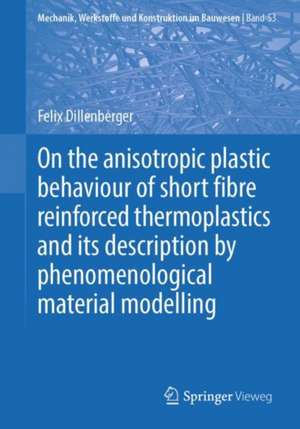
On the anisotropic plastic behaviour of short fibre reinforced thermoplastics and its description by phenomenological material modelling: Mechanik, Werkstoffe und Konstruktion im Bauwesen, cartea 53
Autor Felix Dillenbergeren Limba Engleză Paperback – 30 oct 2019
Din seria Mechanik, Werkstoffe und Konstruktion im Bauwesen
-
 Preț: 294.95 lei
 - 13%
 Preț: 492.33 lei
 - 18%
 Preț: 1174.45 lei
 -
 Preț: 414.23 lei
 - 15%
 Preț: 516.62 lei
 -
 Preț: 440.55 lei
 -
 Preț: 341.86 lei
 -
 Preț: 406.44 lei
 -
 Preț: 368.96 lei
 -
 Preț: 432.03 lei
 -
 Preț: 465.80 lei
 -
 Preț: 202.64 lei
 -
 Preț: 303.15 lei
 -
 Preț: 374.71 lei
 - 15%
 Preț: 672.74 lei
 - 15%
 Preț: 615.05 lei
 -
 Preț: 371.20 lei
 -
 Preț: 410.86 lei
 -
 Preț: 266.60 lei
 - 15%
 Preț: 508.16 lei
 -
 Preț: 436.83 lei
 -
 Preț: 399.39 lei
 -
 Preț: 404.57 lei
 - 18%
 Preț: 756.50 lei
 - 18%
 Preț: 861.13 lei
 - 18%
 Preț: 752.56 lei
 - 18%
 Preț: 853.23 lei
 - 15%
 Preț: 434.82 lei
 -
 Preț: 399.60 lei
 - 15%
 Preț: 502.93 lei
Preț: 372.67 lei
Nou
Puncte Express: 559
Preț estimativ în valută:
65.96€ • 77.35$ • 57.83£
65.96€ • 77.35$ • 57.83£
Carte tipărită la comandă
Livrare economică 24 ianuarie-07 februarie 26
Preluare comenzi: 021 569.72.76
Specificații
ISBN-13: 9783658281984
ISBN-10: 3658281987
Pagini: 227
Ilustrații: XIX, 227 p. 76 illus., 56 illus. in color.
Dimensiuni: 168 x 240 mm
Greutate: 0.4 kg
Ediția:1st ed. 2020
Editura: Springer Fachmedien Wiesbaden
Colecția Springer Vieweg
Seria Mechanik, Werkstoffe und Konstruktion im Bauwesen
Locul publicării:Wiesbaden, Germany
ISBN-10: 3658281987
Pagini: 227
Ilustrații: XIX, 227 p. 76 illus., 56 illus. in color.
Dimensiuni: 168 x 240 mm
Greutate: 0.4 kg
Ediția:1st ed. 2020
Editura: Springer Fachmedien Wiesbaden
Colecția Springer Vieweg
Seria Mechanik, Werkstoffe und Konstruktion im Bauwesen
Locul publicării:Wiesbaden, Germany
Cuprins
Glossaries.- Motivation and Outline.- Injection Moulded Short Fibre Reinforced Thermoplastics.- Polymeric Matrix Materials.- Reinforcement Fibres.- Composite Properties.- Injection Moulding.- Determination of Fibre Distributions.- State of the Art of SFRP Material Modelling.- Mechanical Basics.- Kinematics.- Stress.- Linear Elasticity.- Yield Condition and Plastic Potential.- Limit Criteria.- Damage.- Rate Dependency.- Material Characterisation.- Choice of Material.- Coordinate System Definition.- Experimental Set-up.- Experimental Results.- Discussion of Temperature Effects.- Material Modelling.- Overview.- Modelling of Linear Elasticity.- Modelling of Plastic Behaviour.- Modelling of Damage and Failure.- Numerical Implementation.- Verification.- Verification of Linear Elastic Response.- Verification of Plastic Response.- Numerical Verification of the Material Model.- Considerations for Engineering Practice 1857.- Determination of the Elastic Stiffness Matrix.- Determination ofthe Limit of Linear Deformation.- Determination of Plastic Deformation.- Consideration of Damage and Failure.- Summary and Outlook.
Notă biografică
Dr.-Ing. Felix Dillenberger is a mechanical engineer whose research focusses on the characterisation of the mechanical behaviour of thermoplastic plastics and their modelling in finite element simulations.
Textul de pe ultima copertă
This work introduces a material modelling approach for explicit finite element simulations of injection moulded short fibre reinforced thermoplastics. The material model considers linear-elastic behaviour and non-linear orthotropic stress-state dependent viscoplastic deformation for arbitrary fibre distributions. Regarding elasticity and the initial yield surface, a micro-mechanical Mori-Tanaka based approach is applied. On the matrix level an isotropic quadratic yield surface is introduced which is transferred into a Tsai-Wu yield surface on the composite level. An analytical expression for non-linear hardening and a simplified consideration of strain rate dependency is presented. The constitutive equations were verified with the experiments of a self-compounded PPGF30 material regarding regarding tension, compression and shear at different orientation distributions.
Caracteristici
New findings on the subject of material modelling of short-fibre reinforced plastics The theoretical work is supplemented with explicit hints for practical application Consideration of simplified approaches for the description of complex material behaviour