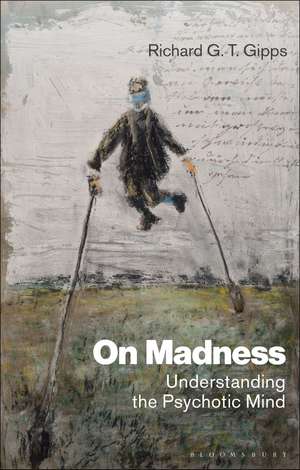
On Madness: Understanding the Psychotic Mind
Autor Richard G. T. Gippsen Limba Engleză Paperback – 6 oct 2022
Această monografie semnată de Richard G. T. Gipps reprezintă o incursiune profundă în structura minții psihotice, situată la intersecția dintre filozofia minții și practica clinică. În On Madness, descoperim o critică argumentată a tendinței psihopatologiei clasice de a căuta o ordine rațională în discursul delirant. Suntem de părere că valoarea acestui volum rezidă în capacitatea autorului de a demonstra cum, încercând să facem delirul „rațional”, riscăm să pierdem contactul cu suferința reală a subiectului. Lucrarea extinde cadrul propus de On Delusion de Jennifer Radden prin integrarea unei perspective clinice directe, trecând dincolo de simpla clasificare a erorilor de credință.
Structura cărții urmărește o progresie logică, de la definirea bolii mentale în capitolul de debut, spre analize complexe ale contactului cu realitatea și ale sinelui divizat. Capitolele dedicate halucinațiilor și simbolizării psihotice oferă instrumente teoretice pentru a înțelege de ce rațiunea eșuează în fața psihozei. Spre deosebire de abordarea enciclopedică din The Routledge Handbook of Philosophy of Delusion, Richard G. T. Gipps construiește o teză unitară: înțelegerea autentică a nebuniei apare abia atunci când acceptăm irecuperabilitatea rațională a delirului. Stilul este academic și riguros, însă textul rămâne ancorat în realitatea umană prin folosirea memoriilor de caz, oferind o perspectivă empatică asupra deznădejdii și fragmentării identitare.
Preț: 172.23 lei
Preț vechi: 216.71 lei
-21%
Carte disponibilă
Livrare economică 19 octombrie-02 noiembrie
Livrare express 02-08 octombrie pentru 76.10 lei
Specificații
ISBN-10: 1350192546
Pagini: 272
Dimensiuni: 156 x 232 x 16 mm
Greutate: 0.44 kg
Editura: Bloomsbury Publishing
Colecția Bloomsbury Academic
Locul publicării:London, United Kingdom
De ce să citești această carte
Suntem în fața unei lecturi esențiale pentru studenții și profesioniștii din psihologie și filozofie care doresc să depășească modelele pur cognitive ale psihozei. Cititorul câștigă o înțelegere nuanțată a modului în care simbolizarea și motivația funcționează acolo unde logica formală se prăbușește. Este o resursă valoroasă pentru oricine caută să fundamenteze teoretic intersecția dintre sănătatea mintală și ontologie, oferind o metodă de a depune mărturie în fața suferinței fără a o simplifica.
Descriere
Bringing together patient memoir, psychopathological observation and philosophical thought, Gipps offers a profound alternative. On the one hand he shows how, by appreciating just why we can't locate rational order within psychotic thought, we can better understand what it is to suffer delusion and psychosis. On the other, he recovers for us the value of such expressive, motivational and symbolic forms of understanding as only become available once we've been turned away at reason's door. In such ways Gipps not only solves the psychopathological problem of delusion, but also shows us how to bear a truer witness to the psychotic subject in their brokenness, pain and despair.
Cuprins
Introduction
1. Mental Illness
2. Delusion's Rational Irretrievability
3. Reality Contact
4. A World of One's Own
5. The Divided Self
6. Self and Other
7. Hallucination
8. Disordered Thought
9. Psychotic Symbolization
10. The Politics of Insanity Ascription
Notes
References
Index
Recenzii
Gipps's is a deeply necessary work, because it is the first book of philosophy to take seriously that madness and delusion defy positive definition. For the ground required in order to predicate of the non-sane the kinds of things we can normally take for granted is missing. The desire to say of someone who is suffering the severest forms of strangeness that she thinks such-and-such is typically, Gipps wisely warns us, dangerously over-reaching, running the risk, if doggedly pursued, of being itself a madness of method. This brilliant book retrieves the disturbing, disturbed, difficult reality of psychoses from beneath the layers of motivated metaphysical scientism that have accreted over them. Moreover, Gipps shows how the very failures of the various forms of scientism themselves often take us as close as we can get to understanding the non-sane.
In this fascinating meditation, grounded in the thought of Wittgenstein, Richard Gipps argues that an adequate understanding of madness must first recognize the limits, perhaps even the impossibility, of any such understanding. Psychosis for Gipps is like the God of "negative theology": indescribable and unknowable, approachable only through negation. His subtle critique of psychiatric and psychological concepts nevertheless illuminates many mysteries that are typically obscured by standard forms of explanation and description.
Richard Gipps has produced a remarkable book that forces us to reconsider the rather easy definitions of madness that we are so easily drawn into, often quite unwittingly. Delusions are not just false beliefs in the house of reason, which might be corrected or easily translated, for reason itself is functioning here in a different way. Gipps has the advantage of being both a clinician and very talented philosopher with a deep understanding of Wittgenstein. This book will appeal both to psychiatrists and psychoanalysts who have an interest in philosophy and to philosophers who will see how examining madness brings fresh new ways of thinking into knowledge, reason and epistemology more generally.