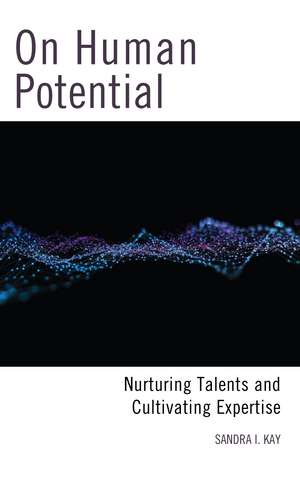
On Human Potential: Nurturing Talents and Cultivating Expertise
Autor Sandra I. Kayen Limba Engleză Hardback – 16 apr 2019
Preț: 551.05 lei
Preț vechi: 778.79 lei
-29%
Puncte Express: 827
Carte tipărită la comandă
Livrare economică 24 noiembrie-08 decembrie
Livrare prin curier în România Termenul estimat este afișat lângă disponibilitate.
Transport gratuit pentru acest produs Plată online sau ramburs, în funcție de opțiunile comenzii.
Retur gratuit în 14 zile Comandă securizată și suport în română.
Specificații
ISBN-13: 9781475842913
ISBN-10: 1475842910
Pagini: 220
Ilustrații: 24 tables
Dimensiuni: 161 x 229 x 22 mm
Greutate: 0.49 kg
Editura: Bloomsbury Publishing
Colecția Rowman & Littlefield
Locul publicării:New York, United States
ISBN-10: 1475842910
Pagini: 220
Ilustrații: 24 tables
Dimensiuni: 161 x 229 x 22 mm
Greutate: 0.49 kg
Editura: Bloomsbury Publishing
Colecția Rowman & Littlefield
Locul publicării:New York, United States
Descriere
According to experts in educational measurement, current and past performance remains the best single predictor of future performance. This book seeks to maximize individual and institutional efforts to support students optimal development, specifically their talents. The Talent Record introduced a common language, cataloging, and recording levels of talent achieved thus far on a Talent Profile page. Communicating accomplishments in a common language across talent fields unites the ever-changing team of individuals associated with a child's development and advances meaningful educational practice.
Cuprins
Foreword
Acknowledgements
Preface
Introduction: Perspectives on talent development and expertiseChapter One: Measuring what matters most
Chapter Two: Moving beyond 'a pleasure to have in class'
Chapter Three: Components of the Talent Record: Chronicling the development of expertise
Chapter Four: Recognizing Emerging Expertise
Chapter Five: A look at Intellectual Aptitude (IA) surfacing
Chapter Six: A look at emerging Specific Academic (AC) ability
Chapter Seven: Early sightings of Creative/Productive (CR) ability
Chapter Eight: On materializing Leadership (L)
Chapter Nine: A closer look at Visual/Performing Arts (AR) abilities
Chapter Ten: Early sightings of Psychomotor/Kinesthetic (PK) abilities
Chapter Eleven: So what? - The synergy of collaborationAppendix A: Intellectual (IA) & Academic (AC) Classroom Checklist of Observed Behaviors
Appendix B: Achievement Survey
Appendix C: Creativity (CR) ClassroomChecklist of Observed Behaviors
Appendix D: Leadership (L) ClassroomChecklist of Observed Behaviors
Appendix E: Visual Arts (AR.v) ClassroomChecklist of Observed Behaviors
Appendix F: Performing Arts (AR) Classroom Checklist of Observed Behaviors
AppendixG: Psychomotor/Kinesthetic (PK) Classroom Checklist of Observed Behaviors
Appendix H:TwoAutobiographical Talent Records: Extrapolation Examples for Constructing Talent:S. Wolzniak & C. S. Lewis
References
About the Author
Acknowledgements
Preface
Introduction: Perspectives on talent development and expertiseChapter One: Measuring what matters most
Chapter Two: Moving beyond 'a pleasure to have in class'
Chapter Three: Components of the Talent Record: Chronicling the development of expertise
Chapter Four: Recognizing Emerging Expertise
Chapter Five: A look at Intellectual Aptitude (IA) surfacing
Chapter Six: A look at emerging Specific Academic (AC) ability
Chapter Seven: Early sightings of Creative/Productive (CR) ability
Chapter Eight: On materializing Leadership (L)
Chapter Nine: A closer look at Visual/Performing Arts (AR) abilities
Chapter Ten: Early sightings of Psychomotor/Kinesthetic (PK) abilities
Chapter Eleven: So what? - The synergy of collaborationAppendix A: Intellectual (IA) & Academic (AC) Classroom Checklist of Observed Behaviors
Appendix B: Achievement Survey
Appendix C: Creativity (CR) ClassroomChecklist of Observed Behaviors
Appendix D: Leadership (L) ClassroomChecklist of Observed Behaviors
Appendix E: Visual Arts (AR.v) ClassroomChecklist of Observed Behaviors
Appendix F: Performing Arts (AR) Classroom Checklist of Observed Behaviors
AppendixG: Psychomotor/Kinesthetic (PK) Classroom Checklist of Observed Behaviors
Appendix H:TwoAutobiographical Talent Records: Extrapolation Examples for Constructing Talent:S. Wolzniak & C. S. Lewis
References
About the Author
Recenzii
In On Human Potential Kay, an independent scholar and instructional strategist, encourages teachers and administrators to rethink the ways they work with students, who have a diverse range of talents, in the classroom. She calls for the development of a common language for recording talents so that plans can be put in place for students to be best supported in reaching their potential. Through the use of case studies and charts to illustrate her findings, Kay discusses ways to identify students who demonstrate advanced behaviors in various domains, including traditional academic disciplines like math and science, as well as in the arts and in psychomotor skills. She emphasizes the importance of having teachers and mentors support students as they pursue their various talents. Administrators, teachers, and parents will appreciate the sample lists of resources for programs to support talented students. This text is highly recommended for administrators, pre-service and practicing teachers, and parents to help them rethink the ways different talents are identified and supported in schools.
Summing Up: Highly recommended. Upper-division undergraduates through faculty; professionals.
On Human Potential: Nurturing Talents and Cultivating Expertise represents an important breakthrough in examining the talent development process in the school context, how to find it and how to respond to students who exhibit advanced behaviors in specific domains. It is a "must read" for busy practitioners who want to be guided in their work with talented learners and offers practical advice to other educators and parents who want to ensure that students who show abilities in areas of learning have opportunities that match them.
This book fills a gap in the gifted education literature by focusing on the development of talent in those domains currently identified in the federal definition. I particularly liked the discussion related to converting strengths into talents. Being able to observe specific characteristics and achievements to create a multi-dimensional portrait would support educators' cultivation of talent in each and every learner.
As a student of Dr. Sandra Kay, I remember how moving and unusual it felt to have a teacher focus on understanding and encouraging the potential in my little self. For me, this included her generously reading and responding to endless pages of my early creative writing that I would type in my basement and vulnerably deliver to her desk. Now, many years later, as a parent grappling with how to guide my own child toward opportunities that match her interests and abilities, Dr. Kay's wisdom on identifying and building expertise, and her Talent Record as a tool, offer a blueprint for moving forward.
Sandra Kay's book is a timely and badly needed corrective to the shameful disregard that educators have shown over recent decades for meeting the needs of gifted and talented students in regular classrooms. Using innovative, simple-to-implement methods, and providing clear guidelines and exemplars, Kay empowers teachers, schools, parents, and communities to unite in recognizing, tracking, and fostering the unique abilities of our most precocious and creative students.
Every classroom K-12 is an opportunity to discover and develop talent. There is potential in children and it is our obligation as educators to understand how this potential can be nourished and guided. While developing expertise is complex, it follows patterns and Sandra Kay helps us understand these patterns. Through her experience, knowledge, and caring for students and teachers, she challenges us to accept this wonderful obligation to guide students from potential to expertise.
Providing a graceful, down-to-earth tri-part intertwining of research from multiple disciplines with tenets of professional educational practice with principles of positive parenting, Sandra Kay's On Human Potential: Nurturing Talents, Cultivating Expertise is a resource that any adult who is in any way involved in the development of a young person must read. Foundational to this book is the undeniable necessity for schools and parents to collaborate for identifying, nurturing, and optimizing young people's greatest abilities. Just as the aegis of special education promotes schools and homes working together to ensure that the needs of students with disabilities are accommodated, this book delineates a powerful, evidence-based systems approach for ensuring that children mature in a manner likely to bolster and promote their individual talents.
Although our society desperately needs to inspire a new generation of problem-solvers, creators, and innovators, much talent goes undeveloped in many classrooms. In this vitally important book, Sandra Kay offers insight into the talent development process and provides a roadmap for teachers and others to ensure that each student's capabilities are recognized and developed to their fullest potential. Teachers and parents everywhere, as well as school administrators, counselors, and educational policymakers, should not miss it!
Summing Up: Highly recommended. Upper-division undergraduates through faculty; professionals.
On Human Potential: Nurturing Talents and Cultivating Expertise represents an important breakthrough in examining the talent development process in the school context, how to find it and how to respond to students who exhibit advanced behaviors in specific domains. It is a "must read" for busy practitioners who want to be guided in their work with talented learners and offers practical advice to other educators and parents who want to ensure that students who show abilities in areas of learning have opportunities that match them.
This book fills a gap in the gifted education literature by focusing on the development of talent in those domains currently identified in the federal definition. I particularly liked the discussion related to converting strengths into talents. Being able to observe specific characteristics and achievements to create a multi-dimensional portrait would support educators' cultivation of talent in each and every learner.
As a student of Dr. Sandra Kay, I remember how moving and unusual it felt to have a teacher focus on understanding and encouraging the potential in my little self. For me, this included her generously reading and responding to endless pages of my early creative writing that I would type in my basement and vulnerably deliver to her desk. Now, many years later, as a parent grappling with how to guide my own child toward opportunities that match her interests and abilities, Dr. Kay's wisdom on identifying and building expertise, and her Talent Record as a tool, offer a blueprint for moving forward.
Sandra Kay's book is a timely and badly needed corrective to the shameful disregard that educators have shown over recent decades for meeting the needs of gifted and talented students in regular classrooms. Using innovative, simple-to-implement methods, and providing clear guidelines and exemplars, Kay empowers teachers, schools, parents, and communities to unite in recognizing, tracking, and fostering the unique abilities of our most precocious and creative students.
Every classroom K-12 is an opportunity to discover and develop talent. There is potential in children and it is our obligation as educators to understand how this potential can be nourished and guided. While developing expertise is complex, it follows patterns and Sandra Kay helps us understand these patterns. Through her experience, knowledge, and caring for students and teachers, she challenges us to accept this wonderful obligation to guide students from potential to expertise.
Providing a graceful, down-to-earth tri-part intertwining of research from multiple disciplines with tenets of professional educational practice with principles of positive parenting, Sandra Kay's On Human Potential: Nurturing Talents, Cultivating Expertise is a resource that any adult who is in any way involved in the development of a young person must read. Foundational to this book is the undeniable necessity for schools and parents to collaborate for identifying, nurturing, and optimizing young people's greatest abilities. Just as the aegis of special education promotes schools and homes working together to ensure that the needs of students with disabilities are accommodated, this book delineates a powerful, evidence-based systems approach for ensuring that children mature in a manner likely to bolster and promote their individual talents.
Although our society desperately needs to inspire a new generation of problem-solvers, creators, and innovators, much talent goes undeveloped in many classrooms. In this vitally important book, Sandra Kay offers insight into the talent development process and provides a roadmap for teachers and others to ensure that each student's capabilities are recognized and developed to their fullest potential. Teachers and parents everywhere, as well as school administrators, counselors, and educational policymakers, should not miss it!