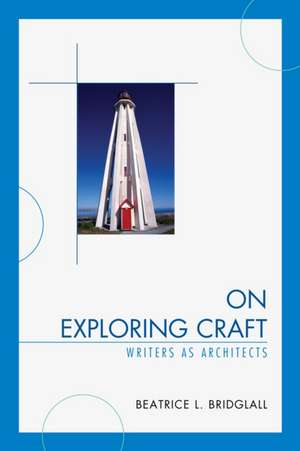
On Exploring Craft: Writers as Architects
Autor Beatrice L. Bridglallen Limba Engleză Hardback – 7 noi 2015
Preț: 391.28 lei
Preț vechi: 578.03 lei
-32%
Puncte Express: 587
Carte tipărită la comandă
Livrare economică 24 noiembrie-08 decembrie
Livrare prin curier în România Termenul estimat este afișat lângă disponibilitate.
Transport gratuit de la 400.00 lei Plată online sau ramburs, în funcție de opțiunile comenzii.
Retur gratuit în 14 zile Comandă securizată și suport în română.
Specificații
ISBN-13: 9780761866749
ISBN-10: 0761866744
Pagini: 116
Ilustrații: 4 graphs
Dimensiuni: 152 x 229 x 15 mm
Greutate: 0.36 kg
Editura: Bloomsbury Publishing
Colecția University Press of America
Locul publicării:New York, United States
ISBN-10: 0761866744
Pagini: 116
Ilustrații: 4 graphs
Dimensiuni: 152 x 229 x 15 mm
Greutate: 0.36 kg
Editura: Bloomsbury Publishing
Colecția University Press of America
Locul publicării:New York, United States
V-ar putea interesa
-
 -31%Preț: 773.74 lei1123.52 lei
 -
 Preț: 55.72 lei
 -
 Selected PoetryGerard Manley HopkinsPreț: 47.75 lei
 -
 Don Juan and Other PlaysMolièrePreț: 69.29 lei
 -
 -15%Preț: 70.31 lei82.65 lei
 -
 Finding IrelandRichard TillinghastPreț: 162.18 lei
 -
 Preț: 132.32 lei
 -
 Stepping StonesDennis O'DriscollPreț: 123.95 lei
 -
 Ramsey Campbell: Critical Essays on the Modern Master of HorrorGary William Crawford-36%Preț: 676.37 lei1052.46 lei
 -
 Preț: 61.12 lei
 -
 Preț: 59.26 lei
 -
 Preț: 61.33 lei
 -
 Preț: 61.11 lei
 -
 Dostoevsky: Language, Faith and FictionThe Rt Hon Rowan Williams-42%Preț: 100.79 lei172.79 lei
Cuprins
Foreword by Rochelle Hendricks, Secretary of New Jersey Higher Education
Preface and Organization of the Book
Acknowledgments
Chapter 1: Writers as Architects: Exploring Parallel Concepts in Architecture and Literature
Chapter 2: A Meditation on Lines, Direction, Movement and Mass: The Poems of Marina Tsvetaeva
Chapter 3: Light, Color and Space in Select Poems by Robert Hass
Chapter 4: Glimpses of Proportion and Symmetry: F. Scott Fitzgerald's The Great Gatsby
Chapter 5: Unraveling Texture in William Faulkner's Light in August
Chapter 6: Toward Plumbing Architectural and Narrative Space in Ernest Hemingway's The Old Man and the Sea, "Soldier's Home", and "A Clean Well-Lighted Place"
Chapter 7: Tension, Compression and Pacing in Vladimir Nabokov's Lolita and Pnin
Chapter 8: Exploring Pattern and Rhythm: Alice Munro's "Dulse" and "Labor Day Dinner"
Chapter 9: Appreciating Unity and Harmony in Kazuo Ishiguro's The Remains of the Day
Chapter 10: The Role of Order and Propriety in William Gass' In the Heart of the Heart of the Country
Chapter 11: Investigating Balance in Gustave Flaubert's Madame Bovary and The First Sentimental Education
References
Index
About the Author
Preface and Organization of the Book
Acknowledgments
Chapter 1: Writers as Architects: Exploring Parallel Concepts in Architecture and Literature
Chapter 2: A Meditation on Lines, Direction, Movement and Mass: The Poems of Marina Tsvetaeva
Chapter 3: Light, Color and Space in Select Poems by Robert Hass
Chapter 4: Glimpses of Proportion and Symmetry: F. Scott Fitzgerald's The Great Gatsby
Chapter 5: Unraveling Texture in William Faulkner's Light in August
Chapter 6: Toward Plumbing Architectural and Narrative Space in Ernest Hemingway's The Old Man and the Sea, "Soldier's Home", and "A Clean Well-Lighted Place"
Chapter 7: Tension, Compression and Pacing in Vladimir Nabokov's Lolita and Pnin
Chapter 8: Exploring Pattern and Rhythm: Alice Munro's "Dulse" and "Labor Day Dinner"
Chapter 9: Appreciating Unity and Harmony in Kazuo Ishiguro's The Remains of the Day
Chapter 10: The Role of Order and Propriety in William Gass' In the Heart of the Heart of the Country
Chapter 11: Investigating Balance in Gustave Flaubert's Madame Bovary and The First Sentimental Education
References
Index
About the Author
Recenzii
At a time in which a heated debate rages over whether education should be vocational or liberal, this book makes a much needed contribution. It applies the tenets of architecture to illuminate great works of literature, demonstrating that the useful arts and liberal tradition are inextricably intertwined.
The exploration of parallel concepts that both architects and writers utilize in their respective work, is no easy task. Even more impressive however, is Dr. Bridglall's astute investigation of worlds imagined yet enduring; philosophical, poetic and fictional worlds in which ideas of identity, truth, nature, beauty and belonging collide and unfold in chaos, conflict, and occasionally, enlightenment. Worlds in which we can train our lenses on characters, sometimes very much like ourselves, and observe as they struggle to understand and bring human shape to their world. This book reinforces the power of literature, particularly for our students, as they navigate their way in an increasingly complex and diverse world.
The opportunity to 'work through' the chapters in this volume has been a fantastic exercise in understanding and constructing the analytical lenses through which Dr. Bridglall perceives and describes the literary works chosen for inclusion. She maps out an intriguing way of working with the texts for reading, reflection, analysis, and synthesis, and explains her approach so well that readers can approach the works along with her as she works through their applied interpretive meaning. Dr. Bridglall's framework brings together a unique way of examining literature that for many post-secondary level readers would be far more accessible than the 'reader response', 'literary devices', or 'critical analysis' approaches that often dominate such readings and discussions. For more advanced readers, it provides a novel and challenging way to examine and reflect on literary works. It crosses the spectrum. I enjoyed her rendering of what I'd consider to be one of the more complex interpretive levels in relation to the line, "I've loved living with little." The work also calls on readers to read past the literary works themselves to bring actual knowledge and understanding of writers' lives to literary renderings.
The exploration of parallel concepts that both architects and writers utilize in their respective work, is no easy task. Even more impressive however, is Dr. Bridglall's astute investigation of worlds imagined yet enduring; philosophical, poetic and fictional worlds in which ideas of identity, truth, nature, beauty and belonging collide and unfold in chaos, conflict, and occasionally, enlightenment. Worlds in which we can train our lenses on characters, sometimes very much like ourselves, and observe as they struggle to understand and bring human shape to their world. This book reinforces the power of literature, particularly for our students, as they navigate their way in an increasingly complex and diverse world.
The opportunity to 'work through' the chapters in this volume has been a fantastic exercise in understanding and constructing the analytical lenses through which Dr. Bridglall perceives and describes the literary works chosen for inclusion. She maps out an intriguing way of working with the texts for reading, reflection, analysis, and synthesis, and explains her approach so well that readers can approach the works along with her as she works through their applied interpretive meaning. Dr. Bridglall's framework brings together a unique way of examining literature that for many post-secondary level readers would be far more accessible than the 'reader response', 'literary devices', or 'critical analysis' approaches that often dominate such readings and discussions. For more advanced readers, it provides a novel and challenging way to examine and reflect on literary works. It crosses the spectrum. I enjoyed her rendering of what I'd consider to be one of the more complex interpretive levels in relation to the line, "I've loved living with little." The work also calls on readers to read past the literary works themselves to bring actual knowledge and understanding of writers' lives to literary renderings.