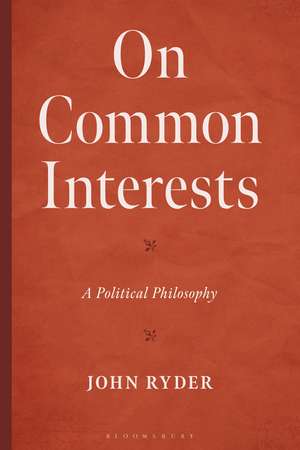
On Common Interests: A Political Philosophy
Autor John Ryderen Limba Engleză Hardback – 18 sep 2025
Preț: 588.81 lei
Preț vechi: 684.66 lei
-14%
Puncte Express: 883
Carte tipărită la comandă
Livrare economică 04-18 decembrie
Livrare prin curier în România Termenul estimat este afișat lângă disponibilitate.
Transport gratuit pentru acest produs Plată online sau ramburs, în funcție de opțiunile comenzii.
Retur gratuit în 14 zile Comandă securizată și suport în română.
Specificații
ISBN-13: 9798765143490
Pagini: 368
Dimensiuni: 152 x 232 x 26 mm
Greutate: 0.68 kg
Editura: Bloomsbury Publishing
Colecția Bloomsbury Academic
Locul publicării:New York, United States
Pagini: 368
Dimensiuni: 152 x 232 x 26 mm
Greutate: 0.68 kg
Editura: Bloomsbury Publishing
Colecția Bloomsbury Academic
Locul publicării:New York, United States
Cuprins
Acknowledgements
Preface
Introduction
Part I: Preliminary Considerations and Background Conceptions
Chapter 1. The Failure of Political Philosophy
Chapter 2. The Varieties of Political Experience
Chapter 3. Practice Over Propositions
Chapter 4. Experience and Social Values
Part II: Political Principles, Common Interests, and the Polity
Chapter 5. Political Principles
Chapter 6. The Plurality and Diversity of Common Interests
Chapter 7. Common Interests and the Polity
Conclusion
Bibliography
Index
About the Author
Preface
Introduction
Part I: Preliminary Considerations and Background Conceptions
Chapter 1. The Failure of Political Philosophy
Chapter 2. The Varieties of Political Experience
Chapter 3. Practice Over Propositions
Chapter 4. Experience and Social Values
Part II: Political Principles, Common Interests, and the Polity
Chapter 5. Political Principles
Chapter 6. The Plurality and Diversity of Common Interests
Chapter 7. Common Interests and the Polity
Conclusion
Bibliography
Index
About the Author
Recenzii
Ryder develops a detailed and tightly reasoned pragmatic alternative to political philosophies constructed on left/right/center and liberal/anti-liberal assumptions. His innovative approach is pluralistic and ecumenical. He urges consensus-building motivated not by what people think or believe, but by how their experiences shape their lives as individuals and members of communities.
This is a radical exercise of the political imagination, in the sense that the author at every turn attempts to get to the root of the matter, digging deeper than any other contemporary theorist is disposed to do. John Ryder is unafraid to draw out disconcertingly novel implications from his historical observations and theoretical conclusions, to entertain utterly unorthodox possibilities. He does so in an historically informed, philosophically rigorous, and rhetorically engaging manner. This is a very serious and, in the best sense, disturbing work. His position does not neatly fit into any traditional category-so much the worse for those categories, so much to the credit of this author.
This is a radical exercise of the political imagination, in the sense that the author at every turn attempts to get to the root of the matter, digging deeper than any other contemporary theorist is disposed to do. John Ryder is unafraid to draw out disconcertingly novel implications from his historical observations and theoretical conclusions, to entertain utterly unorthodox possibilities. He does so in an historically informed, philosophically rigorous, and rhetorically engaging manner. This is a very serious and, in the best sense, disturbing work. His position does not neatly fit into any traditional category-so much the worse for those categories, so much to the credit of this author.