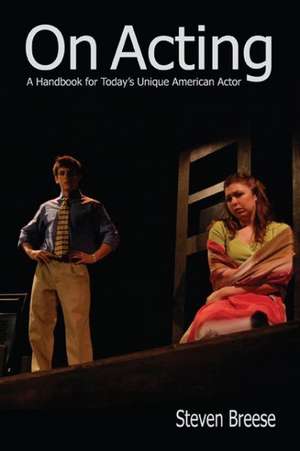
On Acting: A Handbook for Today's Unique American Actor
Autor Steven Breeseen Limba Engleză Paperback – 15 ian 2013
To support a new generation of actors/acting teachers by coupling fresh ideas and new approaches with the best proven methods and practices. On Acting is written primarily for the contemporary American actor. It strives to address the acting process with an eye toward the performance culture and requirements that exist today. It is a book for the new twenty-first century artist—the serious practical artist who seeks to pursue a career that is both fulfilling and viable.
The text features a balance of philosophy, practical advice, anecdotal evidence/experiences and a wide variety of acting exercises/activities. Also included is the short Steven Breese play "Run. Run. Run Away" and an example of a scene score from that play.
The text features a balance of philosophy, practical advice, anecdotal evidence/experiences and a wide variety of acting exercises/activities. Also included is the short Steven Breese play "Run. Run. Run Away" and an example of a scene score from that play.
Preț: 174.17 lei
Preț vechi: 224.53 lei
-22%
Puncte Express: 261
Carte disponibilă
Livrare economică 06-20 noiembrie
Livrare prin curier în România Termenul estimat este afișat lângă disponibilitate.
Transport gratuit de la 400.00 lei Plată online sau ramburs, în funcție de opțiunile comenzii.
Retur gratuit în 14 zile Comandă securizată și suport în română.
Specificații
ISBN-13: 9781585104550
ISBN-10: 1585104558
Pagini: 268
Ilustrații: photos and diagrams
Dimensiuni: 152 x 229 x 27 mm
Greutate: 0.43 kg
Ediția:First Edition
Editura: Hackett Publishing Company,Inc
Colecția Focus
Locul publicării:United States
ISBN-10: 1585104558
Pagini: 268
Ilustrații: photos and diagrams
Dimensiuni: 152 x 229 x 27 mm
Greutate: 0.43 kg
Ediția:First Edition
Editura: Hackett Publishing Company,Inc
Colecția Focus
Locul publicării:United States
V-ar putea interesa
-
 Voice and the ActorCicely BerryPreț: 84.07 lei
 -
 The Actor's Art and CraftWilliam EsperPreț: 109.10 lei
 -
 The Intent to LiveLarry Moss-27%Preț: 100.20 lei137.31 lei
 -
 True and FalseDavid MametPreț: 92.31 lei
 -
 -23%Preț: 133.03 lei173.58 lei
 -
 Challenge for the ActorUta HagenPreț: 171.97 lei
 -
 No Acting PleaseEric MorrisPreț: 110.12 lei
 -
 Stanislavsky and Mindfulness: Being in the MomentDawn InglesonPreț: 379.01 lei
 -
 Respect for ActingUta HagenPreț: 126.26 lei
 -
 100 Acting Exercises for 8 - 18 Year OldsSamantha Marsden-18%Preț: 124.99 lei151.74 lei
 -
 Listening and Talking: A Pathway to ActingEvan Yionoulis-19%Preț: 143.70 lei177.19 lei
 -
 Acting: A Backstage GuideLucian Msamati-11%Preț: 72.41 lei81.42 lei
 -
 -15%Preț: 186.48 lei220.63 lei
 -
 -8%Preț: 170.14 lei185.61 lei
 -
 The Actor and the TargetDeclan DonnellanPreț: 120.72 lei
 -
 An Actor PreparesConstantin Stanislavski-15%Preț: 118.59 lei139.96 lei
 -
 The Acting BookJohn Abbott-11%Preț: 94.33 lei106.10 lei
 -
 Actioning and How to Do ItNick MoseleyPreț: 79.15 lei
 -
 Actions: The Actors' ThesaurusMarina CaldaronePreț: 78.85 lei
 -
 Different Every NightMike AlfredsPreț: 125.82 lei
Recenzii
“It's about time this rational, actor-centric, and systematic approach to acting theory was made widely available to the many young (and old) artists who haven't had the benefit of learning from Steven Breese directly.”
- Danny Devlin, Professional Actor/Former Student
- Danny Devlin, Professional Actor/Former Student
"I believe I have already mentioned many of the strong points. Yes, I would definitely like to use this book in Acting II and maybe in Acting I. It is a book that is similar enough to satisfy those professors who like a very traditional approach to training, yet different enough to add excitement to the training process with professional examples and great exercises."
- James R. Hartman, Schoolcraft College
- James R. Hartman, Schoolcraft College
"Strongest element is the exercises. Easy to follow and to visualize. I would recommend this text as supplemental reading."
- Bette Pettigrew, Johnson County Community College
- Bette Pettigrew, Johnson County Community College
"As an educator and director for the past 40+ years, I highly recommend On Acting. Steven's writing style is totally engaging, informative, and thought provoking. He speaks from experience and experiences, exemplified by personal anecdotes, classroom examples, asides, quotes, delightful humor and just the right amount of humility. It all works. No matter what your level of theatrical expertise, this book is for you."
- Catherine Davis, Professional Director & Educator
- Catherine Davis, Professional Director & Educator
"I can already say that On Acting should be required reading for any actor or anyone who teaches acting. It is beautifully and interestingly written. It gives due reverence to the art and craft of acting without being pompous or pretentious. And a quick scan of the sections on process and technique tells me that following your "method" will turn out actors who really are 'actors'."
- Ron Reid, Professional Actor
- Ron Reid, Professional Actor
On Acting is written to support a new generation of actors/acting teachers by coupling fresh ideas and new approaches with the best proven methods and practices. It is written primarily for the contemporary American actor and it strives to address the acting process with an eye toward the performance culture and requirements that exist today. It is a book for the new twenty-first century artist—the serious practical artist who seeks to pursue a career that is both fulfilling and viable.
“It's about time this rational, actor-centric, and systematic approach to acting theory was made widely available to the many young (and old) artists who haven't had the benefit of learning from Steven Breese directly.”
- Danny Devlin, Professional Actor/Former Student
"I believe I have already mentioned many of the strong points. Yes, I would definitely like to use this book in Acting II and maybe in Acting I. It is a book that is similar enough to satisfy those professors who like a very traditional approach to training, yet different enough to add excitement to the training process with professional examples and great exercises."
- James R. Hartman, Schoolcraft College
"... [the exercises are] easy to follow and to visualize."
- Bette Pettigrew, Johnson County Community College
Steven Breese has enjoyed a national and international acting, directing, and playwriting career that has spanned more than 30 years. He is currently serving as Dean of the College of Arts & Humanities at Christopher Newport University.
“It's about time this rational, actor-centric, and systematic approach to acting theory was made widely available to the many young (and old) artists who haven't had the benefit of learning from Steven Breese directly.”
- Danny Devlin, Professional Actor/Former Student
"I believe I have already mentioned many of the strong points. Yes, I would definitely like to use this book in Acting II and maybe in Acting I. It is a book that is similar enough to satisfy those professors who like a very traditional approach to training, yet different enough to add excitement to the training process with professional examples and great exercises."
- James R. Hartman, Schoolcraft College
"... [the exercises are] easy to follow and to visualize."
- Bette Pettigrew, Johnson County Community College
Steven Breese has enjoyed a national and international acting, directing, and playwriting career that has spanned more than 30 years. He is currently serving as Dean of the College of Arts & Humanities at Christopher Newport University.
Cuprins
Table of Contents
Before We Get Started xi
Acknowledgment xiv
Forward xv
ACT I: The Actor’s Work
Lesson 1: On Being an Actor 1
Before We Get Started xi
Acknowledgment xiv
Forward xv
ACT I: The Actor’s Work
Lesson 1: On Being an Actor 1
- Since Stanislavski 3
- Historical Perspective
- Taking Ownership
- Characteristics and Meanings
- Points of View
- Interactions
- Being Alive
- Public Anxiety
- Divide and Release
- Shifting Into Reverse
- Reflection, Curiosity and Aesthetic
Lesson 2: On Beginning 21- The Beginners Mind 22
- Five Assumptions
- The Necessity of Failure
- Scene by Scene
- Magic in the Making
- Stuff that’s in Our Way
- Finding Zero
- Using Zero
Lesson 3: On Action 41- Making Human Beings 41
- What Do You Want? 43
- Say It / Play It 45
- Tactics
- Actions
- Common Playable Actions
- What is at Stake?
Lesson 4: On Obstacle 59- The Essential Struggle 59
- Essential Elements
- Those Without
- Those Within
Lesson 5: On Public Isolation 65- Intimate Strangers 65
- Concentration 66
- Split Concentration 68
- Summary: Lesson 5 69
- Activities and Exercises: Mirror Exercise, One-Word Sentences, Entrance/Exit 69
- Just Do, Don’t Judge 73
- Self-Censorship
- Risk
- Ready, Render, Reflect, Repeat
Lesson 7: On Intimacy 83- The Morning After 83
- The Sensuality of the Process 84
- What We See
- What We Hear
- Inner Monologue
- What We Smell and Taste
- What We Touch
- Relationship and Backstory
- Obstacle and Risk
- Mystery
- Anticipation and 1000% Listening
- Decision
- Emotional Arc
- Checking In
Lesson 8: On Emotion 95- Emotion and Acting 96
- Using Emotion
- Accepting Offers
Lesson 9: On Repetition 103- Do It 100 Times 103
- Process of Building a Scene 105
- Read-through
- Memorize Lines / Own the Words
- Five Scene Study Questions
- Putting the Scene On its Feet
- Stage Directions
- The Four “Rs”
Lesson 10: On Improvement 115- The Big Secret 115
- Breakthroughs and Little Steps
- Stagnation and Patience
ACT II: The Actor’s Toolbox
Lesson 11: On Script Analysis 123- Dramatic Construction 124
- Crisis
- What Is?
- What Probably Is?
- What Might, Could or May be?
- What’s Missing?
- What Do You Want Overall?
- Scene’s Given Circumstances
- What’s the Episode?
- Starting in the Middle
- Characters and Relationships
- What’s New? Discoveries, Changes and Decisions
- Change in Relationship
- Change that Drive Decisions
- Beats and Beat Change
- Dominant Tactics/Beats
- Score the Scene
Lesson 12: On Movement 141- Strength 142
- Thoughts on Dance
- The Spine
- The Cat
- The Serpent
- The Question Mark
- Rolling and Stacking
- Rotation
- Side (Obliques)
- The Center
- Specificity, Economy of Movement and Character Traits
- Posture
- Stylized Movement, Period Movement and Dance
- Stage Violence and Combat
Lesson 13: On Stillness 161- Vibrancy Inside 161
- Internal Focus 162
- Summary: Lesson 13 163
- Activities and Further Study 163
Lesson 14: On Voice and Speech 165- Breath and Breathing 166
- Releasing Sound 167
- Pitch and Resonance 168
- Language 169
- Diction and Articulation 171
- Voiced vs. Unvoiced
- Stops, Fricatives, Approximates, Affricates and Laterals
- Playing With Language
- Practical Measures
- Checklist to Assist Use of Voice and Text
Lesson 15: On Character 181- Asking the Right Questions 182
- What Did the Playwright Write?
- What is Required Physically?
- Social, Educational and Economic Status
- Psychological and Moral Outlook
- Dominant Tactic
- Core Value(s)
- Falling in Love
Lesson 16: On Stuff 191- Stuff in Our Hands 192
- Helping to Define Character
- Hand Props as Stage Business
- Creative Opportunities
- Research
- Discussions
- Wearing What When?
- How You Wear It
Lesson 17: On Rehearsal 201- First Rehearsal 203
- The Actor’s Job 203
- Blocking
- Scene Work/Scene Rehearsal
- Work-Through/Run-Through
- Designer Run-Through
- Technical rehearsals and Cue-To-Cue
- Dress Rehearsals.
Lesson 18: On Vocabulary / Glossary of Terms 209
Lesson 19: On the Future 221
Appendix A: “Run. Run. Run Away.” A short play by Steven Breese 225
Appendix B: Scene score for “Run. Run. Run Away.” 245
Bibliography 251