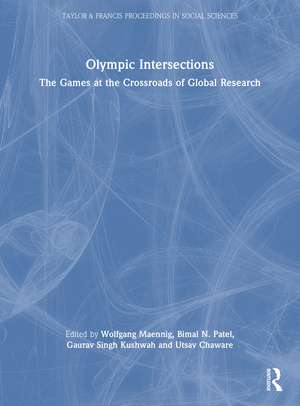
Olympic Intersections: The Games at the Crossroads of Global Research: Taylor & Francis Proceedings in Social Sciences
Editat de Wolfgang Maennig, Bimal N. Patel, Gaurav Singh Kushwah, Utsav Chawareen Limba Engleză Paperback – 22 oct 2026
The book encompasses research across four thematic areas that define current Olympic discourse. The first theme examines Olympic host city selection, legacy planning, and urban transformation, with case studies on how cities leverage mega sporting events for sustainable development. The second theme explores economic strategies and technological innovation, presenting financial models, digital infrastructure requirements, and smart venue management approaches. The third theme addresses sustainability and environmental responsibility through green infrastructure designs, climate mitigation strategies, and practical applications of Olympic Agenda 2020+5. The fourth theme investigates governance, equity, and inclusion, offering frameworks for ethical administration, gender parity, and accessible sports programs.
This strategic initiative strengthens India’s position in the global Olympic movement through academic excellence and cross-cultural dialogue, making it distinctly valuable for both established researchers and early-career scholars interested in Olympic studies, particularly as India aspires to host mega sporting events and the Olympics in 2036.





Preț: 457.88 lei
Nou
Puncte Express: 687
Carte disponibilă
Livrare economică 17 noiembrie-01 decembrie
Livrare express 31 octombrie-06 noiembrie pentru 40.52 lei
Livrare prin curier în România Termenul estimat este afișat lângă disponibilitate.
Transport gratuit pentru acest produs Plată online sau ramburs, în funcție de opțiunile comenzii.
Retur gratuit în 14 zile Comandă securizată și suport în română.
Specificații
ISBN-13: 9781041435082
ISBN-10: 1041435088
Pagini: 250
Dimensiuni: 210 x 280 mm
Greutate: 0.57 kg
Ediția:1
Editura: CRC Press
Colecția Routledge
Seria Taylor & Francis Proceedings in Social Sciences
ISBN-10: 1041435088
Pagini: 250
Dimensiuni: 210 x 280 mm
Greutate: 0.57 kg
Ediția:1
Editura: CRC Press
Colecția Routledge
Seria Taylor & Francis Proceedings in Social Sciences
Public țintă
Academic and GeneralNotă biografică
Wolfgang Maennig is an Olympic gold medallist in rowing (Seoul 1988) and Chair of Economic Policy at the University of Hamburg, Germany. He specializes in sports economics, focusing on Olympic Games and megaevents. His unique background combines elite athletic achievement with distinguished academic expertise in urban economics and sports infrastructure development. Professor Maennig has published extensively on Olympic bid strategies, economic impacts of mega-events, and sustainable sports development, making him one of the world’s leading authorities on Olympic economics.
Bimal N. Patel is a distinguished international law expert, serving on the UN International Law Commission and India’s National Security Advisory Board. As Vice-Chancellor of Rashtriya Raksha University, he drives national security education and has expanded RRU’s mandate to include Olympic research and sports studies. With a Ph.D. from Leiden University, his expertise spans maritime law, international organizations, and state practice, evidenced by his extensive publications and advisory roles. Under his leadership, RRU established BCORE as India’s first IOC-recognized Olympic Studies Centre.
Gaurav Singh Kushwah serves as Associate Dean and Senior Assistant Director of Physical Education and Sports at Rashtriya Raksha University. With a strong background in professional tennis, including state and national championships, he holds a Ph.D. in Physical Education and is a prolific researcher. His expertise spans exercise physiology, sports injury and rehabilitation, strength and conditioning, and allied areas. Dr. Kushwah has published extensively in peer-reviewed journals and plays a key role in establishing RRU’s sports research capabilities.
Utsav Chaware is the Founding Director of the Bharat Centre of Olympic Research and Education (BCORE) at Rashtriya Raksha University. Specialized in Health Sciences and Basketball, he has been a UGC Junior Research Fellow and holds a Ph.D. in Talent Identification using Machine Learning. He focuses on enhancing teaching methodologies and applying research in physical education. Since establishing BCORE in June 2024, Dr. Chaware has positioned it as a hub for Olympic research in South Asia. His publications cover Olympic Studies, Sports Sciences, and Strength and Conditioning, with a commitment to advancing the Olympic movement in India.
Bimal N. Patel is a distinguished international law expert, serving on the UN International Law Commission and India’s National Security Advisory Board. As Vice-Chancellor of Rashtriya Raksha University, he drives national security education and has expanded RRU’s mandate to include Olympic research and sports studies. With a Ph.D. from Leiden University, his expertise spans maritime law, international organizations, and state practice, evidenced by his extensive publications and advisory roles. Under his leadership, RRU established BCORE as India’s first IOC-recognized Olympic Studies Centre.
Gaurav Singh Kushwah serves as Associate Dean and Senior Assistant Director of Physical Education and Sports at Rashtriya Raksha University. With a strong background in professional tennis, including state and national championships, he holds a Ph.D. in Physical Education and is a prolific researcher. His expertise spans exercise physiology, sports injury and rehabilitation, strength and conditioning, and allied areas. Dr. Kushwah has published extensively in peer-reviewed journals and plays a key role in establishing RRU’s sports research capabilities.
Utsav Chaware is the Founding Director of the Bharat Centre of Olympic Research and Education (BCORE) at Rashtriya Raksha University. Specialized in Health Sciences and Basketball, he has been a UGC Junior Research Fellow and holds a Ph.D. in Talent Identification using Machine Learning. He focuses on enhancing teaching methodologies and applying research in physical education. Since establishing BCORE in June 2024, Dr. Chaware has positioned it as a hub for Olympic research in South Asia. His publications cover Olympic Studies, Sports Sciences, and Strength and Conditioning, with a commitment to advancing the Olympic movement in India.
Cuprins
Session 1: Urban Development for Mega-Sporting Events: Challenges and Solutions for India; Assessing the Legacy Possibilities of the Brisbane 2032 Olympic and Paralympic Games; Comparative Analysis of Venue Master Planning: Brisbane 2032 and India’s Preparation for the 2036 Olympics; India’s Olympic Forecast: Host Nation Participation and Medal Projections for 2036; Avoiding White Elephants in Olympic Games: Lessons for India’s 2036 Olympic Bid from Past Hosts; India’s Quest for Hosting 2036 Olympics: Benefits, Risks and Mitigation Strategies; Session 2: Economic Strategies and Technological Innovation; Digital Transformation in Olympic Sports Management: Driving Innovation and Economic Strategies for the Modern Games; Tennis as a Spark for Olympic Health Legacy in Developing Host Cities; Fortifying the Arena: Multi-Layered Security Strategies for the 2036 Olympics in Ahmedabad; Integration of Artificial Intelligence in Olympic Security and it’s Challenges; Session 3: Sustainability and Environmental Responsibility; Green Infrastructure and Sustainable Building for the Future Olympics; From the Past to the Future: Environmental Legacies of the Olympic Games in a Warming World; Advancement and Future Directions for Sustainable Practices in Olympic Field Hockey: A Case Study on Paris 2024; Legal Framework for Hosting Sustainable Olympics: An Analysis for India’s 2036 Olympic Bid; Evolution of Windsurfing in the Olympics from 1984 to 2028; Session 4: Governance, Equity, and Inclusion; Building Public Trust in Olympic Governance: The Role of Transparency, Stakeholder Engagement, and Ethical Decision-Making in Strengthening Institutional Integrity; Regulating Fairness: Legal Challenges of Inclusion for Athletes with Intersex Traits or Gender Variance in the Olympics; Prioritizing Mental Health for Indian Athletes: Systematic Literature Review Integrated with an Athlete Psychological Performance Development Framework for Olympic Excellence; The Olympic Games Playing the Role of the Catalyst for Gender Equality: Progress, Achievements, and Ongoing Challenges; Building a Healthy Nation: The Role of Olympism in Youth Physical Education and Sports Curriculum; The Soft Power of India: An Olympic Narrative; The Landscape of Doping in Indian Sports: Contemporary Challenges and Deliberations; Education of Olympic Movement Through Exhibition: A Case Study; Integrating Olympic Values in Grassroots Sports Development: The Kreedakul Program Experience; Reviving Hockey in India Through the Impact of Odisha’s Governance Model and Collaborative Efforts by Different Stakeholders; Global Commons as a Catalyst within the Olympic Movement: An Interdisciplinary Agenda for Integrating Sports Diplomacy, International Legal Frameworks and Sustainable Development Strategies with Multilateral Governance Structures; Classification Considerations in Developing Musculoskeletal Testing Protocols for Para-Athletes; Hosting Olympic Games in Divided Nations During the Cold War Era: The Legacy of the 1972 Munich and 1988 Seoul Games
Descriere
This volume presents the proceedings of the first International Olympic Research Conference held in India, organized by the Bharat Centre of Olympic Research and Education (BCORE) at Rashtriya Raksha University, Gujarat, from January 27-30, 2025.