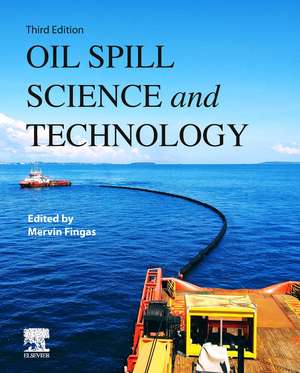
Oil Spill Science and Technology
Editat de Merv Fingasen Limba Engleză Hardback – 12 dec 2024
Written by over 24 experts in the field, this updated edition combines technology with case studies to identify the current state of knowledge surrounding oil spills that will encourage additional areas of research that are left to uncover in this critical sector of the energy industry.
- Updated with new chapters on: The Deepwater Horizon Spill; Oil Seeps; Processes: MOSSFA, Marine Snow, Tar Ball formation, and more
- Supported with technological advances evolved from the Deepwater Horizon/BP oil tragedy and events in the Arctic/Antarctic
- Multi-contributed from various industry experts to provide an extensive background in technical equipment and worldwide procedures used today
- Presents accurate, peer-reviewed topics with thorough literature review
Preț: 1381.36 lei
Preț vechi: 1861.66 lei
-26%
Puncte Express: 2072
Carte tipărită la comandă
Livrare economică 16-30 noiembrie
Livrare prin curier în România Termenul estimat este afișat lângă disponibilitate.
Transport gratuit pentru acest produs Plată online sau ramburs, în funcție de opțiunile comenzii.
Retur gratuit în 14 zile Comandă securizată și suport în română.
Specificații
ISBN-13: 9780443217036
ISBN-10: 0443217033
Pagini: 802
Dimensiuni: 152 x 229 x 43 mm
Greutate: 1.23 kg
Ediția:3rd edition
Editura: ELSEVIER SCIENCE
ISBN-10: 0443217033
Pagini: 802
Dimensiuni: 152 x 229 x 43 mm
Greutate: 1.23 kg
Ediția:3rd edition
Editura: ELSEVIER SCIENCE
V-ar putea interesa
-
 Oil Spill!Melvin BergerPreț: 50.45 lei
 -
 Gemini and Mercury RemasteredAndy SaundersPreț: 408.99 lei
 -
 WreckersSimon ParkPreț: 188.88 lei
 -
 License to SpillRachel Plotnick-14%Preț: 480.35 lei558.55 lei
 -
 Oil in the Sea IVCommittee on Oil in the Sea IV-11%Preț: 418.66 lei470.41 lei
 -
 OilJonah Winter-17%Preț: 77.34 lei93.71 lei
 -
 Advances in Environmental Research: Volume 18Justin A Daniels-26%Preț: 730.58 lei992.26 lei
 -
 Deepwater HorizonNikole Brooks Bethea-12%Preț: 60.08 lei67.92 lei
 -
 Oil Spill Governance & Proposals After Deepwater HorizonKody E Powell-27%Preț: 999.73 lei1362.57 lei
 -
 -27%Preț: 2044.01 lei2787.37 lei
 -
 -27%Preț: 1522.05 lei2075.08 lei
 -
 -27%Preț: 1629.98 lei2225.13 lei
 -
 Oil SpillsRobert LerosePreț: 51.85 lei
 -
 Assessing Environmental Risk of Oil Spills with ERA AcuteCathrine StephansenPreț: 174.23 lei
 -
 Environmental Technology in the Oil IndustryStefan Orszulik-15%Preț: 629.16 lei740.19 lei
 -
 Applications to Marine Disaster PreventionNaomi Kato-15%Preț: 653.83 lei769.22 lei
Cuprins
Chapter 1 - Introduction to the history of oil spills
Chapter 2 - Photooxidation of oil at sea—Historical perspective, current state of the science and future direction
Chapter 3 - How to model evaporation
Chapter 4 - Water-in-oil emulsions
Chapter 5 - Introduction to spill modeling
Chapter 6 - Review of oil spill remote sensing: The current state of the art
Chapter 7 - In situ burning: A summary
Chapter 8 - Laser fluorosensors for oil spill detection
Chapter 9 - Shoreline countermeasures
Chapter 10 - Remediation of oiled mangroves: Lessons from the Niger Delta
Chapter 11 - Rapid forensic oil identification by direct analysis in real time (DART) with time-of-flight mass spectrometry and confirmation by gas chromatography-mass spectrometry
Chapter 12 - Fates of petroleum compounds from the Deepwater Horizon oil spill
Chapter 13 - Bioremediation strategies for diesel-contaminated Antarctic soils
Chapter 2 - Photooxidation of oil at sea—Historical perspective, current state of the science and future direction
Chapter 3 - How to model evaporation
Chapter 4 - Water-in-oil emulsions
Chapter 5 - Introduction to spill modeling
Chapter 6 - Review of oil spill remote sensing: The current state of the art
Chapter 7 - In situ burning: A summary
Chapter 8 - Laser fluorosensors for oil spill detection
Chapter 9 - Shoreline countermeasures
Chapter 10 - Remediation of oiled mangroves: Lessons from the Niger Delta
Chapter 11 - Rapid forensic oil identification by direct analysis in real time (DART) with time-of-flight mass spectrometry and confirmation by gas chromatography-mass spectrometry
Chapter 12 - Fates of petroleum compounds from the Deepwater Horizon oil spill
Chapter 13 - Bioremediation strategies for diesel-contaminated Antarctic soils