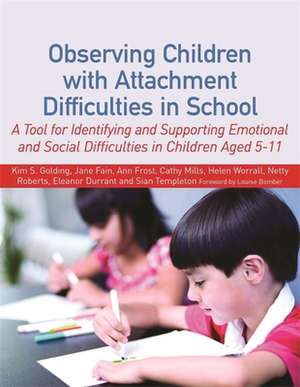
Observing Children with Attachment Difficulties in School: A Tool for Identifying and Supporting Emotional and Social Difficulties in Children Aged 5-11
Autor Helen Worrall, Sian Templeton, Netty Roberts, Ann Frost, Kim S. Golding, Eleanor Durrant, Jane Fain, Cathy Millsen Limba Engleză Paperback – 15 noi 2012
În cadrul programelor de studiu dedicate psihologiei educaționale și asistenței sociale, înțelegerea mecanismelor de atașament reprezintă un pilon esențial pentru gestionarea eficientă a sălii de clasă. Găsim în această carte, Observing Children with Attachment Difficulties in School, un instrument metodologic riguros, conceput special pentru a sprijini cadrele didactice și psihologii școlari în decodarea comportamentelor complexe ale copiilor cu vârste între 5 și 11 ani. Reținem că volumul nu se limitează la teorie, ci propune o abordare aplicată prin intermediul unei liste de verificare a observațiilor, menită să transforme semnalele comportamentale — de la atitudinea față de prezența școlară până la dinamica jocului — în date analizabile.
Descoperim aici o structură logică ce ghidează utilizatorul de la conceptele fundamentale de dezvoltare timpurie către aplicarea practică. Autorii, sub coordonarea lui Kim S. Golding, oferă studii de caz detaliate, precum cele ale personajelor Chloe și Jacob, care exemplifică procesul de interpretare a checklist-ului și elaborarea planurilor de sprijin personalizate. Această lucrare acoperă aceeași arie tematică precum The Teacher's Introduction to Attachment, dar cu o abordare mai tehnică și mai structurată, oferind instrumente de diagnostic observațional pe care volumul Nicola Marshall le prezintă într-un format mai concis și introductiv. În contextul operei lui Kim S. Golding, acest titlu continuă direcția începută cu resursele pentru preșcolari, adaptând intervenția la nevoile specifice ale învățământului primar.
Prin integrarea unor secțiuni despre stilurile de atașament evitant și ambivalent, cartea oferă personalului școlar posibilitatea de a interveni nu doar la nivelul simptomelor comportamentale, ci și la nivelul nevoilor emoționale profunde. Este o resursă indispensabilă pentru cei care caută să transforme mediul școlar într-un spațiu de siguranță și dezvoltare socială.
Preț: 193.02 lei
Preț vechi: 261.69 lei
-26%
Carte disponibilă
Livrare economică 05-19 iunie
Livrare express 21-27 mai pentru 98.64 lei
Specificații
ISBN-10: 1849053367
Pagini: 160
Ilustrații: 11 figures
Dimensiuni: 216 x 280 x 12 mm
Greutate: 0.42 kg
Editura: JESSICA KINGSLEY PUBLISHERS
Colecția Jessica Kingsley Publishers
Locul publicării:London, United Kingdom
V-ar putea interesa
-
 Helping in Child Protective Services: A Competency-Based Casework HandbookAmerican Humane Association-17%Preț: 368.19 lei443.73 lei
 -
 Healing Relational Trauma with Attachment-Focused InterventionsDaniel A. Hughes-5%Preț: 294.68 lei310.19 lei
 -
 -18%Preț: 1405.39 lei1713.90 lei
 -
 Preț: 458.85 lei
 -
 Welfare and the Well-Being of ChildrenJ. Currie-18%Preț: 2213.27 lei2699.12 lei
 -
 -15%Preț: 443.12 lei521.32 lei
 -
 Socializing the Young: The Role of Foundations, 1923-1941Dennis R. Bryson-31%Preț: 475.91 lei690.76 lei
 -
 -31%Preț: 449.99 lei653.45 lei
 -
 Making A Place For Kids With DisabilitiesDale B. Fink-26%Preț: 230.64 lei312.19 lei
 -
 Street Children in Kenya: Voices of Children in Search of a ChildhoodPhilip L. Kilbride-27%Preț: 176.13 lei241.75 lei
 -
 -30%Preț: 375.75 lei536.55 lei
 -
 -27%Preț: 204.20 lei278.72 lei
 -
 -33%Preț: 644.40 lei962.70 lei
 -
 A Tiny Spark of Hope: Healing Childhood Trauma in AdulthoodKim S. Golding-22%Preț: 150.50 lei192.05 lei
 -
 -21%Preț: 163.75 lei208.41 lei
 -
 -26%Preț: 232.77 lei314.52 lei
 -
 -26%Preț: 192.83 lei261.57 lei
 -
 -22%Preț: 158.40 lei202.74 lei
 -
 -25%Preț: 237.68 lei315.63 lei
 -
 Reconsidering Resilience in EducationAdeela Ahmed Shafi-18%Preț: 915.38 lei1116.33 lei
De ce să citești această carte
Această carte este esențială pentru învățători, consilieri școlari și psihologi care lucrează cu copii ce prezintă dificultăți emoționale. Cititorul câștigă un instrument de diagnosticare precis și strategii de intervenție validate clinic. Este recomandată deoarece oferă soluții concrete, precum fișe de lucru și planuri de sprijin, pentru a gestiona provocările de atașament care afectează performanța academică și integrarea socială a elevilor din ciclul primar.
Despre autor
Grupul de autori reunește experți de renume în domeniul educației speciale și psihologiei clinice. Kim S. Golding, figură centrală a echipei, este psiholog clinician și membru de onoare al Societății Britanice de Psihologie, fiind decorată cu CBE pentru serviciile aduse copiilor și familiilor. Format de Dan Hughes în Psihoterapie de Dezvoltare Diadică (DDP), Golding este o autoritate internațională în aplicarea teoriei atașamentului. Alături de ea, Helen Worrall, Sian Templeton și ceilalți coautori aduc decenii de experiență practică în învățământul special și psihologia educațională, oferind o perspectivă multidisciplinară asupra nevoilor copiilor aflați în îngrijire sau adopție.
Descriere
This easy-to-use tool provides an observation checklist which enables staff to identify behavioural patterns in children with social and emotional difficulties, analyse the emotional difficulties underlying these behaviours and establish what kind of help and support the children need. Behavioural responses are categorised within clearly outlined topics, including behaviour, play and relationship with peers, attachment behaviours, emotional state in the classroom and attitude to attendance. Checklists and diagrams identify different 'styles' of relating (secure, avoidant, ambivalent), to help school staff who work with children and their families to respond appropriately to the individual needs of each child. A range of handouts include activities designed to provide emotional support, to focus and regulate behaviour and enable the child to develop important social and emotional skills.
Suitable for use with children aged 5-11, this tool will be an invaluable resource for teachers, teaching assistants, learning support staff, school counsellors and educational psychologists.
Recenzii
[W]ith increasing numbers of [staff] now becoming aware of the impact of relational trauma and loss upon the capacities of children in their care, tools such as those recommended here are welcomed. This book provides clear descriptors of some of the possible vulnerabilities around for these children and a framework through which to make sense of these vulnerabilities with an attachment focus... Dr Golding and her colleagues have made a significant contribution to inclusive practice by contributing this book'
Much of what these children need to learn can't be learnt alone through text books. They need you and me. Relationships matter. Let's take up our responsibility in ensuring that these children experience healthy secure attachment in our care so that they can be all that they can and want to be, making valuable contributions towards our shared society.
Building on its excellent companion book for preschool settings, Kim Golding et al beautifully demonstrate how to use their Observation Checklist for understanding and developing support and action programs in school settings for children from age 5 to 11. They clearly describe attachment theory and its implications for understanding the emotional and social difficulties that often emerge from attachment difficulties and insecure attachment styles. They provide a context for understanding the child's behavioural challenges which will greatly assist in developing relationship-focused interventions. Finally, with this core attachment perspective they show how to use their Checklist to develop a specific profile of the child and an action program that best meets his unique developmental needs. In short, the authors' Observational Checklist and the action plans that are certain to emerge from its use, will enable the educator to develop very sensitive and sophisticated interventions to best meet the child's attachment, emotional, and social needs.