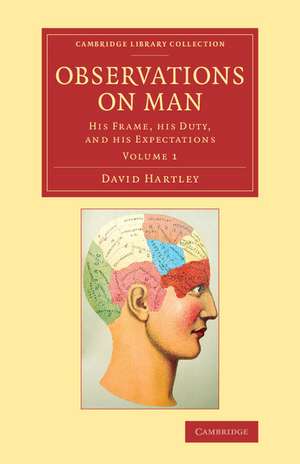
Observations on Man: His Frame, his Duty, and his Expectations: Cambridge Library Collection - Philosophy
Autor David Hartleyen Limba Engleză Paperback – 30 oct 2013
Din seria Cambridge Library Collection - Philosophy
-
 Preț: 427.48 lei
 - 19%
 Preț: 433.94 lei
 -
 Preț: 428.22 lei
 -
 Preț: 340.96 lei
 -
 Preț: 289.38 lei
 - 19%
 Preț: 476.98 lei
 - 19%
 Preț: 441.48 lei
 -
 Preț: 272.70 lei
 -
 Preț: 374.18 lei
 - 19%
 Preț: 428.64 lei
 -
 Preț: 379.01 lei
 -
 Preț: 254.00 lei
 -
 Preț: 289.90 lei
 - 19%
 Preț: 436.07 lei
 -
 Preț: 252.85 lei
 -
 Preț: 346.62 lei
 -
 Preț: 346.78 lei
 - 19%
 Preț: 429.24 lei
 -
 Preț: 427.84 lei
 -
 Preț: 341.54 lei
 -
 Preț: 428.22 lei
 - 19%
 Preț: 435.61 lei
 -
 Preț: 436.82 lei
 -
 Preț: 288.22 lei
 -
 Preț: 339.28 lei
 - 19%
 Preț: 646.05 lei
 -
 Preț: 241.47 lei
 -
 Preț: 376.06 lei
 -
 Preț: 254.00 lei
 -
 Preț: 338.72 lei
 -
 Preț: 378.84 lei
 -
 Preț: 340.96 lei
 -
 Preț: 425.65 lei
 -
 Preț: 240.33 lei
Preț: 479.44 lei
Puncte Express: 719
Carte tipărită la comandă
Livrare economică 08-22 iulie
Livrare prin curier în România Termenul estimat este afișat lângă disponibilitate.
Transport gratuit pentru acest produs Plată online sau ramburs, în funcție de opțiunile comenzii.
Retur gratuit în 14 zile Comandă securizată și suport în română.
Specificații
ISBN-13: 9781108063623
ISBN-10: 1108063624
Pagini: 538
Dimensiuni: 140 x 216 x 30 mm
Greutate: 0.68 kg
Editura: Cambridge University Press
Colecția Cambridge University Press
Seria Cambridge Library Collection - Philosophy
Locul publicării:Cambridge, United Kingdom
ISBN-10: 1108063624
Pagini: 538
Dimensiuni: 140 x 216 x 30 mm
Greutate: 0.68 kg
Editura: Cambridge University Press
Colecția Cambridge University Press
Seria Cambridge Library Collection - Philosophy
Locul publicării:Cambridge, United Kingdom
V-ar putea interesa
-
 A Nietzsche ReaderFriedrich Nietzsche-20%Preț: 56.59 lei70.93 lei
 -
 Hegel: A Very Short IntroductionPeter Singer-21%Preț: 55.07 lei70.00 lei
 -
 Rousseau: A Very Short IntroductionRobert Wokler-21%Preț: 55.82 lei70.46 lei
 -
 Kant's Metaphysics of Morals: Interpretative EssaysMark Timmons-19%Preț: 452.78 lei556.21 lei
 -
 Hume's ReasonDavid Owen-22%Preț: 300.59 lei385.56 lei
 -
 Themes in Hume: The Self, the Will, ReligionTerence Penelhum-31%Preț: 356.32 lei514.84 lei
 -
 Oxford Studies in Early Modern Philosophy Volume 1Daniel Garber-15%Preț: 351.36 lei412.21 lei
 -
 -24%Preț: 388.23 lei511.00 lei
 -
 Hume VariationsJerry A. Fodor-13%Preț: 338.24 lei390.89 lei
 -
 Preț: 366.29 lei
 -
 Newton as PhilosopherAndrew JaniakPreț: 343.91 lei
 -
 Introductions to NietzscheRobert PippinPreț: 194.84 lei
 -
 The Cambridge Companion to Hegel and Nineteenth-Century PhilosophyFrederick C. BeiserPreț: 240.37 lei
 -
 Kant: Anthropology from a Pragmatic Point of ViewRobert B. LoudenPreț: 264.21 lei
 -
 BerkeleyDesmond M. ClarkePreț: 281.00 lei
 -
 LockeRoger WoolhousePreț: 254.05 lei
 -
 Kant: Groundwork of the Metaphysics of MoralsChristine M. KorsgaardPreț: 134.29 lei
 -
 Conversations With Isaiah BerlinRamin JahanbeglooPreț: 76.02 lei
Cuprins
Preface; Introduction; 1. Of the general laws; 2. The application of the doctrines of vibrations; 3. A particular application of the foregoing theory; 4. The six classes of intellectual pleasures; Conclusion.
Descriere
Published in 1749, Hartley's two-volume analysis of human nature, blending philosophy and psychology, influenced scientists, theologians, social reformers and poets.