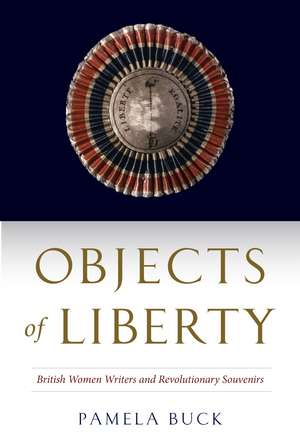
Objects of Liberty
Autor Pamela Bucken Limba Engleză Paperback – 15 mar 2024
Preț: 372.17 lei
Precomandă
Puncte Express: 558
Carte nepublicată încă
Doresc să fiu notificat când acest titlu va fi disponibil:
Se trimite...
Specificații
ISBN-13: 9781644533321
ISBN-10: 1644533324
Pagini: 202
Ilustrații: 13 color and 13 b-w images
Dimensiuni: 154 x 227 x 13 mm
Greutate: 0.33 kg
Editura: University of Delaware Press
ISBN-10: 1644533324
Pagini: 202
Ilustrații: 13 color and 13 b-w images
Dimensiuni: 154 x 227 x 13 mm
Greutate: 0.33 kg
Editura: University of Delaware Press
Notă biografică
PAMELA BUCK is associate professor of English at Sacred Heart University in Fairfield, Connecticut. Her research focuses primarily on women’s writing and material culture in late eighteenth- and early nineteenth-century British literature.
Descriere
Objects of Liberty explores the prevalence of souvenirs in six British women’s travel accounts of the French Revolution and Napoleonic era. Using a methodology informed by literary, gender, and material culture studies, it argues that women writers employed the souvenir to circulate political ideas and contribute to conversations about individual and national identity.