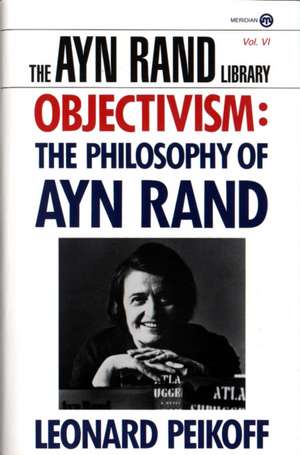
Objectivism
Autor Leonard Peikoffen Limba Engleză Paperback – dec 1993
Observăm în Objectivism o resursă fundamentală pentru oricine urmărește o certificare intelectuală în sistemul de gândire creat de Ayn Rand. Această lucrare nu este doar un comentariu, ci singura expunere sistematică a întregului corpus filozofic randian pe care autoarea a considerat-o pe deplin acurată. Într-un domeniu în care interpretările pot fi divergente, volumul de față servește drept referință standard pentru studiul academic și personal al obiectivismului. Descoperim aici o structură riguroasă, organizată ierarhic, ce pornește de la fundamentele metafizice și epistemologice. Primele capitole stabilesc axiomele existenței și identității, progresând logic spre formarea conceptelor și natura obiectivității. Leonard Peikoff reușește să integreze temele explorate în lucrările sale anterioare, cum ar fi analiza cauzalității ideilor din The Cause of Hitler's Germany, într-un sistem coerent care explică viziunea din romane precum The Fountainhead. Comparabil cu Objectivism in One Lesson de Andrew Bernstein în claritatea expunerii, volumul lui Leonard Peikoff se distinge prin profunzimea academică și prin caracterul său exhaustiv. În timp ce Introduction to Objectivist Epistemology se concentrează strict pe facultatea conceptuală, Objectivism extinde analiza asupra întregului spectru al experienței umane. Găsim în această carte un echilibru între abstract și concret, unde principiile metafizice sunt ilustrate prin citate din opera literară a lui Ayn Rand și prin nuanțe teoretice oferite de aceasta în cadrul discuțiilor private cu autorul. Este o lectură esențială pentru a înțelege fundamentul logic al egoismului rațional și al capitalismului laissez-faire.
Preț: 128.13 lei
Carte disponibilă
Livrare economică 05-19 noiembrie
Livrare express 22-28 octombrie pentru 33.86 lei
Specificații
ISBN-10: 0452011019
Pagini: 512
Dimensiuni: 134 x 200 x 38 mm
Greutate: 0.42 kg
Editura: Penguin Publishing Group
V-ar putea interesa
-
 The Cause of Hitler's GermanyLeonard PeikoffPreț: 186.67 lei
 -
 Frege's TheoremRichard G. HeckPreț: 274.43 lei
 -
 The Oxford Handbook of WittgensteinOskari Kuusela-18%Preț: 325.13 lei398.49 lei
 -
 Wittgenstein and Natural ReligionGordon Graham-29%Preț: 503.52 lei704.98 lei
 -
 British Ethical Theorists from Sidgwick to EwingThomas Hurka-28%Preț: 429.88 lei598.67 lei
 -
 PhilosophyAyn RandPreț: 56.41 lei
 -
 The DIM HypothesisLeonard PeikoffPreț: 153.55 lei
 -
 Existentialism from Dostoevsky to SartreWalter KaufmannPreț: 113.40 lei
 -
 Preț: 157.19 lei
 -
 Ominous ParallelsLeonard PeikoffPreț: 151.49 lei
 -
 The Art of FictionAyn RandPreț: 144.42 lei
 -
 Preț: 124.03 lei
 -
 Carl SchmittReinhard Mehring-19%Preț: 475.05 lei586.48 lei
 -
 Before TomorrowCatherine MalabouPreț: 157.39 lei
 -
 Freedom to FailPeter TrawnyPreț: 145.42 lei
 -
 Die Geburt der Philosophie im Garten der LüsteWilhelm SchmidPreț: 101.91 lei
De ce să citești această carte
Recomandăm această carte cititorilor care doresc să treacă dincolo de mesajul literar al lui Ayn Rand pentru a înțelege arhitectura logică din spatele ideilor sale. Veți câștiga o perspectivă clară asupra modului în care rațiunea și realitatea se aplică în viața cotidiană. Este instrumentul definitiv de studiu pentru oricine dorește să stăpânească sistemul filozofic obiectivist într-o formă autorizată și completă.
Despre autor
Leonard Peikoff este recunoscut la nivel internațional drept cel mai important expert în opera lui Ayn Rand. Având o colaborare strânsă de treizeci de ani cu autoarea, el a fost desemnat moștenitorul legal și intelectual al acesteia. Cu o carieră academică solidă, a predat filozofia la instituții prestigioase precum Hunter College și New York University. Expertiza sa este reflectată în numeroase lucrări, inclusiv Objective Communication, unde aplică rigoarea filozofică în domeniul comunicării, consolidându-și poziția de interpret principal al gândirii randiene în context contemporan.
Descriere scurtă
Dr. Peikoff, Rand's designated heir and foremost interpreter, reveals the abstract fundamentals of Objectivism and its practical applications in the everyday world. He covers every branch of philosophy recognized by Rand and every philosophic topic she regarded as important--from certainty to money, from logic to art, from measurement to sex. Illustrated with quotes from her published works, complete with an abundance of new material that Ayn Rand offered only in private conversations with Peikoff, these clear, cogent chapters illuminate Objectivism--and its creator--with startling clarity. Now the millions of readers who have been transformed by Atlas Shrugged and The Fountainhead will discover the full philosophical system underlying Ayn Rand's stories about life "as it might be and ought to be."
Cuprins
Preface
Chapter 1: Reality
Existence, Consciousness, and Identity as the Basic Axioms
Causality as a Corollary of Identity
Existence as Possessing Primacy over Consciousness
The Metaphysically Given as Absolute
Idealism and Materialism as the Rejection of Basic Axioms
Chapter 2: Sense Perception and Volition
The Senses as Necessarily Valid
Sensory Qualities as Real
Consciousness as Possessing Identity
The Perceptual Level as the Given
The Primary Choice as the Choice to Focus or Not
Human Actions, Mental and Physical, as Both Caused and Free
Volition as Axiomatic
Chapter 3: Concept-Formation
Differentiation and Integration as the Means to a Unit-Perspective
Concept-Formation as a Mathematical Process
Concepts of Consciousness as Involving Measurement-Omission
Definition as the Final Step in Concept-Formation
Concepts as Devices to Achieve Unit-Economy
Chapter 4: Objectivity
Concepts as Objective
Objectivity as Volitional Adherence to Reality by the Method of Logic
Knowledge as Contextual
Knowledge as Hierarchical
Intrinsicism and Subjectivism as the Two Forms of Rejecting Objectivity
Chapter 5: Reason
Emotions as a Product of Ideas
Reason as Man's Only Means of Knowledge
The Arbitrary as Neither True nor False
Certainty as Contextual
Mysticism and Skepticism as Denials of Reason
Chapter 6: Man
Living Organisms as Goal-Directed and Conditional
Reason as Man's Basic Means of Survival
Reason as an Attribute of the Individual
Chapter 7: The Good
"Life" as the Essential Root of "Value"
Man's Life as the Standard of Moral Value
Rationality as the Primary Virtue
The Individual as the Proper Beneficiary of His Own Moral Action
Values as Objective
Chapter 8: Virtue
Independence as a Primary Orientation to Reality, Not to Other Men
Integrity as Loyalty to Rational Principles
Honesty as the Rejection of Unreality
Justice as Rationality in the Evaluation of Men
Productiveness as the Adjustment of Nature to Man
Pride as Moral Ambitiousness
The Initiation of Physical Force as Evil
Chapter 9: Happiness
Virtue as Practical
Happiness as the Normal Condition of Man
Sex as Metaphysical
Chapter 10: Government
Individual Rights as Absolutes
Government as an Agency to Protect Rights
Statism as the Politics of Unreason
Chapter 11: Capitalism
Capitalism as the Only Moral Social System
Capitalism as the System of Objectivity
Opposition to Capitalism as Dependent on Bad Epistemology
Chapter 12: Art
Art as a Concretization of Metaphysics
Romantic Literature as Illustrating the Role of Philosophy in Art
Esthetic Value as Objective
Epilogue: The Duel Between Plato and Aristotle
References
Index