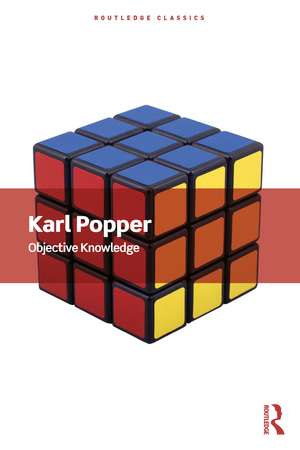
Objective Knowledge: An Evolutionary Approach: Routledge Classics
Autor Karl Popperen Limba Engleză Paperback – 16 feb 2026
- Karl Popper, Objective Knowledge
The extent and scope of human knowledge is arguably one of humankind's greatest achievements. Since Descartes, however, the theory of human knowledge has been mainly what philosophers call subjectivist: even scientific knowledge was regarded as a special kind of human belief, but human nonetheless. In Objective Knowledge, which contains some of his most important writings on epistemology, Karl Popper breaks decisively and controversially with this view of human knowledge.
A realist and a fallibilist, he argues that human knowledge, stated in human language, is no longer part of ourselves but open to objective criticism. Above all, Popper argues that human knowledge grows through a process of conjecture, testing and criticism. Such objective knowledge has significance also for us as individuals, as critical interaction with problem-situations and the constant process of trial and error playing a role in all walks of life, from philosophy and science to music and art.
A brilliant exposition of Popper's theory of knowledge, this Routledge Classics edition includes a new Introduction by Jeremy Shearmur, which provides some helpful context to Objective Knowledge and Popper's philosophy in general.
Din seria Routledge Classics
-
 Preț: 159.10 lei
 -
 Preț: 181.46 lei
 -
 Preț: 192.23 lei
 -
 Preț: 130.07 lei
 - 9%
 Preț: 1623.03 lei
 -
 Preț: 137.18 lei
 -
 Preț: 136.93 lei
 -
 Preț: 192.11 lei
 -
 Preț: 233.98 lei
 -
 Preț: 174.29 lei
 -
 Preț: 191.35 lei
 -
 Preț: 167.03 lei
 -
 Preț: 149.04 lei
 -
 Preț: 175.48 lei
 -
 Preț: 157.94 lei
 -
 Preț: 231.79 lei
 - 9%
 Preț: 778.76 lei
 -
 Preț: 235.79 lei
 -
 Preț: 172.43 lei
 -
 Preț: 210.54 lei
 -
 Preț: 154.81 lei
 -
 Preț: 221.84 lei
 - 18%
 Preț: 857.65 lei
 -
 Preț: 173.52 lei
 -
 Preț: 137.96 lei
 - 18%
 Preț: 1038.92 lei
 -
 Preț: 242.60 lei
 -
 Preț: 159.20 lei
 -
 Preț: 174.15 lei
 - 9%
 Preț: 808.31 lei
 -
 Preț: 137.87 lei
 - 18%
 Preț: 903.36 lei
 - 5%
 Preț: 217.39 lei
 -
 Preț: 158.33 lei
 -
 Preț: 139.94 lei
 -
 Preț: 192.14 lei
 -
 Preț: 171.61 lei
 -
 Preț: 176.25 lei
 -
 Preț: 138.01 lei
 -
 Preț: 158.24 lei
 -
 Preț: 137.77 lei
 -
 Preț: 174.83 lei
 -
 Preț: 170.65 lei
 -
 Preț: 175.55 lei
 -
 Preț: 175.22 lei
 -
 Preț: 131.00 lei
 -
 Preț: 138.96 lei
 -
 Preț: 175.25 lei
Preț: 187.95 lei
Puncte Express: 282
Carte disponibilă
Livrare economică 05-19 noiembrie
Livrare express 22-28 octombrie pentru 36.53 lei
Livrare prin curier în România Termenul estimat este afișat lângă disponibilitate.
Transport gratuit de la 400.00 lei Plată online sau ramburs, în funcție de opțiunile comenzii.
Retur gratuit în 14 zile Comandă securizată și suport în română.
Specificații
ISBN-13: 9781041139225
ISBN-10: 1041139225
Pagini: 406
Dimensiuni: 156 x 234 mm
Greutate: 0.57 kg
Ediția:1
Editura: Taylor & Francis
Colecția Routledge
Seria Routledge Classics
Locul publicării:Oxford, United Kingdom
ISBN-10: 1041139225
Pagini: 406
Dimensiuni: 156 x 234 mm
Greutate: 0.57 kg
Ediția:1
Editura: Taylor & Francis
Colecția Routledge
Seria Routledge Classics
Locul publicării:Oxford, United Kingdom
Public țintă
General, Postgraduate, Undergraduate Advanced, and Undergraduate CoreCuprins
Introduction to the Routledge Classics Edition Jeremy Shearmur Dedication Preface Acknowledgements 1. Conjectural Knowledge: My Solution of the Problem of Induction 2. Two Faces of Common Sense: An argument for Commonsense Realism and Against the Commonsense Theory of Realism 3. Epistemology Without a Knowing Subject 4. On the Theory of the Objective Mind 5. The Aim of Science 6. Of Clouds and Clocks 7. Evolution and the Tree of Knowledge 8. A Realist View of Logic, Physics and History 9. Philosophical Comments on Tarski's Theory of Truth Addendum: A Note on Tarski's Definition of Truth Appendix 1. The Blanket and the Searchlight: Two Theories of Knowledge Appendix 2: Supplementary Remarks. Index
Recenzii
'Popper writes very skilfully and reasons strongly. Those who are determined not to be persuaded by him had best not read him.' - Peter Medawar, Nature
'Popper writes very skilfully and reasons strongly. Those who are determined not to be persuaded by him had best not read him.'
Peter Medawar, Nature
'Popper writes very skilfully and reasons strongly. Those who are determined not to be persuaded by him had best not read him.'
Peter Medawar, Nature
Notă biografică
Karl Popper (1902–1994) was one of the most provocative philosophers of the twentieth century. His relationship with the philosophers and scientists of the Vienna Circle led to his first book, The Logic of Scientific Discovery, which appeared in German in 1934 and presented his theory of the growth of scientific knowledge. On its publication in English in 1959, the book was described by the New Scientist as 'one of the most important documents of the twentieth century.' Popper emigrated to New Zealand in 1939 on the eve of World War Two. Reflecting on the tyranny sweeping through Europe, he wrote The Open Society and Its Enemies. Published in 1945, it remains his most compelling and widely read book. In 1946 Popper moved to the London School of Economics, where he taught until his retirement in 1969. This period saw the publication of The Poverty of Historicism, described by the Sunday Times as 'probably the only book which will outlive this century' and Conjectures and Refutations, a collection of many of Popper's classic essays. Karl Popper was knighted in 1965 and appointed Companion of Honour in 1982. He continued to write until his death in 1994.
Descriere
A brilliant exposition of Popper's theory of knowledge, this Routledge Classics edition includes a new Introduction by Jeremy Shearmur, which provides some helpful context to Objective Knowledge and Popper's philosophy in general.