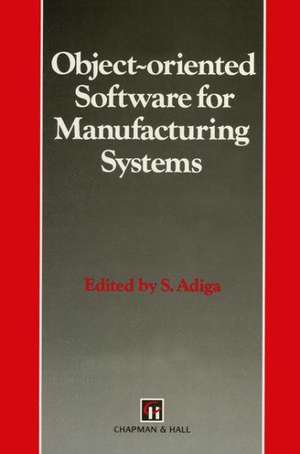
Object-oriented Software for Manufacturing Systems
Autor S. Adigaen Limba Engleză Hardback – 22 iul 1998
Preț: 586.80 lei
Preț vechi: 690.35 lei
-15%
Puncte Express: 880
Carte tipărită la comandă
Livrare economică 25 septembrie-09 octombrie
Livrare prin curier în România Termenul estimat este afișat lângă disponibilitate.
Transport gratuit pentru acest produs Plată online sau ramburs, în funcție de opțiunile comenzii.
Retur gratuit în 14 zile Comandă securizată și suport în română.
Specificații
ISBN-13: 9780412397509
ISBN-10: 0412397501
Pagini: 288
Dimensiuni: 160 x 241 x 22 mm
Greutate: 0.6 kg
Editura: Springer Nature B.V.
Locul publicării:Dordrecht, Netherlands
ISBN-10: 0412397501
Pagini: 288
Dimensiuni: 160 x 241 x 22 mm
Greutate: 0.6 kg
Editura: Springer Nature B.V.
Locul publicării:Dordrecht, Netherlands
V-ar putea interesa
-
 The Pipe Fitter's and Pipe Welder's HandbookN/A McGraw Hill-35%Preț: 171.37 lei263.64 lei
 -
 The TAB Guide to DIY WeldingJackson Morley-38%Preț: 162.76 lei261.53 lei
 -
 Technology and PurposeJoseph Robert Liberto-20%Preț: 103.96 lei129.95 lei
 -
 SAP and Bw Data WarehousingArshad Khan-20%Preț: 449.48 lei561.86 lei
 -
 The Internet Interconnection ConundrumCameron Cooper-20%Preț: 57.30 lei71.62 lei
 -
 Oracle10gr2 Recovery ManagerRamesh Raghav-20%Preț: 161.64 lei202.05 lei
 -
 Audel Welding Pocket RefJames E. BrumbaughPreț: 170.73 lei
 -
 Human Factors in Control Room DesignTex Crampin-8%Preț: 598.49 lei650.53 lei
 -
 A Hardware Interfacing and Control ProtocolJohn Blankenship-20%Preț: 122.17 lei152.71 lei
 -
 Secure Hash Standard (Shs)U. S. Depar Tment of Commerce-20%Preț: 72.22 lei90.27 lei
 -
 Perl Para GeocientificosDorian Oria San MartinPreț: 181.68 lei
 -
 The First Software Patent and Other First SystemsAnatoly (Tony) KandiewPreț: 58.99 lei
 -
 -20%Preț: 320.86 lei401.07 lei
 -
 -20%Preț: 365.39 lei456.73 lei
 -
 -20%Preț: 320.50 lei400.62 lei
 -
 Oracle Weblogic Server 11gJ. Clarke-20%Preț: 209.87 lei262.34 lei
 -
 Wordpress for Normal PeopleAllan Hall-20%Preț: 103.21 lei129.02 lei
 -
 Year 2000 Software CrisisKeith A. Jones-20%Preț: 226.45 lei283.06 lei
 -
 Automated Software Performance MeasurementKeith A. Jones-20%Preț: 197.25 lei246.56 lei
 -
 WeldingRichard LoftingPreț: 120.04 lei
 -
 Cutting Tool TechnologyGraham T. Smith-23%Preț: 1444.44 lei1875.90 lei
 -
 Simple Workshop DevicesTubal CainPreț: 81.46 lei
Public țintă
ResearchCuprins
1 Introduction.- 1.1 Objects and object-oriented software.- 1.2 Objective and target audience of the book.- 1.3 Organization of the book.- 1.4 Conclusion.- References.- One Conceptual Background.- 2 Object-oriented software systems: Concepts.- 3 Object-oriented software: Relevance to manufacturing.- Summary: Part One.- Two Design and Implementation Techniques.- 4 Towards an object-oriented architecture for CIM systems.- 5 Prototyping object systems and reusable object libraries.- 6 Object-oriented databases.- 7 Comparing object-oriented programming languages.- Summary: Part Two.- Three Manufacturing Applications.- 8 FlowStream: An object-oriented plant-floor management system.- 9 OOPS in real-time control applications.- Summary: Part Three.- Four Management and Organizational Issues.- 10 Management issues in adopting object-oriented technology.- 11 Concluding remarks.- Appendix A: OO resources Paul Worhach.