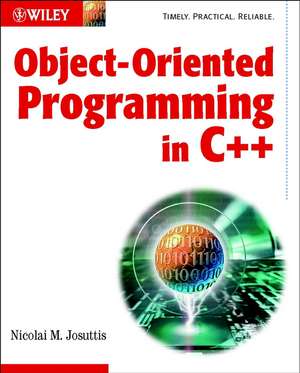
Object-Oriented Programming in C++
Autor Josuttisen Limba Engleză Paperback – 5 dec 2002
Preț: 662.93 lei
Preț vechi: 828.66 lei
-20%
Puncte Express: 994
Carte tipărită la comandă
Livrare economică 09-23 noiembrie
Livrare prin curier în România Termenul estimat este afișat lângă disponibilitate.
Transport gratuit pentru acest produs Plată online sau ramburs, în funcție de opțiunile comenzii.
Retur gratuit în 14 zile Comandă securizată și suport în română.
Specificații
ISBN-13: 9780470843994
ISBN-10: 0470843993
Pagini: 628
Dimensiuni: 189 x 246 x 33 mm
Greutate: 1.2 kg
Ediția:0003
Editura: Wiley
Locul publicării:Chichester, United Kingdom
ISBN-10: 0470843993
Pagini: 628
Dimensiuni: 189 x 246 x 33 mm
Greutate: 1.2 kg
Ediția:0003
Editura: Wiley
Locul publicării:Chichester, United Kingdom
V-ar putea interesa
-
 C++ TemplatesDavid Vandevoorde-20%Preț: 500.81 lei626.01 lei
 -
 Karel++Joseph Bergin-20%Preț: 541.39 lei676.74 lei
 -
 The Foundations of Program VerificationJacques Loeckx-27%Preț: 2736.89 lei3749.17 lei
 -
 The World of Scripting LanguagesDavid Barron-20%Preț: 571.07 lei713.84 lei
 -
 Searching GodGeorge Kuser-20%Preț: 71.67 lei89.59 lei
 -
 Programming Flex 3Chafic Kazoun-20%Preț: 286.62 lei358.27 lei
 -
 XSLTDoug Tidwell-20%Preț: 288.00 lei360.01 lei
 -
 SOA in PracticeNicolai M. Josuttis-20%Preț: 237.28 lei296.60 lei
 -
 C++ DATA STRUCTURESJim Brandle-20%Preț: 711.87 lei889.83 lei
 -
 Laboratory Course for Programming with JavaPh.d. Dale, Nell-20%Preț: 419.44 lei524.30 lei
 -
 Visual Basic .NET All-In-One Desk Reference For DummiesRichard Mansfield-20%Preț: 262.70 lei328.38 lei
 -
 Underwater Demolition Team 13: Westpac 1969Steven L. WatermanPreț: 173.58 lei
 -
 Beginning Java Me PlatformRay Rischpater-20%Preț: 260.59 lei325.74 lei
 -
 Life in Mexico During a Residence of Two Years in That CountryFrances Calderon De La BarcaPreț: 384.35 lei
 -
 The Life of Miranda Volume IIWilliam Spence RobertsonPreț: 281.26 lei
 -
 The Conquest of Mexico Volume IIWilliam H. PrescottPreț: 436.54 lei
 -
 Growing Up in the Black Belt: Negro Youth in the Rural SouthJR. Johnson, Charles S.Preț: 338.68 lei
 -
 Preț: 159.14 lei
 -
 -20%Preț: 562.49 lei703.12 lei
 -
 Strings of Natural LanguagesMarkus Stengel-20%Preț: 391.90 lei489.88 lei
 -
 -20%Preț: 394.92 lei493.65 lei
Public țintă
Though it assumes no object oriented programming knowledge, this book will be well suited to C or Java programmers (and undergraduates who are competent in one of these languages already) moving onto a C++ project. Application programmers will gain most from sections on how to use classes and libraries to develop programs. Software designers are shown how to implement classes, libraries and components. It would also serve as a follow on book to basic introductions.Notă biografică
Nicolai M. Josuttis is an independent system architect, technical manager, author, consultant, and trainer who has been active in C++ standardization for over 20 years. He designs mid-sized and large software systems for the telecommunications, traffic, finance, and manufacturing industries. A former member of the C++ Standard Committee library working group, he is highly regarded and well known in the programming community for his authoritative books.
Cuprins
Preface. 1. About this Book.
Why Did Write this Book?
Prerequisites.
Organization of the Book.
How Should You Read this Book?
Example Code and Additional Informations.
Feedback.
2. Introduction: C++ and Object-Oriented Programming.
The C++ Language.
C++ as an Object-Oriented Programming Language.
Other Concepts of C++.
Teminology.
3. Basic Concepts of C++ Programs.
The First Program.
Types, Operators, and Control Constructs.
Functions and Modules.
Strings.
Collections.
Exception Handling.
Pointers, Arrays, and C-Strings.
Memory Management Using new and delete.
Communication with the Outside World.
4. Class Programming.
The First Class: Fraction.
Operators for Classes.
Running Time and Code Optimization.
References and Constants.
Input and Output Using Streams.
Friends and Other Types.
Exception Handling for Classes.
5. Inheritance and Polymorphism. Virtual Functions.
Polymorphism.
Multiple Inheritance.
Design Pitfalls with Inheritance.
6. Dynamic and Static Members.
Dynamic Members.
Other Aspects of Dynamic Members.
Inheritance of Classes with Dynamic Members.
Classes Containing Classes.
Static Members and Auxiliary Types.
7. Templates.
Why Templates?
Function Templates.
Class Templates.
Non-Type Template Parameters.
Additional Aspects of Templates.
Templates in Practice.
8. The Standard I/O Library in Detail.
The Standard Stream Classes.
File Access.
Stream Classes for Strings.
9. Other Language Features and Details.
Additional Details of the Standard Library.
Defining Special Operators.
Additional Aspects of new and delete.
Function Pointers and Member Pointers.
Combining C++ with C Code.
Additional Keywords.
10. Summary.
Hierarchy of C++ Operators.
Class-Specific Properties of Operations.
Rules for Automatic Type Conversion.
Useful Programming Guidelines and Conventions.
Bibliography.
Glossary.
Index.
Why Did Write this Book?
Prerequisites.
Organization of the Book.
How Should You Read this Book?
Example Code and Additional Informations.
Feedback.
2. Introduction: C++ and Object-Oriented Programming.
The C++ Language.
C++ as an Object-Oriented Programming Language.
Other Concepts of C++.
Teminology.
3. Basic Concepts of C++ Programs.
The First Program.
Types, Operators, and Control Constructs.
Functions and Modules.
Strings.
Collections.
Exception Handling.
Pointers, Arrays, and C-Strings.
Memory Management Using new and delete.
Communication with the Outside World.
4. Class Programming.
The First Class: Fraction.
Operators for Classes.
Running Time and Code Optimization.
References and Constants.
Input and Output Using Streams.
Friends and Other Types.
Exception Handling for Classes.
5. Inheritance and Polymorphism. Virtual Functions.
Polymorphism.
Multiple Inheritance.
Design Pitfalls with Inheritance.
6. Dynamic and Static Members.
Dynamic Members.
Other Aspects of Dynamic Members.
Inheritance of Classes with Dynamic Members.
Classes Containing Classes.
Static Members and Auxiliary Types.
7. Templates.
Why Templates?
Function Templates.
Class Templates.
Non-Type Template Parameters.
Additional Aspects of Templates.
Templates in Practice.
8. The Standard I/O Library in Detail.
The Standard Stream Classes.
File Access.
Stream Classes for Strings.
9. Other Language Features and Details.
Additional Details of the Standard Library.
Defining Special Operators.
Additional Aspects of new and delete.
Function Pointers and Member Pointers.
Combining C++ with C Code.
Additional Keywords.
10. Summary.
Hierarchy of C++ Operators.
Class-Specific Properties of Operations.
Rules for Automatic Type Conversion.
Useful Programming Guidelines and Conventions.
Bibliography.
Glossary.
Index.