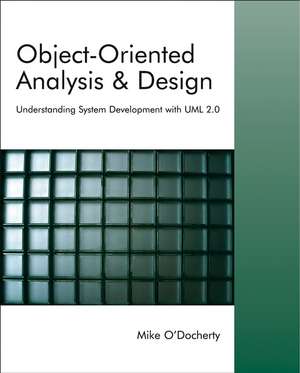
Object-Oriented Analysis and Design
Autor O'Dochertyen Limba Engleză Paperback – 10 mai 2005
Preț: 632.90 lei
Preț vechi: 791.12 lei
-20%
Puncte Express: 949
Carte tipărită la comandă
Livrare economică 16-30 noiembrie
Livrare prin curier în România Termenul estimat este afișat lângă disponibilitate.
Transport gratuit pentru acest produs Plată online sau ramburs, în funcție de opțiunile comenzii.
Retur gratuit în 14 zile Comandă securizată și suport în română.
Specificații
ISBN-13: 9780470092408
ISBN-10: 0470092408
Pagini: 580
Ilustrații: Illustrations
Dimensiuni: 191 x 235 x 31 mm
Greutate: 1.07 kg
Editura: Wiley
Locul publicării:Chichester, United Kingdom
ISBN-10: 0470092408
Pagini: 580
Ilustrații: Illustrations
Dimensiuni: 191 x 235 x 31 mm
Greutate: 1.07 kg
Editura: Wiley
Locul publicării:Chichester, United Kingdom
V-ar putea interesa
-
 -34%Preț: 282.04 lei426.32 lei
 -
 API Design for C++Martin Reddy-39%Preț: 296.07 lei482.67 lei
 -
 -37%Preț: 232.96 lei368.43 lei
 -
 UML in PracticePascal Roques-20%Preț: 282.56 lei353.20 lei
 -
 -20%Preț: 1586.27 lei1982.84 lei
 -
 UML by ExampleGhinwa Jalloul-20%Preț: 388.51 lei485.64 lei
 -
 Foundations of Component-Based SystemsGary T. Leavens-20%Preț: 385.37 lei481.72 lei
 -
 -20%Preț: 512.40 lei640.50 lei
 -
 The Object PrimerScott W. Ambler-20%Preț: 477.52 lei596.90 lei
 -
 -20%Preț: 397.91 lei497.39 lei
 -
 e-EnterpriseFaisal HoquePreț: 434.44 lei
 -
 More C++ GemsRobert C. Martin-20%Preț: 584.79 lei730.99 lei
 -
 UML Xtra-LightMilan Kratochvíl-20%Preț: 238.41 lei298.01 lei
 -
 UML 2 for DummiesJames A. Schardt-20%Preț: 143.03 lei178.79 lei
 -
 JavaFX For DummiesDoug Lowe-20%Preț: 134.27 lei167.83 lei
 -
 Data Structures & Algorithms in Java 6e International Student VersionMichael H. Goldwasser-20%Preț: 469.37 lei586.71 lei
 -
 Object-oriented Programming with SmalltalkHarald Wertz-20%Preț: 763.79 lei954.74 lei
 -
 Functional SwiftChris Eidhof-20%Preț: 200.84 lei251.05 lei
 -
 Aliasing in Object-Oriented ProgrammingDavid Clarke-20%Preț: 346.95 lei433.69 lei
Public țintă
Undergraduate and masters computing students on Object–oriented Design and Object Oriented Analysis and Design courses. Practitioners moving from a structured development environment to an object–oriented one.Notă biografică
Mike O'Docherty, Manchester UK, is an IT Training Consultant for IBM and Manchester University. He has delivered OOA&D courses to undergraduates and MSc students and professionals.
Cuprins
1. Introduction Part I: Setting the Scene
2. Object Concepts
3. Inheritance
4. Type Systems
5. Software Development Methodologies
Part II: Understanding the Problem
6. Gathering Requirements
7. Analyzing the Problem
Part III: Designing the Solution
8. Designing the System Architecture
9. Choosing Technologies
10. Designing the Subsystems
11. Reusable Design Patterns
12. Specifying the Interfaces of Classes
13. Continuous Testing
Appendix A: Ripple Summary
Appendix B: iCoot Case Study
Appendix C: Summary of UML Notation Used
Bibliography
Index
2. Object Concepts
3. Inheritance
4. Type Systems
5. Software Development Methodologies
Part II: Understanding the Problem
6. Gathering Requirements
7. Analyzing the Problem
Part III: Designing the Solution
8. Designing the System Architecture
9. Choosing Technologies
10. Designing the Subsystems
11. Reusable Design Patterns
12. Specifying the Interfaces of Classes
13. Continuous Testing
Appendix A: Ripple Summary
Appendix B: iCoot Case Study
Appendix C: Summary of UML Notation Used
Bibliography
Index