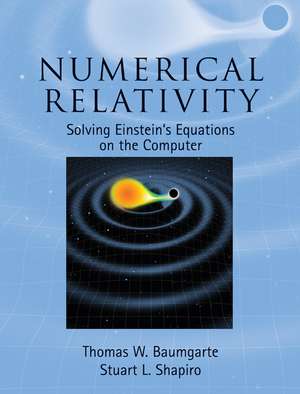
Numerical Relativity: Solving Einstein's Equations on the Computer
Autor Thomas W. Baumgarte, Stuart L. Shapiroen Limba Engleză Hardback – 23 iun 2010
În peisajul academic actual, Numerical Relativity se poziționează ca o resursă fundamentală pentru studenții și cercetătorii care doresc să stăpânească simulările computaționale ale fenomenelor astrofizice extreme. Suntem de părere că această lucrare, publicată de Cambridge University Press, reușește să pună o punte solidă între teoria relativității generale și implementarea sa algoritmică, fiind esențială în curriculumul de astrofizică relativistă și cosmologie.
Ne-a atras atenția rigoarea cu care autorii Thomas W. Baumgarte și Stuart L. Shapiro structurează materialul. Lucrarea extinde cadrul propus de Introduction to 3+1 Numerical Relativity de Miguel Alcubierre prin includerea unor date noi despre simulările de stele neutronice și colapsul clusterelor de stele. În timp ce volumul lui Alcubierre se concentrează pe fundamentele teoretice ale formalismului 3+1, textul de față merge mai departe, oferind o bibliotecă vastă de studii de caz, de la sisteme binare de găuri negre până la fenomene critice și unde gravitaționale.
Structura cărții este una progresivă, debutând cu preliminariile relativității generale și evoluând către metode numerice specifice și localizarea orizonturilor găurilor negre. Capitolele dedicate evoluției sistemelor binare și stelelor rotative demonstrează aplicabilitatea practică a formalismului matematic descris în primele secțiuni. Putem afirma că prezența celor 300 de exerciții transformă volumul dintr-o simplă monografie într-un instrument pedagogic activ, facilitând înțelegerea intuitivă a spațiu-timpului prin intermediul celor 165 de ilustrații tehnice.
Preț: 674.45 lei
Preț vechi: 741.15 lei
-9%
Carte tipărită la comandă
Livrare economică 08-22 iulie
Specificații
ISBN-10: 052151407X
Pagini: 720
Ilustrații: 97 b/w illus. 68 colour illus. 300 exercises
Dimensiuni: 193 x 253 x 37 mm
Greutate: 1.7 kg
Editura: Cambridge University Press
Colecția Cambridge University Press
Locul publicării:Cambridge, United Kingdom
V-ar putea interesa
-
 Feynman's Lost LectureDavid L Goodstein-34%Preț: 50.83 lei77.43 lei
 -
 The Mathematical Theory of Black HolesS. Chandrasekhar-21%Preț: 615.27 lei778.37 lei
 -
 Flat and Curved Space-TimesG. F. R. Ellis-19%Preț: 459.35 lei565.20 lei
 -
 In Search of Dark MatterKen FreemanPreț: 270.32 lei
 -
 Unmasking EuropaRichard GreenbergPreț: 278.13 lei
 -
 Measuring and Modeling the UniverseWendy L. FreedmanPreț: 364.81 lei
 -
 Astrophysics for PhysicistsArnab Rai Choudhuri-19%Preț: 543.92 lei671.51 lei
 -
 Nucleosynthesis and Chemical Evolution of GalaxiesBernard E. J. Pagel-19%Preț: 676.58 lei835.29 lei
 -
 Planetary Nebulae in Our Galaxy and Beyond (Iau S234)Roberto H Méndez-28%Preț: 547.00 lei763.17 lei
 -
 The Sky Is Not the LimitNeil De Grasse TysonPreț: 154.15 lei
De ce să citești această carte
Recomandăm această carte cercetătorilor care au nevoie de un ghid complet pentru rezolvarea ecuațiilor lui Einstein pe calculator. Cititorul câștigă acces la o metodologie clară pentru simularea coliziunilor dintre găurile negre și generarea undelor gravitaționale. Este un instrument indispensabil pentru cei care doresc să treacă de la teoria pură la modelarea computațională a universului, beneficiind de expertiza a doi lideri în domeniul astrofizicii relativiste.
Despre autor
Thomas W. Baumgarte este profesor de fizică la Bowdoin College și profesor adjunct la Universitatea din Illinois la Urbana-Champaign. Cu un doctorat obținut la Ludwig-Maximilians-Universität München și o carieră postdoctorală solidă la Cornell, Baumgarte este o figură centrală în fizica teoretică, fiind distins cu bursa Guggenheim. A publicat peste 65 de articole de cercetare axate pe găuri negre și astrofizică relativistă, expertiza sa fiind reflectată direct în claritatea și profunzimea tehnică a acestui volum de referință.
Cuprins
Preface; Suggestions for using this book; 1. General relativity preliminaries; 2. The 3+1 decomposition of Einstein's equations; 3. Constructing initial data; 4. Choosing coordinates: the lapse and shift; 5. Matter sources; 6. Numerical methods; 7. Locating black hole horizons; 8. Spherically symmetric spacetimes; 9. Gravitational waves; 10. Collapse of collisionless clusters in axisymmetry; 11. Recasting the evolution equations; 12. Binary black hole initial data; 13. Binary black hole evolution; 14. Rotating stars; 15. Binary neutron star initial data; 16. Binary neutron star evolution; 17. Binary black hole-neutron stars: initial data and evolution; 18. Epilogue; Appendixes; References; Index.
Recenzii
'Numerical relativity has come of age with a number of recent breakthroughs. Two leading experts give a lucid as well as richly detailed account building a bridge from the basics to current research - highly recommended.' Bernd Brügmann, Friedrich-Schiller-Universität
'Over the last five years, there have been impressive advances in numerical relativity. It has now become a central area in the fast growing field of gravitational wave physics. These tools have played an important role also in the theory of critical phenomena associated with gravitational collapse, loop quantum cosmology and the discussion of quantum black holes and black branes. The book by Baumgarte and Shapiro provides an excellent introduction to the subject covering both, mathematical aspects and numerical techniques. The authors are world leaders in numerical relativity and their contributions have shaped neutron star simulations, the new frontier of this field. This book will soon become the standard advanced text for younger researchers entering the field and will also serve as the authoritative reference for senior researchers in numerical relativity and neighboring fields.' Abhay Ashtekhar, Director, Institute for Gravitation and the Cosmos, Pennsylvania State University
'Quiescent black holes are well understood, but until recently nobody could calculate how they behave when they collide with each other, or are in the process of formation. Recent breakthroughs make such computations possible - an advance that is crucially important for understanding galactic nuclei and gravitational waves. Baumgarte and Shapiro are established leaders in this subject. Their book is a timely contribution to the literature, and the ideal primer for researchers newly attracted to the burgeoning field of computational relativity.' Martin Rees, Astronomer Royal and Master of Trinity College, Cambridge
' … a well-written overview that includes a brief introduction to general relativity … and tips on matter sources of a gravitational field … the authors aim to make Numerical Relativity useful as a graduate-level textbook and not just a reference. That feature, and the text's coverage of neutron stars, distinguishes it from the other comprehensive treatments of the subject … It is difficult to imagine that a book covering a field at the intersection of multiple disciplines could please all possible audiences. Nonetheless, Numerical Relativity hits the mark in its quite comprehensive coverage. It will be useful for practitioners in the field and especially to graduate students wishing to join them in this active and exciting area of research.' Physics Today
Descriere
Aimed at students and researchers entering the field, this pedagogical introduction to numerical relativity will also interest scientists seeking a broad survey of its challenges and achievements. Assuming only a basic knowledge of classical general relativity, the book develops the mathematical formalism from first principles, and then highlights some of the pioneering simulations involving black holes and neutron stars, gravitational collapse and gravitational waves. The book contains 300 exercises to help readers master new material as it is presented. Numerous illustrations, many in color, assist in visualizing new geometric concepts and highlighting the results of computer simulations. Summary boxes encapsulate some of the most important results for quick reference. Applications covered include calculations of coalescing binary black holes and binary neutron stars, rotating stars, colliding star clusters, gravitational and magnetorotational collapse, critical phenomena, the generation of gravitational waves, and other topics of current physical and astrophysical significance.