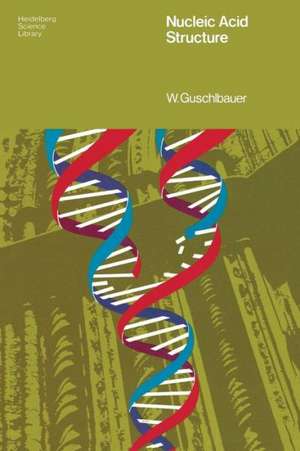
Nucleic Acid Structure: Heidelberg Science Library
Autor W. Guschlbaueren Limba Engleză Paperback – 5 apr 1976
Din seria Heidelberg Science Library
- 18%
 Preț: 895.55 lei
 - 20%
 Preț: 313.82 lei
 - 15%
 Preț: 507.35 lei
 -
 Preț: 369.10 lei
 -
 Preț: 366.77 lei
 -
 Preț: 367.19 lei
 - 20%
 Preț: 476.61 lei
 - 15%
 Preț: 611.27 lei
 - 5%
 Preț: 347.53 lei
 - 20%
 Preț: 324.31 lei
 -
 Preț: 372.70 lei
 - 5%
 Preț: 348.01 lei
 - 5%
 Preț: 349.76 lei
 -
 Preț: 371.35 lei
 -
 Preț: 368.93 lei
 -
 Preț: 373.66 lei
 -
 Preț: 373.16 lei
 - 15%
 Preț: 607.96 lei
 -
 Preț: 377.94 lei
 -
 Preț: 364.71 lei
 - 15%
 Preț: 558.12 lei
Preț: 368.16 lei
Puncte Express: 552
Carte tipărită la comandă
Livrare economică 30 noiembrie-14 decembrie
Livrare prin curier în România Termenul estimat este afișat lângă disponibilitate.
Transport gratuit de la 400.00 lei Plată online sau ramburs, în funcție de opțiunile comenzii.
Retur gratuit în 14 zile Comandă securizată și suport în română.
Specificații
ISBN-13: 9780387901411
ISBN-10: 0387901418
Pagini: 160
Ilustrații: XII, 146 p. 11 illus.
Dimensiuni: 155 x 235 x 9 mm
Greutate: 0.25 kg
Ediția:Softcover reprint of the original 1st ed. 1976
Editura: Springer
Colecția Heidelberg Science Library
Seria Heidelberg Science Library
Locul publicării:New York, NY, United States
ISBN-10: 0387901418
Pagini: 160
Ilustrații: XII, 146 p. 11 illus.
Dimensiuni: 155 x 235 x 9 mm
Greutate: 0.25 kg
Ediția:Softcover reprint of the original 1st ed. 1976
Editura: Springer
Colecția Heidelberg Science Library
Seria Heidelberg Science Library
Locul publicării:New York, NY, United States
V-ar putea interesa
-
 Pyridines: From Lab to ProductionEric F.V. Scriven-30%Preț: 904.69 lei1290.60 lei
 -
 Solutions Manual to accompany Organic ChemistryJonathan Clayden-20%Preț: 424.61 lei530.15 lei
 -
 Organic Synthesis: State of the Art 2009 - 2011Douglass F. Taber-31%Preț: 946.77 lei1377.82 lei
 -
 -15%Preț: 538.69 lei633.75 lei
 -
 -23%Preț: 1214.99 lei1577.92 lei
 -
 Preț: 506.37 lei
 -
 Advanced Practical Organic ChemistryJohn Leonard-15%Preț: 682.24 lei802.63 lei
 -
 -11%Preț: 529.10 lei594.49 lei
 -
 Polymer Synthesis: Theory and PracticeDietrich Braun-15%Preț: 618.51 lei727.66 lei
Public țintă
ResearchCuprins
1 Introduction.- 1.1 History.- 1.2 Cellular localization of nucleic acids.- 2 Methods and Techniques.- 2.1 Absorption and optical activity (ORD and CD).- 2.2 Nuclear magnetic resonance (NMR).- 2.3 Ultracentrifugation.- 2.4 X-ray fiber diffraction.- 3 Chemistry and Enzymology of Nucleic Acids.- 3.1 Chemistry of nucleic acids and their constituents.- 3.2 Chemical reactions of nucleic acids and their constituents.- 3.3 Isolation of nucleic acids.- 3.4 Degradation and determination of nucleic acids.- 4 Structure and Function of DNA.- 4.1 The double helix of Watson and Crick.- 4.2 Experimental tests of the Watson-Crick hypothesis.- 4.3 The role of DNA in the cellular machinery—the central dogma.- 5 Physical Chemistry of DNA—The Problems of DNA Research.- 5.1 Established facts.- 5.2 Facts that may require amendments of details of the Watson–Crick theory.- 5.3 What do we require from biologically operative DNA?.- 5.4 What do we still not know?.- 6 Model Systems for Nucleic Acids.- 6.1 Polynucleotides.- 6.2 Oligonucleotides.- 6.3 Association of monomers in solutions and crystals.- 7 Errors and Mutations.- 7.1 Chemical mutagenesis.- 7.2 Base analogues.- 7.3 Antibiotics, pigments, dyes.- 7.4 Mutagenesis by radiation (UV, X-rays).- 8 The Structure of Ribonucleic Acids.- 8.1 Protein biosynthesis.- 8.2 Transfer RNA.- 8.3 Ribosome structure and rRNA.- 8.4 Viral RNA and virus structure.- 9 Nucleic Acid—Protein Interactions.- 9.1 Polyamines.- 9.2 Polypeptides and protamines.- 9.3 Histones and chromatin.- In the Guise of an Epilogue.- Appendix: Abbreviations and Symbols for Nucleic Acids, Polynucleotides, and Their Constituents.- Suggested Bibliography for Advanced Reading.