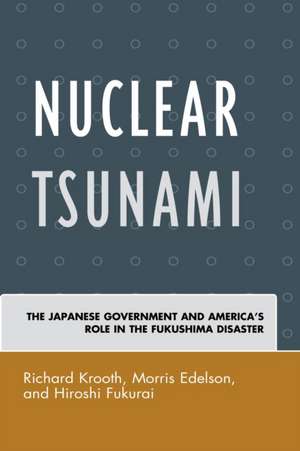
Nuclear Tsunami: The Japanese Government and America's Role in the Fukushima Disaster
Autor Richard Krooth, Morris Edelson, Hiroshi Fukuraien Limba Engleză Paperback – 14 noi 2016
Preț: 343.17 lei
Preț vechi: 482.74 lei
-29%
Puncte Express: 515
Carte tipărită la comandă
Livrare economică 30 noiembrie-14 decembrie
Livrare prin curier în România Termenul estimat este afișat lângă disponibilitate.
Transport gratuit de la 400.00 lei Plată online sau ramburs, în funcție de opțiunile comenzii.
Retur gratuit în 14 zile Comandă securizată și suport în română.
Specificații
ISBN-13: 9780739195710
ISBN-10: 0739195719
Pagini: 186
Dimensiuni: 151 x 231 x 17 mm
Greutate: 0.32 kg
Editura: Bloomsbury Publishing
Colecția Lexington Books
Locul publicării:New York, United States
ISBN-10: 0739195719
Pagini: 186
Dimensiuni: 151 x 231 x 17 mm
Greutate: 0.32 kg
Editura: Bloomsbury Publishing
Colecția Lexington Books
Locul publicării:New York, United States
V-ar putea interesa
-
 The Theory of Political CultureStephen Welch-31%Preț: 869.12 lei1262.81 lei
 -
 A General Theory of Domination and JusticeFrank Lovett-21%Preț: 386.08 lei490.44 lei
 -
 Clausewitz and Contemporary WarAntulio J. Echevarria II-14%Preț: 261.15 lei304.64 lei
 -
 Agricultural Input Subsidies: The Recent Malawi ExperienceEphraim Chirwa-34%Preț: 728.94 lei1096.86 lei
 -
 Nature for Sale: The Commons versus CommoditiesGiovanna RicoveriPreț: 221.31 lei
 -
 Who Stole the American Dream?Hedrick SmithPreț: 171.69 lei
 -
 Public OpinionCarroll J. Glynn-15%Preț: 459.76 lei540.89 lei
 -
 Gaza in CrisisNoam ChomskyPreț: 98.68 lei
 -
 U.S.-India Security Relations: Engagement & Strategic PerspectivesMalcolm E Miller-27%Preț: 1055.43 lei1438.72 lei
 -
 The Intelligent Woman's GuideBernard Shaw-7%Preț: 79.58 lei85.65 lei
 -
 Giving Is Good For YouJohn NicksonPreț: 139.52 lei
Cuprins
Table of Contents
Part I: Roots-U.S. Psychological Warfare Strategies & Propaganda Campaigns In Japan
Chapter 1: Most Nuclear-Feared Populations to the Atomic Enthusiast
Part II: Nuclear Fallout
Chapter 2: Trial by Sea, Trial by Fire
Chapter 3: Invisible Bullets
Chapter 4: Ignoring Risks to Species Life
Chapter 5: Mission Impossible: All About Nuclear Reactors
Chapter 6: Hubris and the Meta-World
Part III: In The Maelstrom
Chapter 7: Fail-Safe Fails Again
Chapter 8: Radiation Without End
Chapter 9: Nature as Nuclear Trash Bin
Chapter 10: Can Anyone Ever Pay?
Chapter 11: Returning-on Shaken Feet
Chapter 12: Popular Rights versus Corporate Power
Chapter 13: Who is in Charge Here?
Chapter 14: Making a Nation Safe for Profits
Chapter 15: Futures Unknown
Part I: Roots-U.S. Psychological Warfare Strategies & Propaganda Campaigns In Japan
Chapter 1: Most Nuclear-Feared Populations to the Atomic Enthusiast
Part II: Nuclear Fallout
Chapter 2: Trial by Sea, Trial by Fire
Chapter 3: Invisible Bullets
Chapter 4: Ignoring Risks to Species Life
Chapter 5: Mission Impossible: All About Nuclear Reactors
Chapter 6: Hubris and the Meta-World
Part III: In The Maelstrom
Chapter 7: Fail-Safe Fails Again
Chapter 8: Radiation Without End
Chapter 9: Nature as Nuclear Trash Bin
Chapter 10: Can Anyone Ever Pay?
Chapter 11: Returning-on Shaken Feet
Chapter 12: Popular Rights versus Corporate Power
Chapter 13: Who is in Charge Here?
Chapter 14: Making a Nation Safe for Profits
Chapter 15: Futures Unknown
Recenzii
Rather than a dispassionate public policy treatment of the Fukushima nuclear disaster, the three authors of this book have written an impassioned denunciation of the decision makers responsible for the event. Understandable moral outrage drives a discussion that hits every major aspect of the tragedy, from the public relations campaign that convinced many Japanese to accept nuclear electric power production reactors less than a decade after Hiroshima and Nagasaki, to the irresponsible nuclear reactor design and location decisions by Tokyo Electric Power Company, to involvement of organized crime syndicate labor subcontractors in the cleanup operations at the Fukushima site. Some of the most interesting material in the book describes the relationship between conservative media mogul and nuclear power enthusiast Matsutaro Shoriki and the CIA. The authors detail the cozy relationship between the nuclear industry and the government and the bumbling response of Prime Minister Naoto Kan's cabinet. The government's insistence on dealing with the disaster primarily as a public opinion problem rather than a public health problem, including official prevarication about the magnitude of the risks to health of radioactive contamination, comes in for scathing attack. Summing Up: Recommended. All readership levels.
With PM Abe itching to rev the reactors back up, Nuclear Tsunami is essential reading because it exposes the web of deceit and half-truths surrounding Japan's nuclear catastrophe, failures to learn the lessons highlighted in three major investigations and shambolic decommissioning efforts at Fukushima Daichi. Risk is yet again being downplayed and bleak evacuation scenarios ignored while the shattered lives of 100,000 nuclear refugees remind us of the nuclear village's folly and remarkable resilience in the face of cascading, damning revelations.
This cutting-edge work merits considerable attention for those who are interested in learning more about Japan's relationship with nuclear energy and the ramifications of the colossal disaster caused by the implosion of the Fukushima nuclear plant. Not only does this book provide a well-researched historical perspective of Japan's nuclear energy industry, but it also presents a bold and brave analysis of the Fukushima disaster including industry's role, the Japanese government's failures, and United States' impact on this catastrophe. It also provides valuable insights into the legal issues and compensation claims arising from Fukushima.
With PM Abe itching to rev the reactors back up, Nuclear Tsunami is essential reading because it exposes the web of deceit and half-truths surrounding Japan's nuclear catastrophe, failures to learn the lessons highlighted in three major investigations and shambolic decommissioning efforts at Fukushima Daichi. Risk is yet again being downplayed and bleak evacuation scenarios ignored while the shattered lives of 100,000 nuclear refugees remind us of the nuclear village's folly and remarkable resilience in the face of cascading, damning revelations.
This cutting-edge work merits considerable attention for those who are interested in learning more about Japan's relationship with nuclear energy and the ramifications of the colossal disaster caused by the implosion of the Fukushima nuclear plant. Not only does this book provide a well-researched historical perspective of Japan's nuclear energy industry, but it also presents a bold and brave analysis of the Fukushima disaster including industry's role, the Japanese government's failures, and United States' impact on this catastrophe. It also provides valuable insights into the legal issues and compensation claims arising from Fukushima.