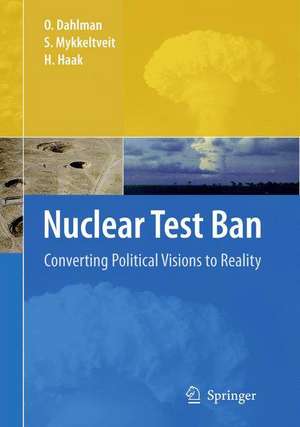
Nuclear Test Ban
Autor Ola Dahlman, S. Mykkeltveit, Hein Haaken Limba Engleză Hardback – 23 feb 2009
Preț: 426.26 lei
Puncte Express: 639
Carte disponibilă
Livrare economică 31 octombrie-14 noiembrie
Livrare express 17-23 octombrie pentru 43.51 lei
Livrare prin curier în România Termenul estimat este afișat lângă disponibilitate.
Transport gratuit pentru acest produs Plată online sau ramburs, în funcție de opțiunile comenzii.
Retur gratuit în 14 zile Comandă securizată și suport în română.
Specificații
ISBN-13: 9781402068836
ISBN-10: 1402068832
Pagini: 296
Ilustrații: XVIII, 250 p. 90 illus. in color.
Dimensiuni: 160 x 241 x 21 mm
Greutate: 0.56 kg
Ediția:2009
Editura: Springer
Locul publicării:Dordrecht, Netherlands
ISBN-10: 1402068832
Pagini: 296
Ilustrații: XVIII, 250 p. 90 illus. in color.
Dimensiuni: 160 x 241 x 21 mm
Greutate: 0.56 kg
Ediția:2009
Editura: Springer
Locul publicării:Dordrecht, Netherlands
V-ar putea interesa
-
 Tolerance: A Sensorial Orientation to PoliticsLars Tonder-12%Preț: 241.05 lei272.51 lei
 -
 A General Theory of Domination and JusticeFrank Lovett-21%Preț: 386.08 lei490.44 lei
 -
 Agricultural Input Subsidies: The Recent Malawi ExperienceEphraim Chirwa-34%Preț: 711.55 lei1077.81 lei
 -
 Public OpinionCarroll J. Glynn-8%Preț: 446.72 lei485.57 lei
 -
 The Political Thought of Frederick DouglassNicholas BuccolaPreț: 262.77 lei
 -
 U.S.-India Security Relations: Engagement & Strategic PerspectivesMalcolm E Miller-27%Preț: 1055.43 lei1438.72 lei
Public țintă
Professional/practitionerCuprins
To Test or Not to Test.- Monitoring Technologies.- A Long Journey to a Treaty.- The Treaty.- The Birth of An Organization.- Establishing the Verification Regime.- Testing Shows High Performance.- National Technical Implementation of the CTBT.- The CTBTO Preparatory Commission and the PTS - an Organizational Perspective.- The CTBTO Preparatory Commission and the World.- Always Too Early to Give Up.
Recenzii
From the reviews:
"Drawing from their experience, the authors provide a well-structured and comprehensive view of the CTBT, from the construction of nuclear devices to the promising first results of the monitoring system of the treaty. In an impeccable edition, the chapters are clearly divided into subsections, and numerous illustrations are used to clarify the arguments in the text."
G. Suarez, EOS Newsletter, Vol. 91, No. 21, p. 193
“The book focuses on the Comprehensive Nuclear Test Ban Treaty and the CTBT Organization (CTBTO) that runs the International Monitoring System (IMS) and the International Data Centre (IDC). The authors are experienced researchers with outstanding experience in seismic monitoring and who have helped to create what is now CTBTO. … seems very important to scientists dealing with seismic- or hydroacoustic, infrasound and radionuclide monitoring … .” (Pawel Wiejacz, Pure and Applied Geophysics, Vol. 167, 2010)
“It is a solid reference edition concerning the Comprehensive Nuclear-Test-Ban Treaty (CTBT), International Nuclear Explosion Monitoring System (IMS) and Preparatory Commission of the CTBT Organization. … the authors produced a multilayered book in which one can distinguish several conceptual layers. … the text is supplied with a lot of photographs, maps and diagrams … . The structure of the book is designed to make good that thesis. … gives the reader a holistic view of the diplomatic struggle for the nuclear test ban.” (Alexey Fenenko, International Trends, Vol. 8 (3), September-December, 2010)
"Drawing from their experience, the authors provide a well-structured and comprehensive view of the CTBT, from the construction of nuclear devices to the promising first results of the monitoring system of the treaty. In an impeccable edition, the chapters are clearly divided into subsections, and numerous illustrations are used to clarify the arguments in the text."
G. Suarez, EOS Newsletter, Vol. 91, No. 21, p. 193
“The book focuses on the Comprehensive Nuclear Test Ban Treaty and the CTBT Organization (CTBTO) that runs the International Monitoring System (IMS) and the International Data Centre (IDC). The authors are experienced researchers with outstanding experience in seismic monitoring and who have helped to create what is now CTBTO. … seems very important to scientists dealing with seismic- or hydroacoustic, infrasound and radionuclide monitoring … .” (Pawel Wiejacz, Pure and Applied Geophysics, Vol. 167, 2010)
“It is a solid reference edition concerning the Comprehensive Nuclear-Test-Ban Treaty (CTBT), International Nuclear Explosion Monitoring System (IMS) and Preparatory Commission of the CTBT Organization. … the authors produced a multilayered book in which one can distinguish several conceptual layers. … the text is supplied with a lot of photographs, maps and diagrams … . The structure of the book is designed to make good that thesis. … gives the reader a holistic view of the diplomatic struggle for the nuclear test ban.” (Alexey Fenenko, International Trends, Vol. 8 (3), September-December, 2010)
Textul de pe ultima copertă
The book gives a broad presentation in laymen's language of the creation and the implementation of the treaty prohibiting nuclear test explosions (Comprehensive Nuclear-Test-Ban Treaty: CTBT), one of the key guarantors of nuclear non-proliferation. The writers, who personally guided this work for more than 25 years, give a unique insight into the challenging international work to establish a complex technological system with global coverage in a political environment.
Extensive nuclear testing has occurred and this is comprehensively reviewed, as are the arguments in favour of a test ban and efforts to implement one. The Conference on Disarmament in Geneva witnessed unprecedented efforts by scientists from around the world to form a common understanding of how to verify a test ban treaty and develop a prototype global verification system; work that was significant in building confidence at the height of the Cold War. The political negotiations and Treaty itself are briefly analysed, but the main part of the book is devoted to more than a decade of effort by the Preparatory Commission for the CTBT Organization to implement the treaty and its verification system: the most comprehensive verification system ever created, with a global coverage connecting more than 300 monitoring stations and an intrusive on-site inspection regime.
The first, most promising test results are also presented. An essential element of the book is its assessment of the experience gained through many years of political, managerial and technical activity. Such lessons, if well learned, can benefit the negotiations of future international treaties where verification is crucial, such as in arms control, disarmament or the environment.
Audience:
This book will be of interest to professionals in political, diplomatic and military areas, and to politicians and their staffs. Scientists and graduate students in political science and researchers at institutions in security related fields and at NGOs will find valuable information in this book.
Extensive nuclear testing has occurred and this is comprehensively reviewed, as are the arguments in favour of a test ban and efforts to implement one. The Conference on Disarmament in Geneva witnessed unprecedented efforts by scientists from around the world to form a common understanding of how to verify a test ban treaty and develop a prototype global verification system; work that was significant in building confidence at the height of the Cold War. The political negotiations and Treaty itself are briefly analysed, but the main part of the book is devoted to more than a decade of effort by the Preparatory Commission for the CTBT Organization to implement the treaty and its verification system: the most comprehensive verification system ever created, with a global coverage connecting more than 300 monitoring stations and an intrusive on-site inspection regime.
The first, most promising test results are also presented. An essential element of the book is its assessment of the experience gained through many years of political, managerial and technical activity. Such lessons, if well learned, can benefit the negotiations of future international treaties where verification is crucial, such as in arms control, disarmament or the environment.
Audience:
This book will be of interest to professionals in political, diplomatic and military areas, and to politicians and their staffs. Scientists and graduate students in political science and researchers at institutions in security related fields and at NGOs will find valuable information in this book.
Caracteristici
CTBT is likely to be on the front pages the coming years - this book gives you the background The most comprehensive verification system ever created is soon operational - this book gives you an assessment Science for Security is a concept of the CTBT and of this book Provides a unique insight to the creation and implementation of a treaty by those at the helm
Notă biografică
Ola Dahlman studied at Lund University, the Royal Institute of Technology and the Defence Collage in Stockholm, He spent his research career at the Swedish Defence Research Agency (FOA) as a scientist anda research director working mainly on CTBT verification. Dahlman then served as the 1 director of two FOA Laboratories and finally, for six years, as the deputy director general of FOA. After retiringfrom FOA i spent a year as a visiting scientist at the EU Joint Research Centre at ISPRA, Italy,working on the concept of resilience. Parallel to his work at FOA I served as an expert to the Ministry of Foreign Affairs engaged ininternational negotiations, primarily on a nuclear test ban. He chaired for 15 years the Group ofScientific Experts at the Conference on Disarmament in Geneva and for 10 years the CompeCTBTO Working group on verification in Vienna. He chaired the CTBTO InternationalScientific Study project and its conference in 2009, which essentially was a large-scale S&Tprocess. Further, he worked for a short time at the Organisation for Security and Co-operation in Europein Vienna on Container Security and also co-chaired a three year Strategic Study onBioterrorism with European and Russian bio-experts. Dahlman has co-authored four books; Detect and Deter: Can Countries Verify the Nuclear Test Ban?Springer 2011, Nuclear Test Ban: Converting Political Visions to Reality Springer, 2009, Container Security. A Proposal for a Comprehensive Code of Conduct. National Defense University FortMcNair Washington, 2005, and Monitoring Underground Nuclear Explosions, Elsevier, 1977.