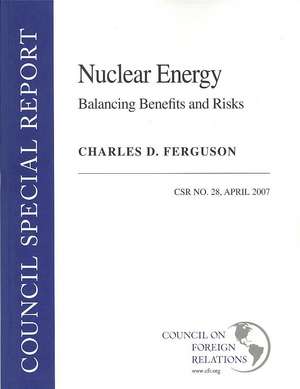
Nuclear Energy
Autor Charles D. Fergusonen Limba Engleză Paperback – apr 2007
Preț: 94.84 lei
Puncte Express: 142
Carte tipărită la comandă
Livrare economică 06-20 noiembrie
Livrare prin curier în România Termenul estimat este afișat lângă disponibilitate.
Transport gratuit de la 400.00 lei Plată online sau ramburs, în funcție de opțiunile comenzii.
Retur gratuit în 14 zile Comandă securizată și suport în română.
Specificații
ISBN-13: 9780876094006
ISBN-10: 0876094000
Pagini: 52
Ilustrații: 1
Dimensiuni: 210 x 279 x 3 mm
Greutate: 0.14 kg
Editura: Council on Foreign Relations
Locul publicării:United States
ISBN-10: 0876094000
Pagini: 52
Ilustrații: 1
Dimensiuni: 210 x 279 x 3 mm
Greutate: 0.14 kg
Editura: Council on Foreign Relations
Locul publicării:United States
V-ar putea interesa
-
 Why We Need Nuclear Power: The Environmental CaseMichael H. Fox-28%Preț: 356.15 lei493.74 lei
 -
 The Four Faces of Nuclear TerrorismCharles D. Ferguson-18%Preț: 1419.55 lei1731.16 lei
 -
 Preventing Catastrophic Nuclear TerrorismCharles D. FergusonPreț: 94.49 lei
Descriere
Descriere de la o altă ediție sau format:
For decades, the use of nuclear energy has been extremely controversial. Worries about the dangers that nuclear plants and their radioactive waste posed to nearby communities grew over time, and plant construction in the United States virtually died after the early 1980s. The 1986 disaster at Chernobyl only reinforced nuclear power's negative image. Yet in the decade prior to the Japanese nuclear crisis of 2011, sentiment about nuclear power underwent a marked change. The alarming acceleration of global warming due to the burning of fossil fuels and concern about dependence on foreign fuel has led policymakers, climate scientists, and energy experts to look once again at nuclear power as a source of energy. In this accessible overview, Charles D. Ferguson provides an authoritative account of the key facts about nuclear energy. What is the origin of nuclear energy? What countries use commercial nuclear power, and how much electricity do they obtain from it? How can future nuclear power plants be made safer? What can countries do to protect their nuclear facilities from military attacks? How hazardous is radioactive waste? Is nuclear energy a renewable energy source? Featuring a discussion of the recent nuclear crisis in Japan and its ramifications, Ferguson addresses these questions and more in a book that is essential for anyone looking to learn more about this important issue.
For decades, the use of nuclear energy has been extremely controversial. Worries about the dangers that nuclear plants and their radioactive waste posed to nearby communities grew over time, and plant construction in the United States virtually died after the early 1980s. The 1986 disaster at Chernobyl only reinforced nuclear power's negative image. Yet in the decade prior to the Japanese nuclear crisis of 2011, sentiment about nuclear power underwent a marked change. The alarming acceleration of global warming due to the burning of fossil fuels and concern about dependence on foreign fuel has led policymakers, climate scientists, and energy experts to look once again at nuclear power as a source of energy. In this accessible overview, Charles D. Ferguson provides an authoritative account of the key facts about nuclear energy. What is the origin of nuclear energy? What countries use commercial nuclear power, and how much electricity do they obtain from it? How can future nuclear power plants be made safer? What can countries do to protect their nuclear facilities from military attacks? How hazardous is radioactive waste? Is nuclear energy a renewable energy source? Featuring a discussion of the recent nuclear crisis in Japan and its ramifications, Ferguson addresses these questions and more in a book that is essential for anyone looking to learn more about this important issue.
Recenzii
An accessible text with a strong structure that provides a launch pad for further exploration.
Notă biografică
Charles D. Ferguson is President of the Federation of American Scientists and an Adjunct Professor in Georgetown University's Security Studies Program. Trained as a physicist and nuclear engineer, he has worked on nuclear policy issues at the U.S. Department of State and the Council on Foreign Relations.
Cuprins
- Contents
- Preface
- Acknowledgements
- 1. Fundamentals
- What is energy, and what is power?
- Is most energy that people use derived from nuclear energy?
- What is the origin of nuclear energy?
- What is radioactivity?
- Why is ionizing radiation a health concern?
- What is radioactive half-life, and how can knowing it help increase countries' security?
- How much more energetic is nuclear energy compared to chemical energy?
- Why has it been so difficult to commercialize nuclear fusion?
- How was nuclear fission discovered?
- What role, if any, did Albert Einstein play in the discovery of nuclear energy?
- What is a fission chain reaction?
- What is uranium, where did it come from, and how was it discovered?
- What is plutonium, how was it discovered, and how hazardous is it?
- Why can't nuclear reactors explode like a nuclear bomb?
- What is the nuclear fuel cycle?
- Why are certain activities in the nuclear fuel cycle called "dual-use "?
- What are the various uranium enrichment methods?
- What are the nuclear