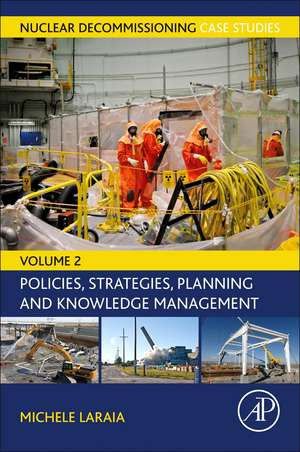
Nuclear Decommissioning Case Studies: Policies, Strategies, Planning and Knowledge Management: Nuclear Decommissioning Case studies
Autor Michele Laraiaen Limba Engleză Paperback – 25 iun 2021
Decommissioning experts, including regulators, operators, waste managers, researchers and academics will find this book to be suitable supplementary material to Michele Laraia’s reference works on the theory and applications of nuclear decommissioning.
- Presents a selection of global case studies that focus on the early stages of nuclear decommissioning
- Highlights the need to ensure sustainability plans are in place at the beginning of a nuclear project
- Informs decision-makers on selecting the best options
- Assists the reader in setting clear plans and strategies to avoid schedule delays and cost overruns
Preț: 724.52 lei
Preț vechi: 981.08 lei
-26%
Puncte Express: 1087
Carte tipărită la comandă
Livrare economică 12-26 noiembrie
Livrare prin curier în România Termenul estimat este afișat lângă disponibilitate.
Transport gratuit pentru acest produs Plată online sau ramburs, în funcție de opțiunile comenzii.
Retur gratuit în 14 zile Comandă securizată și suport în română.
Specificații
ISBN-13: 9780323857345
ISBN-10: 0323857345
Pagini: 372
Dimensiuni: 152 x 229 mm
Greutate: 0.49 kg
Editura: ELSEVIER SCIENCE
Seria Nuclear Decommissioning Case studies
ISBN-10: 0323857345
Pagini: 372
Dimensiuni: 152 x 229 mm
Greutate: 0.49 kg
Editura: ELSEVIER SCIENCE
Seria Nuclear Decommissioning Case studies
V-ar putea interesa
-
 On the EdgeNate SilverPreț: 107.37 lei
 -
 The Infinite AlphabetCésar A. HidalgoPreț: 191.96 lei
 -
 What's Stopping You?Timothy ArmooPreț: 122.61 lei
 -
 WreckersSimon ParkPreț: 188.88 lei
 -
 -9%Preț: 476.76 lei523.91 lei
 -
 The Adventure of Sustainable PerformanceStuart MclachlanPreț: 190.19 lei
 -
 -19%Preț: 433.32 lei534.96 lei
 -
 Preț: 330.23 lei
 -
 Project ManagementHarold R. Kerzner-23%Preț: 684.74 lei889.27 lei
 -
 The Caring CompanyIsaac GetzPreț: 183.45 lei
 -
 From Values to ActionHarry M Jansen KraemerPreț: 188.69 lei
 -
 The Communication CodeJeremie KubicekPreț: 99.12 lei
 -
 Preț: 135.71 lei
 -
 The Consultant¿s HandbookSamir ParikhPreț: 190.93 lei
 -
 The New Nature of BusinessAndre HoffmannPreț: 116.02 lei
 -
 Going NuclearTim GregoryPreț: 124.00 lei
 -
 What Will Your Legacy Be?Sangeeta Waldron-10%Preț: 110.74 lei123.53 lei
 -
 LET It HappenMau Espinosa-11%Preț: 83.92 lei93.89 lei
 -
 Shadows At WorkSteven D'SouzaPreț: 112.49 lei
 -
 Lean & Green: Best PracticeDaniel ReichertPreț: 451.09 lei
Public țintă
Nuclear engineers; nuclear researchers; nuclear students; decommissioning specialists; governments and decision makers; nuclear operators and waste managers.Cuprins
1. Introduction
2. The concept of economic and other forms of sustainability as applicable to nuclear decommissioning
3. Relevant decommissioning events
4. Categorizations
5. Policies and strategies (from operators, regulators, waste managers and others’ perspectives)
6. Planning (from preliminary to detailed)
7. Knowledge management (record generation and keeping, knowledge transfer, succession planning etc.)
8. Conclusions
2. The concept of economic and other forms of sustainability as applicable to nuclear decommissioning
3. Relevant decommissioning events
4. Categorizations
5. Policies and strategies (from operators, regulators, waste managers and others’ perspectives)
6. Planning (from preliminary to detailed)
7. Knowledge management (record generation and keeping, knowledge transfer, succession planning etc.)
8. Conclusions
Notă biografică
Michele Laraia, a chemical engineer by background, gained his first degree at the University of Rome. In 1975 he began to work at Italy's Regulatory Body, since 1982 as licensing manager of decommissioning projects. From July 1991, Michele worked at the International Atomic Energy Agency, Waste Technology Section, as Unit Leader responsible for decontamination and decommissioning of nuclear installations and environmental remediation. The objectives of the work were to provide guidance to Member States on the planning and implementation of nuclear decommissioning and site remediation, to disseminate information on good practices, and to provide direct assistance to Member States in the implementation of their programmes. Following his retirement in November 2011 Michele offers consultant services in the above-mentioned areas.