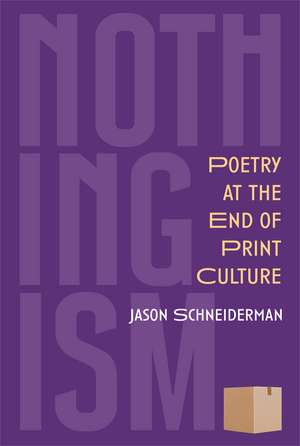
Nothingism: Poetry at the End of Print Culture: Poets On Poetry
Autor Jason Schneidermanen Limba Engleză Paperback – 5 mar 2025
In this collection, the essays range from blistering manifesto to deep historical dives to gentle classroom guidance to considerations of the poems of James Merrill and Agha Shahid Ali, moving between the theoretical and the practical. Nothingism is both deeply personal and highly erudite, providing an engaging and scholarly account of reading, writing, and teaching poetry as our world continues its unsupervised lurch toward digital culture.
Din seria Poets On Poetry
-
 Preț: 127.98 lei
 -
 Preț: 157.95 lei
 -
 Preț: 107.03 lei
 -
 Preț: 127.59 lei
 -
 Preț: 190.38 lei
 -
 Preț: 128.27 lei
 -
 Preț: 89.81 lei
 -
 Preț: 158.62 lei
 -
 Preț: 221.57 lei
 -
 Preț: 154.55 lei
 -
 Preț: 107.30 lei
 -
 Preț: 105.23 lei
 -
 Preț: 167.70 lei
 -
 Preț: 185.45 lei
 -
 Preț: 261.06 lei
 -
 Preț: 176.58 lei
 -
 Preț: 176.58 lei
 -
 Preț: 146.46 lei
 -
 Preț: 220.53 lei
 -
 Preț: 157.91 lei
 -
 Preț: 194.62 lei
 -
 Preț: 221.83 lei
 -
 Preț: 193.50 lei
 - 8%
 Preț: 135.76 lei
 - 7%
 Preț: 151.35 lei
 - 28%
 Preț: 489.78 lei
 -
 Preț: 242.92 lei
 -
 Preț: 150.66 lei
 -
 Preț: 185.23 lei
 -
 Preț: 176.25 lei
 - 23%
 Preț: 454.63 lei
 -
 Preț: 114.07 lei
 -
 Preț: 374.89 lei
 -
 Preț: 149.88 lei
 -
 Preț: 158.53 lei
 -
 Preț: 390.38 lei
 -
 Preț: 107.94 lei
 - 24%
 Preț: 458.02 lei
 - 18%
 Preț: 365.83 lei
 -
 Preț: 171.11 lei
 -
 Preț: 194.53 lei
 - 8%
 Preț: 169.08 lei
 -
 Preț: 193.91 lei
 -
 Preț: 168.14 lei
 -
 Preț: 154.27 lei
 -
 Preț: 112.43 lei
 -
 Preț: 181.68 lei
Preț: 106.26 lei
Puncte Express: 159
Carte disponibilă
Livrare economică 06-20 noiembrie
Livrare prin curier în România Termenul estimat este afișat lângă disponibilitate.
Transport gratuit de la 400.00 lei Plată online sau ramburs, în funcție de opțiunile comenzii.
Retur gratuit în 14 zile Comandă securizată și suport în română.
Specificații
ISBN-13: 9780472039845
ISBN-10: 0472039849
Pagini: 154
Ilustrații: 5 Images
Dimensiuni: 137 x 203 x 13 mm
Greutate: 0.17 kg
Editura: UNIVERSITY OF MICHIGAN PRESS
Colecția University of Michigan Press
Seria Poets On Poetry
ISBN-10: 0472039849
Pagini: 154
Ilustrații: 5 Images
Dimensiuni: 137 x 203 x 13 mm
Greutate: 0.17 kg
Editura: UNIVERSITY OF MICHIGAN PRESS
Colecția University of Michigan Press
Seria Poets On Poetry
Notă biografică
Jason Schneiderman is the author of five poetry collections, most recently Self Portrait of Icarus as a Country on Fire (Red Hen, 2024). He also edited the anthology Queer: A Reader for Writers (Oxford, 2016). He is Professor of English at CUNY’s BMCC and teaches in the MFA Program for Writers at Warren Wilson College.
Cuprins
Introduction
Chapter 1 – Nothingism: A Manifesto
Chapter 2 – A History and Theory of the Line in English Language Poetry
Chapter 3 – How the Sonnet Turns: From a Fold to a Helix
Chapter 4 – I Thought I Hated Inaugural Poems (But It Turns Out I Don't)
Chapter 5 – A Rising Tide Floats All Boats: Ten Lessons from a Quarter Century of Teaching
Chapter 6 – Notes on Not Writing: Revisiting The Changing Light at Sandover
Chapter 7 – The Loved One Always Leaves: The Poetic Friendship of Agha Shahid Ali and James Merrill
Acknowledgments
Chapter 1 – Nothingism: A Manifesto
Chapter 2 – A History and Theory of the Line in English Language Poetry
Chapter 3 – How the Sonnet Turns: From a Fold to a Helix
Chapter 4 – I Thought I Hated Inaugural Poems (But It Turns Out I Don't)
Chapter 5 – A Rising Tide Floats All Boats: Ten Lessons from a Quarter Century of Teaching
Chapter 6 – Notes on Not Writing: Revisiting The Changing Light at Sandover
Chapter 7 – The Loved One Always Leaves: The Poetic Friendship of Agha Shahid Ali and James Merrill
Acknowledgments
Recenzii
At once an (anti-) primer on pedagogy, poesy, and prophecy, Jason Schneiderman deftly blurs the lines in Nothingism. It's everything, as the digital natives say, taking on Emily Dickenson, Megan Thee Stallion, Agha Shahid Ali and James Merrill, and more, with acuity and care. The essay collection transcends Derridean aporias and Deleuzian lines of flight, Windows™ / windows and mirrors (psychoanalytic and metaphysical). This transdisciplinary work –mindf*ck, 'linefuck'—tears apart our assumptions about literature (and life)—I leave and return: elation, revelation, tears.
Beginning with a playful manifesto and ending with a meditation on friendship, Jason Schneiderman's Nothingism is no ordinary collection of essays 'about poetry.' What I love most about this book is how frequently Schneiderman brings forward a personal perspective, moments from the author's life, imbuing the writing's rigor and insight with a distinct and human presence. These are wonderful essays: charming, rigorous, and alive.
Why read a poem? Why read a hundred? What makes you less likely to read a hundred poems in a row than to read a hundred Tweets or Insta posts or emails, and why should the answer make you put down your phone? What's in a poetic line? Are poems bundled silently into codex books in English near the end of the line? Are we all linef*cked? If not, should we fall in line? How does one sonnet from 1958 'spiral out across the unknowability—or unspeakability—of love'? If you have students, what do your students want from you, and how can you learn when to give them what they want, and whether to give them something else? 'The loved one always leaves,' as one of Schneiderman's models loved and hurt to say, but these essays—these printed leaves— stick around: they're answers to questions that I wish I had long known how to ask. Stay with them.
"This diverse collection of literary essays is unified by the author’s personality and his probing response to the 'move away from poetry as a printed object toward poetry as a digital object.'. . . Recommended."
Beginning with a playful manifesto and ending with a meditation on friendship, Jason Schneiderman's Nothingism is no ordinary collection of essays 'about poetry.' What I love most about this book is how frequently Schneiderman brings forward a personal perspective, moments from the author's life, imbuing the writing's rigor and insight with a distinct and human presence. These are wonderful essays: charming, rigorous, and alive.
Why read a poem? Why read a hundred? What makes you less likely to read a hundred poems in a row than to read a hundred Tweets or Insta posts or emails, and why should the answer make you put down your phone? What's in a poetic line? Are poems bundled silently into codex books in English near the end of the line? Are we all linef*cked? If not, should we fall in line? How does one sonnet from 1958 'spiral out across the unknowability—or unspeakability—of love'? If you have students, what do your students want from you, and how can you learn when to give them what they want, and whether to give them something else? 'The loved one always leaves,' as one of Schneiderman's models loved and hurt to say, but these essays—these printed leaves— stick around: they're answers to questions that I wish I had long known how to ask. Stay with them.
"This diverse collection of literary essays is unified by the author’s personality and his probing response to the 'move away from poetry as a printed object toward poetry as a digital object.'. . . Recommended."
Descriere
Exploring the form and significance of poetry in a digital age