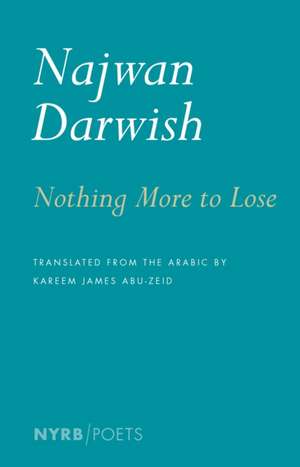
Nothing More To Lose
Autor Najwan Darwishen Limba Engleză Paperback – 29 apr 2014
Structura volumului Nothing More To Lose este concepută ca o retrospectivă esențială, organizând cronologic evoluția lui Najwan Darwish de la primele sale versuri din anii '90 până în 2013. Metodologia de selecție evidențiază o voce care refuză să fie limitată de geografia politică a Palestinei, preferând să exploreze intersecția dintre social, psihologic și mitic. Descoperim aici o poezie care pendulează între disperare și rezistență, folosind umorul negru ca instrument de supraviețuire în fața realității dure a morții. Putem afirma că forța acestui volum rezidă în capacitatea autorului de a asimila tradiții literare și religioase vaste, transformând Ierusalimul dintr-un reper geografic într-un personaj complex, deopotrivă iubit și persecutor. Cititorii familiarizați cu The Butterfly's Burden de Mahmoud Darwish vor aprecia modul în care Najwan se distanțează de predecesorul său; în timp ce Mahmoud este vocea poetică a identității naționale, Najwan propune un model mai incluziv și mai universalist al identității arabe. Această abordare îl plasează într-un dialog direct cu preocupările din Chaos, Crossing, ambele lucrări explorând dezrădăcinarea și inechitatea socială. În contextul operei sale, Nothing More To Lose servește drept fundație pentru volumele ulterioare, precum Exhausted on the Cross. Dacă în lucrările mai recente observăm o auto-interogare existențială și mai profundă, acest prim volum tradus în engleză fixează temele recurente ale autorului: rescrierea figurii lui Hristos și refuzul de a accepta rolul de „poet național” tradițional. Ritmul dens al imaginilor și tonul de sfidare fac din această colecție un reper al poeziei arabe contemporane.
Preț: 105.28 lei
Carte disponibilă
Livrare economică 30 octombrie-13 noiembrie
Livrare express 16-22 octombrie pentru 14.93 lei
Specificații
ISBN-10: 1590177304
Pagini: 128
Dimensiuni: 113 x 177 x 10 mm
Greutate: 0.11 kg
Ediția:Main
Editura: New York Review Books
V-ar putea interesa
-
 J RJoy Williams-25%Preț: 159.16 lei211.74 lei
 -
 GroveEsther KinskyPreț: 93.41 lei
 -
 The RadicantJames GussenPreț: 122.88 lei
 -
 Preț: 67.81 lei
 -
 Co-existence of TimesJoahnne LogstrupPreț: 68.00 lei
 -
 Exhibition-ismMieke BalPreț: 63.77 lei
 -
 I Can’t SleepLionel RuffelPreț: 61.39 lei
De ce să citești această carte
Recomandăm acest volum cititorilor care caută poezie politică transformată în artă universală. Nothing More To Lose oferă o perspectivă viscerală asupra luptei palestiniene, dar o face prin prisma justiției globale și a unei sensibilități moderne, departe de clișeele naționaliste. Este o achiziție obligatorie pentru cei care doresc să înțeleagă noua generație de intelectuali arabi care provoacă normele istorice și literare stabilite.
Despre autor
Najwan Darwish, născut în 1978 la Ierusalim, este considerat unul dintre cei mai importanți poeți arabi ai generației sale. Spre deosebire de omonimul său mai celebru, Mahmoud Darwish, Najwan a cultivat o estetică a refuzului și a includerii, fiind tradus în peste douăzeci de limbi. Dincolo de activitatea sa literară, este implicat activ în viața culturală a lumii arabe, fiind editor și critic. Opera sa este marcată de o colaborare strânsă cu traducătorul Kareem James Abu-Zeid, care a reușit să redea în engleză densitatea ritmului și aciditatea imaginilor sale, aducându-i recunoașterea internațională în publicații precum New York Review Books.
Notă biografică
Kareem James Abu-Zeid was born in 1981. Half American and half Egyptian, he has translated novels by the Lebanese writer Rabee Jaber and the Sudanese writer Tarek Eltayeb, as well the poetry collection The Iraqi Nights by Dunya Mikhail. Abu-Zeid also translates from French and German, and has taught university courses in four different languages in Berkeley, Mannheim, and Heidelberg. He works as a freelance translator and editor, and is currently writing a history of psychedelic literature that is doubling as his PhD dissertation in comparative literature at the University of California Berkeley.
Descriere scurtă
Although they are strongly rooted in Darwish’s homeland, these poems repeatedly link the Palestinian cause to more global visions of equality and justice, and to historical moments from across the Arab world and beyond. This ability to transcend national boundaries—and to assimilate a vast array of literary and religious traditions—has made Darwish one of the very few Palestinian poets to garner a large readership outside his homeland.
While so many poets within Palestine are trying to follow in the footsteps of Mahmoud Darwish—whose influence on Palestinian poetry was enormous from the 1960s to his death in 2008—Najwan Darwish is widely respected for his refusal to take on the mantle of his famous namesake (to whom he bears no relation). This refusal is clearest in his own poetic rebuttal to Mahmoud Darwish’s best-known poem, “Identity Card”—a radical rewriting that espouses a more inclusive view of what it means to be both Arab and Palestinian.
Recenzii
“Constrained by neither temporality nor place, his poetry is a medium of defiance, employing a sharp wit to illuminate absurdities and injustices. While his poetry is at times political, it embodies a universal message, reminiscent of the great mystical poets like Rumi. From Jerusalem, where he works and lives, N. Darwish has become a distinguished voice for his nation’s struggle. His poetry renders the particularity of the Palestinian experience in luminous imagery and piercing observations, but his imagination and interests are not limited by borders.” —Emily Dische-Becker, Poetry International
“Najwan Darwish’s poetry is different: it seems to have overcome the false dichotomy between poetry and social and political reality. What struck me first about reading these poems is his capacity to do justice to both poetry (to image, to condensed form) while also doing justice to its surrounding reality. This is a significant challenge: how to mediate between two intense forms without ruining either.” —Bashir Abu-Manneh, Barnard College