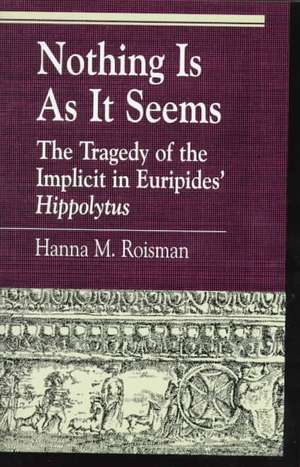
Nothing Is as It Seems: The Tragedy of the Implicit in Euripides' Hippolytus: Greek Studies: Interdisciplinary Approaches
Autor Hanna M. Roismanen Limba Engleză Paperback – 24 noi 1998
Din seria Greek Studies: Interdisciplinary Approaches
- 32%
 Preț: 440.04 lei
 - 32%
 Preț: 376.43 lei
 - 24%
 Preț: 252.34 lei
 - 20%
 Preț: 271.56 lei
 - 34%
 Preț: 633.75 lei
 - 22%
 Preț: 324.61 lei
 - 32%
 Preț: 398.47 lei
 - 20%
 Preț: 368.26 lei
 - 30%
 Preț: 436.20 lei
 - 24%
 Preț: 353.14 lei
 - 32%
 Preț: 440.57 lei
 - 35%
 Preț: 344.42 lei
 - 23%
 Preț: 319.49 lei
 - 35%
 Preț: 345.34 lei
 - 29%
 Preț: 345.30 lei
 - 33%
 Preț: 373.85 lei
 - 32%
 Preț: 373.22 lei
 - 36%
 Preț: 372.94 lei
 - 23%
 Preț: 318.04 lei
 - 35%
 Preț: 743.76 lei
 -
 Preț: 309.40 lei
 - 29%
 Preț: 345.19 lei
 - 19%
 Preț: 333.56 lei
 - 34%
 Preț: 600.98 lei
 - 35%
 Preț: 562.53 lei
 - 21%
 Preț: 365.28 lei
 - 34%
 Preț: 600.24 lei
 - 27%
 Preț: 284.87 lei
 - 24%
 Preț: 309.81 lei
 - 24%
 Preț: 364.96 lei
 - 30%
 Preț: 418.96 lei
 - 26%
 Preț: 260.97 lei
 - 24%
 Preț: 351.30 lei
 - 32%
 Preț: 362.16 lei
 - 19%
 Preț: 320.50 lei
 - 23%
 Preț: 337.12 lei
 - 35%
 Preț: 347.35 lei
 - 30%
 Preț: 637.16 lei
 - 20%
 Preț: 375.38 lei
 - 19%
 Preț: 313.16 lei
 - 21%
 Preț: 306.74 lei
 - 35%
 Preț: 594.28 lei
Preț: 351.12 lei
Preț vechi: 461.09 lei
-24%
Puncte Express: 527
Carte tipărită la comandă
Livrare economică 07-21 decembrie
Livrare prin curier în România Termenul estimat este afișat lângă disponibilitate.
Transport gratuit de la 400.00 lei Plată online sau ramburs, în funcție de opțiunile comenzii.
Retur gratuit în 14 zile Comandă securizată și suport în română.
Specificații
ISBN-13: 9780847690930
ISBN-10: 0847690938
Pagini: 232
Dimensiuni: 150 x 228 x 18 mm
Greutate: 0.35 kg
Ediția:New.
Editura: Bloomsbury Publishing
Colecția Rowman & Littlefield
Seria Greek Studies: Interdisciplinary Approaches
Locul publicării:New York, United States
ISBN-10: 0847690938
Pagini: 232
Dimensiuni: 150 x 228 x 18 mm
Greutate: 0.35 kg
Ediția:New.
Editura: Bloomsbury Publishing
Colecția Rowman & Littlefield
Seria Greek Studies: Interdisciplinary Approaches
Locul publicării:New York, United States
V-ar putea interesa
-
 The Three Theban PlaysSophocles-41%Preț: 54.98 lei93.57 lei
 -
 Redeeming the KamasutraWendy Doniger-18%Preț: 116.99 lei143.46 lei
 -
 -23%Preț: 603.47 lei783.73 lei
 -
 The Poetic EddaLee M. HollanderPreț: 175.20 lei
 -
 Preț: 60.65 lei
 -
 Preț: 397.48 lei
 -
 Icelandic Histories and RomancesAnne O'ConnorPreț: 93.22 lei
 -
 OCR Anthology for Classical Greek GCSEJudith Affleck-14%Preț: 143.20 lei166.50 lei
 -
 Ovid Heroides: A SelectionDr John GodwinPreț: 120.76 lei
 -
 Tacitus Annals I: A SelectionKatharine Radice-21%Preț: 135.81 lei172.07 lei
 -
 OCR Anthology for Classical Greek AS and A LevelDr Malcolm Campbell-20%Preț: 262.55 lei330.19 lei
 -
 Seneca Letters: A SelectionEliot Maunder-16%Preț: 109.45 lei131.07 lei
 -
 Virgil Aeneid X: A SelectionChristopher Tanfield-22%Preț: 108.92 lei139.84 lei
 -
 Propertius, Tibullus and Ovid: A Selection of Love PoetryDr Anita Nikkanen-20%Preț: 139.47 lei175.14 lei
 -
 Cicero Pro Milone: A SelectionRobert West-23%Preț: 138.02 lei179.45 lei
 -
 Virgil Aeneid VIII: A SelectionDr Keith Maclennan-17%Preț: 108.76 lei131.14 lei
 -
 The Arabian Nights: A CompanionRobert Irwin-52%Preț: 66.98 lei139.66 lei
Recenzii
Roisman discusses an impressive amount of secondary literature in a clearly structured way and concludes the book with two small, but useful indices. Hew style is precise, to the point, and pleasant to read. This monograph provides a convincing and thought-provoking interpretation and should be a 'must' for everyone who is seriously interested in Euripidean tragedy. It fully deserves its own place within the canon of other long established views.
Roisman challenges orthodox ways of reading Greek tragedy . . . This, then, is a volume . . . for the mature scholar, who will enjoy the process of testing Roisman's hypotheses [and] evaluating their unusual implications . . .
Roisman challenges orthodox ways of reading Greek tragedy . . . This, then, is a volume . . . for the mature scholar, who will enjoy the process of testing Roisman's hypotheses [and] evaluating their unusual implications . . .