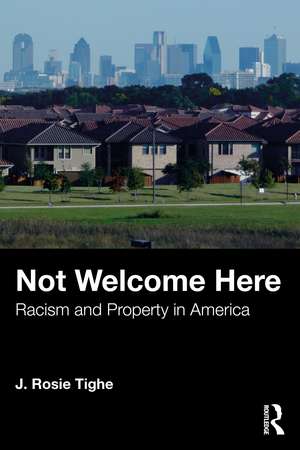
Not Welcome Here: Racism and Property in America
Autor J. Rosie Tigheen Limba Engleză Paperback – 2 aug 2026
Preț: 380.21 lei
Nou
Puncte Express: 570
Carte disponibilă
Livrare economică 10-24 noiembrie
Livrare express 27-31 octombrie pentru 26.26 lei
Livrare prin curier în România Termenul estimat este afișat lângă disponibilitate.
Transport gratuit de la 400.00 lei Plată online sau ramburs, în funcție de opțiunile comenzii.
Retur gratuit în 14 zile Comandă securizată și suport în română.
Specificații
ISBN-13: 9780367258641
ISBN-10: 0367258641
Pagini: 172
Ilustrații: 22
Dimensiuni: 156 x 234 mm
Greutate: 0.25 kg
Ediția:1
Editura: Taylor & Francis
Colecția Routledge
Locul publicării:Oxford, United Kingdom
ISBN-10: 0367258641
Pagini: 172
Ilustrații: 22
Dimensiuni: 156 x 234 mm
Greutate: 0.25 kg
Ediția:1
Editura: Taylor & Francis
Colecția Routledge
Locul publicării:Oxford, United Kingdom
Public țintă
General, Postgraduate, Professional, and UndergraduateRecenzii
“The racism and the anti-black prejudice, in particular, that has animated American housing markets over the past 150 years is as horrific as it is relentless. In this book Rosie Tighe lays out the subtle and unsubtle actions of intentional exclusion and discrimination that have helped to produce the American urban landscape. Not Welcome Here is comprehensive in its description of the actions of white residents and real estate professionals, and the racist attitudes enshrined in public policy at all levels of government that have produced the American system of residential segregation and inequality.”
Ed Goetz, Director, Center for Urban and Regional Affairs, University of Minnesota
“Not Welcome Here is a thorough and desperately needed examination of the fundamental racism that has permeated urban housing markets in the U.S. from the very beginning and into the twenty-first century. Tighe pulls no punches. This is the book needed to provide a corrective to the sometimes overly simplistic market-fundamentalist notions of ‘just build more housing’ that increasingly dominate housing policy discussions. In an age where serious scholarship is sadly too often ignored in favor of social media posts, this book is a must read.”
Dan Immergluck, Professor of Urban Studies, Georgia State University
“This powerful book offers a bold and unwavering examination of how the legacy of racism continues to shape America’s landscape of racial and spatial inequality. At a time when certain federal leaders reject systemic discrimination as an explanation for economic and social disparities, Tighe delivers a compelling argument for how structural racism and white supremacy remain central barriers to equity and opportunity for all. Rather than relying on national policy interventions, Not Welcome Here highlights several critical local strategies to confront entrenched injustice. Essential reading for scholars, urban planners, and policymakers, this timely manuscript is an indispensable roadmap for addressing racial segregation and advancing equitable community development in an era of deep political division.”
Derek Hyra, Professor of Public Administration and Policy at American University and author of Slow and Sudden Violence: Why and When Uprisings Occur
Ed Goetz, Director, Center for Urban and Regional Affairs, University of Minnesota
“Not Welcome Here is a thorough and desperately needed examination of the fundamental racism that has permeated urban housing markets in the U.S. from the very beginning and into the twenty-first century. Tighe pulls no punches. This is the book needed to provide a corrective to the sometimes overly simplistic market-fundamentalist notions of ‘just build more housing’ that increasingly dominate housing policy discussions. In an age where serious scholarship is sadly too often ignored in favor of social media posts, this book is a must read.”
Dan Immergluck, Professor of Urban Studies, Georgia State University
“This powerful book offers a bold and unwavering examination of how the legacy of racism continues to shape America’s landscape of racial and spatial inequality. At a time when certain federal leaders reject systemic discrimination as an explanation for economic and social disparities, Tighe delivers a compelling argument for how structural racism and white supremacy remain central barriers to equity and opportunity for all. Rather than relying on national policy interventions, Not Welcome Here highlights several critical local strategies to confront entrenched injustice. Essential reading for scholars, urban planners, and policymakers, this timely manuscript is an indispensable roadmap for addressing racial segregation and advancing equitable community development in an era of deep political division.”
Derek Hyra, Professor of Public Administration and Policy at American University and author of Slow and Sudden Violence: Why and When Uprisings Occur
Cuprins
Introduction: Not Welcome Here
1. 40 Acres and a Mule
2. Stemming the Negro Tide
3. Home Is Where the Hatred Is
4. Public Subsidies for Private Racism
5. The Insidious Malady
6. A Decent Home
7. Fight and Flight
8. Dream Hoarders
Conclusion: Not Welcome Here
1. 40 Acres and a Mule
2. Stemming the Negro Tide
3. Home Is Where the Hatred Is
4. Public Subsidies for Private Racism
5. The Insidious Malady
6. A Decent Home
7. Fight and Flight
8. Dream Hoarders
Conclusion: Not Welcome Here
Notă biografică
J. Rosie Tighe has spent the past two decades pursuing collaborative and engaged research on housing, racism, and inequality. She holds an MA in urban policy from Tufts University and a PhD in Community & Regional Planning from the University of Texas at Austin. When not traveling abroad, she lives in Cleveland with her foster pups.
Descriere
This book examines the history and current context of racism in housing and neighborhoods to understand how racism and white supremacy have hindered true equality. It explores how Americans use various means– from racial intimidation to restrictive zoning–to exclude entire races and classes of people from their neighborhoods and communities.