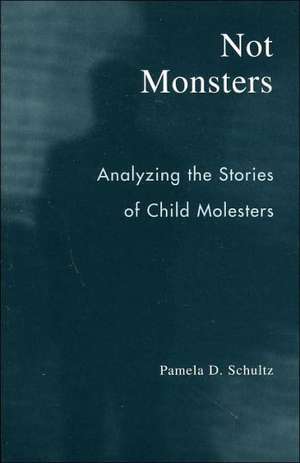
Not Monsters: Analyzing the Stories of Child Molesters
Autor Pamela D. Schultzen Limba Engleză Paperback – 17 ian 2005
Preț: 335.91 lei
Preț vechi: 415.67 lei
-19%
Puncte Express: 504
Carte tipărită la comandă
Livrare economică 05-19 decembrie
Livrare prin curier în România Termenul estimat este afișat lângă disponibilitate.
Transport gratuit de la 400.00 lei Plată online sau ramburs, în funcție de opțiunile comenzii.
Retur gratuit în 14 zile Comandă securizată și suport în română.
Specificații
ISBN-13: 9780742530584
ISBN-10: 0742530582
Pagini: 225
Dimensiuni: 148 x 226 x 14 mm
Greutate: 0.32 kg
Editura: Bloomsbury Publishing
Colecția Rowman & Littlefield
Locul publicării:New York, United States
ISBN-10: 0742530582
Pagini: 225
Dimensiuni: 148 x 226 x 14 mm
Greutate: 0.32 kg
Editura: Bloomsbury Publishing
Colecția Rowman & Littlefield
Locul publicării:New York, United States
V-ar putea interesa
-
 Howard Marks Book Of Dope StoriesHoward MarksPreț: 128.16 lei
 -
 The Murderer Next DoorDavid M BussPreț: 89.84 lei
 -
 -11%Preț: 354.68 lei396.66 lei
 -
 The Japanese Mafia: Yakuza, Law, and the StatePeter B. E. Hill-20%Preț: 400.23 lei499.77 lei
 -
 Donnie BrascoJoseph D PistonePreț: 101.39 lei
 -
 The Science of Sherlock HolmesE J WagnerPreț: 114.89 lei
 -
 Street JusticeBruce A. JacobsPreț: 250.84 lei
 -
 Drug-Crime ConnectionsTrevor BennettPreț: 308.04 lei
 -
 Bonded by BloodBernard O'MahoneyPreț: 115.07 lei
 -
 Criminal PsychologyRay BullPreț: 65.58 lei
 -
 Preț: 417.04 lei
Cuprins
Chapter 1 Acknowledgments
Chapter 2 Preface
Chapter 3 1 The Impact of Child Sexual Abuse
Chapter 4 2 "Truth" and the Social Construction of Child Sexual Abuse
Chapter 5 3 Tony-The Actor
Chapter 6 4 Red-The Martyr
Chapter 7 5 Billy-The Monstrous Child
Chapter 8 6 Darrell-The Altar Boy
Chapter 9 7 Abe-The Family Man
Chapter 10 8 Greg-The Victim
Chapter 11 9 Ben-The Defeated Soldier
Chapter 12 10 Matthew-The Lost Boy
Chapter 13 11 Rick-The User
Chapter 14 12 Making Sense of the Senseless
Chapter 15 Appendix
Chapter 16 Bibliography
Chapter 2 Preface
Chapter 3 1 The Impact of Child Sexual Abuse
Chapter 4 2 "Truth" and the Social Construction of Child Sexual Abuse
Chapter 5 3 Tony-The Actor
Chapter 6 4 Red-The Martyr
Chapter 7 5 Billy-The Monstrous Child
Chapter 8 6 Darrell-The Altar Boy
Chapter 9 7 Abe-The Family Man
Chapter 10 8 Greg-The Victim
Chapter 11 9 Ben-The Defeated Soldier
Chapter 12 10 Matthew-The Lost Boy
Chapter 13 11 Rick-The User
Chapter 14 12 Making Sense of the Senseless
Chapter 15 Appendix
Chapter 16 Bibliography
Recenzii
Not Monsters is a valuable book that is both well written and highly informative. Pamela Schultz has done an excellent job in providing straightforward information about the impact of sexual abuse on victims as well as on men who sexually abuse children, looking critically at the motivation behind their behavior. Working in the field for almost three decades has taught me that punishment alone will not prevent sexual abuse from occurring. We need to fully and completely understand it. Not Monsters provides a daring look into child sexual abuse and furthers our understanding of this public health problem, lending support to the national efforts to prevent child sexual abuse.
A courageous book that involves a look into the mirror of the author's own experience as a victim of sexual abuse to answer the question: 'Why?' This research provides some of the more revealing accounts of child sexual offending and the life histories of offenders to date-a narrative study that brings us a step closer to deciphering the reasons men violate unspeakable sexual boundaries. Professionals addressing the issues of perpetrators and victims should read this book.
This work provides an important contribution to the academic literature because it provides the reader with firsthand accounts from convicted child molesters. Although this may be a rather dark subject matter for many scholars, it nevertheless proves for fascinating reading; and it is, in fact, very well written.
Sexual crimes against children are increasing: statistics show that one in five girls and one in ten boys will be sexually abused by age 18. A survivor of childhood sexual abuse intent on breaking the silence surrounding the issue, Schultz peers into theminds of molesters who were willing to reveal their lives, experiences, and perspectives on their molestations, disclosure, arrest, understanding of the crime, and future plans. These narratives describe the perpetrators' childhoods and the onset of molesting behavior. Interpretations of their actions reflect the Groth Typology (established categories of sexual offenders-e.g., fixated, regressed, sex-pressured). Looking at the personal, situational, organizational, and cultural/historical aspects of thenarratives, Schultz asks perpetrators how they think society can combat this crime. She argues that widespread ritual abuse is a myth: most molesters know their victims but are not murderers, and convicted perpetrators have a lower overall recidivism ratethan those convicted of other crimes. She believes that molesters are not beyond redemption, but she points out the lack of available research on treatment and the fact that Megan's Law and notification policies are cumbersome and untested. Summing Up: H
A courageous book that involves a look into the mirror of the author's own experience as a victim of sexual abuse to answer the question: 'Why?' This research provides some of the more revealing accounts of child sexual offending and the life histories of offenders to date-a narrative study that brings us a step closer to deciphering the reasons men violate unspeakable sexual boundaries. Professionals addressing the issues of perpetrators and victims should read this book.
This work provides an important contribution to the academic literature because it provides the reader with firsthand accounts from convicted child molesters. Although this may be a rather dark subject matter for many scholars, it nevertheless proves for fascinating reading; and it is, in fact, very well written.
Sexual crimes against children are increasing: statistics show that one in five girls and one in ten boys will be sexually abused by age 18. A survivor of childhood sexual abuse intent on breaking the silence surrounding the issue, Schultz peers into theminds of molesters who were willing to reveal their lives, experiences, and perspectives on their molestations, disclosure, arrest, understanding of the crime, and future plans. These narratives describe the perpetrators' childhoods and the onset of molesting behavior. Interpretations of their actions reflect the Groth Typology (established categories of sexual offenders-e.g., fixated, regressed, sex-pressured). Looking at the personal, situational, organizational, and cultural/historical aspects of thenarratives, Schultz asks perpetrators how they think society can combat this crime. She argues that widespread ritual abuse is a myth: most molesters know their victims but are not murderers, and convicted perpetrators have a lower overall recidivism ratethan those convicted of other crimes. She believes that molesters are not beyond redemption, but she points out the lack of available research on treatment and the fact that Megan's Law and notification policies are cumbersome and untested. Summing Up: H