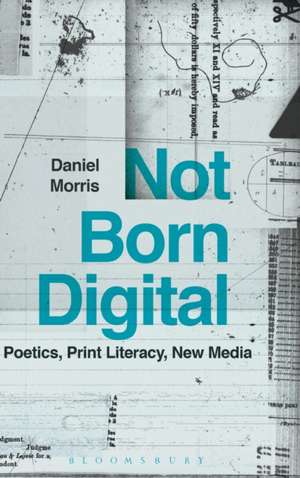
Not Born Digital: Poetics, Print Literacy, New Media
Autor Professor Daniel Morrisen Limba Engleză Hardback – 14 iul 2016
The premise of Not Born Digital is that the innovative contemporary poets studied in this book engage obscure and discarded, but nonetheless historically resonant materials to unsettle what Charles Bernstein, a leading innovative contemporary U.S. poet and critic of "official verse culture," refers to as "frame lock" and "tone jam." While other scholars have begun to analyze poetry that appears in new media contexts, Not Born Digital concerns the ambivalent ways page poets (rather than electronica based poets) have grappled with "screen memory" (that is, electronic and new media sources) through the re-purposing of "found" materials.
Preț: 828.54 lei
Preț vechi: 1245.15 lei
-33%
Puncte Express: 1243
Carte tipărită la comandă
Livrare economică 17 noiembrie-01 decembrie
Livrare prin curier în România Termenul estimat este afișat lângă disponibilitate.
Transport gratuit pentru acest produs Plată online sau ramburs, în funcție de opțiunile comenzii.
Retur gratuit în 14 zile Comandă securizată și suport în română.
Specificații
ISBN-13: 9781501316708
ISBN-10: 1501316702
Pagini: 266
Ilustrații: 4 b/w illustrations
Dimensiuni: 152 x 229 x 19 mm
Greutate: 0.53 kg
Editura: Bloomsbury Publishing
Colecția Bloomsbury Academic
Locul publicării:New York, United States
ISBN-10: 1501316702
Pagini: 266
Ilustrații: 4 b/w illustrations
Dimensiuni: 152 x 229 x 19 mm
Greutate: 0.53 kg
Editura: Bloomsbury Publishing
Colecția Bloomsbury Academic
Locul publicării:New York, United States
V-ar putea interesa
-
 ConfabulationsJohn Berger-31%Preț: 63.48 lei92.64 lei
 -
 -21%Preț: 174.41 lei219.76 lei
 -
 -20%Preț: 164.78 lei206.35 lei
 -
 Inside TradingMalcolm Bradbury-17%Preț: 85.08 lei102.36 lei
 -
 -15%Preț: 176.20 lei208.11 lei
 -
 Rise and Fall of the City of MahagonnyBertolt Brecht-41%Preț: 55.56 lei94.31 lei
 -
 North CountryTajinder Singh Hayer-24%Preț: 85.18 lei112.40 lei
 -
 Wild HoneyMichael Frayn-22%Preț: 108.32 lei139.47 lei
 -
 The Importance of Being Earnest & Other PlaysOscar Wilde-34%Preț: 51.97 lei78.47 lei
 -
 1001 Dark Nights: Bundle FiveJulie KennerPreț: 153.83 lei
 -
 #UntitledtwoKevin WilliamsonPreț: 90.74 lei
 -
 Preț: 205.79 lei
Cuprins
Introduction
Not Born Digital: Poetics, Print Literacy, New Media
Chapter One
Medium as Messenger: Hannah Weiner Anchors the Social Poetics of 1986 in Weeks
Chapter Two
A Blizzard of Snowflakes: Kenneth Goldsmith as Conceptualist at the Cusp of a Digital Age in Soliloquy
Chapter Three
(In)decisive Moments: On Kenneth Goldsmith's Seven American Deaths and Disasters
Chapter Four
"The wound track shows deeper hemorrhage": Kenneth Goldsmith's "The Body of Michael Brown" as The Eighth American Disaster
Chapter Five
Gaps in the Machine: Andrei Codrescu's Unarchival Poetics
Chapter Six
"Needing to Summon the Others": Archival Research as Séance in Susan Howe's Spontaneous Particulars
Chapter Seven
Bad Company, Meet Sonic Youth: On Noah Eli Gordon's Inbox: Social Media, Post Language Conceptual Poetics, and the Ethics of Online Appropriation
Chapter Eight
A Tonalism, Synaesthesia, Translation, and Post-Ableism in The Route
Chapter Nine
What Makes Poetry Happen: The Erotics of Literary Activism in an Age of Internet Virus
Bibliography
Index
Not Born Digital: Poetics, Print Literacy, New Media
Chapter One
Medium as Messenger: Hannah Weiner Anchors the Social Poetics of 1986 in Weeks
Chapter Two
A Blizzard of Snowflakes: Kenneth Goldsmith as Conceptualist at the Cusp of a Digital Age in Soliloquy
Chapter Three
(In)decisive Moments: On Kenneth Goldsmith's Seven American Deaths and Disasters
Chapter Four
"The wound track shows deeper hemorrhage": Kenneth Goldsmith's "The Body of Michael Brown" as The Eighth American Disaster
Chapter Five
Gaps in the Machine: Andrei Codrescu's Unarchival Poetics
Chapter Six
"Needing to Summon the Others": Archival Research as Séance in Susan Howe's Spontaneous Particulars
Chapter Seven
Bad Company, Meet Sonic Youth: On Noah Eli Gordon's Inbox: Social Media, Post Language Conceptual Poetics, and the Ethics of Online Appropriation
Chapter Eight
A Tonalism, Synaesthesia, Translation, and Post-Ableism in The Route
Chapter Nine
What Makes Poetry Happen: The Erotics of Literary Activism in an Age of Internet Virus
Bibliography
Index
Recenzii
This is one of the best studies to date of what happens to poetry and the poetic in our 'new media age.' Himself a poet, Daniel Morris understands as have few critics that the real effect of the digital on younger poets is to create an entirely new sense of materiality, of poetry as the archive of experience rather than a finished product. For the poets in question from Hannah Weiner to Juliana Spahr, it's not a matter of writing 'digital poetry' but of making use of the new constraints the digital puts upon us. The chapters on Kenneth Goldsmith's controversial writings are especially strong-and also eminently reasonable and good-humored.
As long as 'old' media persist, writers will worry, contest, play with, theorize, and explore their relationship to 'new' media. From this position, Daniel Morris reads across generations from Weiner and Howe, through Codrescu and Goldsmith, to 'experiments in digital citizenship' by Noah Eli Gordon, Durgin and Hofer, Spahr and Buuck, offering a careful and sometimes controversial poetics of convergence culture as these poets negotiate issues of personal and historical trauma, archiving, memory, witness, authorship, and some sort of human future.
As long as 'old' media persist, writers will worry, contest, play with, theorize, and explore their relationship to 'new' media. From this position, Daniel Morris reads across generations from Weiner and Howe, through Codrescu and Goldsmith, to 'experiments in digital citizenship' by Noah Eli Gordon, Durgin and Hofer, Spahr and Buuck, offering a careful and sometimes controversial poetics of convergence culture as these poets negotiate issues of personal and historical trauma, archiving, memory, witness, authorship, and some sort of human future.