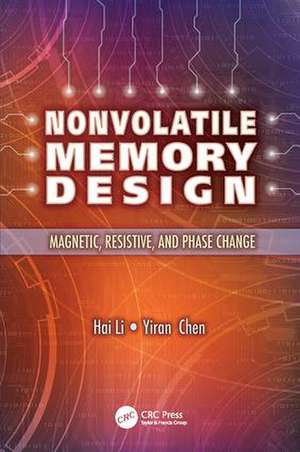
Nonvolatile Memory Design: Magnetic, Resistive, and Phase Change
Autor Hai Li, Yiran Chenen Limba Engleză Paperback – 29 mar 2017
Preț: 907.11 lei
Preț vechi: 1133.90 lei
-20%
Puncte Express: 1361
Carte tipărită la comandă
Livrare economică 05-19 decembrie
Livrare prin curier în România Termenul estimat este afișat lângă disponibilitate.
Transport gratuit pentru acest produs Plată online sau ramburs, în funcție de opțiunile comenzii.
Retur gratuit în 14 zile Comandă securizată și suport în română.
Specificații
ISBN-13: 9781138076631
ISBN-10: 1138076635
Pagini: 204
Ilustrații: 39; 10 Tables, black and white; 175 Illustrations, black and white
Dimensiuni: 156 x 234 x 11 mm
Greutate: 0.45 kg
Ediția:1
Editura: CRC Press
Colecția CRC Press
ISBN-10: 1138076635
Pagini: 204
Ilustrații: 39; 10 Tables, black and white; 175 Illustrations, black and white
Dimensiuni: 156 x 234 x 11 mm
Greutate: 0.45 kg
Ediția:1
Editura: CRC Press
Colecția CRC Press
V-ar putea interesa
-
 ARM System-on-Chip ArchitectureSteve Furber-18%Preț: 646.73 lei788.70 lei
 -
 Computer Architecture: A Quantitative ApproachJohn L. Hennessy-39%Preț: 539.22 lei882.55 lei
 -
 Volatile MemorySeth HaddonPreț: 107.10 lei
 -
 Design of Analog CMOS Integrated CircuitsBehzad Razavi-24%Preț: 402.12 lei530.56 lei
 -
 -26%Preț: 89.91 lei122.07 lei
 -
 -28%Preț: 198.39 lei274.31 lei
 -
 You Have a New MemoryAiden Arata-20%Preț: 131.59 lei164.49 lei
 -
 Hidden in MemoriesViveca StenPreț: 67.29 lei
 -
 Electrical Memory Materials and DevicesWen-Chang Chen-14%Preț: 1239.15 lei1440.87 lei
 -
 FlashlightSusan Choi-27%Preț: 99.11 lei135.81 leiRecomandat
 -
 -14%Preț: 1357.25 lei1578.20 lei
 -
 -24%Preț: 948.65 lei1248.22 lei
 -
 Charge-Trapping Non-Volatile MemoriesPanagiotis Dimitrakis-15%Preț: 665.43 lei782.86 lei
 -
 -24%Preț: 846.14 lei1113.34 lei
 -
 -9%Preț: 646.49 lei710.42 lei
 -
 Neuromorphic Circuits for Nanoscale DevicesPinaki Mazumder-5%Preț: 737.16 lei775.96 lei
 -
 Memristive ComputingYongbin Yu-18%Preț: 1048.96 lei1279.22 lei
Cuprins
Introduction to Semiconductor Memories. Phase Change Memory (PCM). Toggle-Mode MRAM (TM-MRAM). Spin-Torque Transfer RAM (STT -RAM). Resistive RAM (R-RAM). Memresistor. The Future of Nonvolatile Memory.
Descriere
The manufacture of flash memory, which is the dominant nonvolatile memory technology, is facing severe technical barriers. So much so, that some emerging technologies have been proposed as alternatives to flash memory in the nano-regime. Nonvolatile Memory Design: Magnetic, Resistive, and Phase Changing introduces three promising candidates: phase-change memory, magnetic random access memory, and resistive random access memory. The text illustrates the fundamental storage mechanism of these technologies and examines their differences from flash memory techniques. Based on the latest advances, the authors discuss key design methodologies as well as the various functions and capabilities of the three nonvolatile memory technologies.