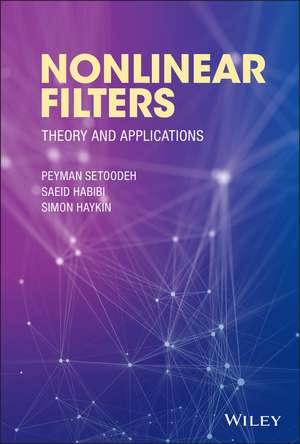
Nonlinear Filters
Autor Peyman Setoodehen Limba Engleză Hardback – 10 mar 2022
Preț: 841.60 lei
Preț vechi: 924.84 lei
-9%
Carte tipărită la comandă
Livrare economică 30 noiembrie-14 decembrie
Specificații
ISBN-10: 1118835816
Pagini: 304
Dimensiuni: 157 x 235 x 21 mm
Greutate: 0.58 kg
Editura: Wiley
Locul publicării:Hoboken, United States
V-ar putea interesa
-
 Service and Device DiscoveryGolden G. RichardPreț: 351.49 lei
-
 Preț: 347.56 lei
-
 Gigabit Ethernet for Metro Area NetworksPaul BedellPreț: 450.44 lei
-
 SNMP at the EdgeJonathan SaperiaPreț: 359.48 lei
-
 Wireless Data DemystifiedJohn VaccaPreț: 372.90 lei
-
 Packet Broadband Networking HandbookHaojin Wang-8%Preț: 444.68 lei483.35 lei
-
 Master Handbook of Audio ProductionJerry WhitakerPreț: 307.33 lei
-
 SoftswitchFrank OhrtmanPreț: 344.53 lei
-
 Concise Encyclopedia of RoboticsStan GibiliscoPreț: 143.57 lei
-
 Telecom AuditM S MastelPreț: 434.15 lei
-
 Wi-Fi SecurityStewart S. MillerPreț: 358.22 lei
-
 InsectronicsKarl WilliamsPreț: 145.52 lei
-
 Wireless Sensor NetworksAkyildiz-9%Preț: 816.16 lei896.88 lei
-
 Wireless Mobile InternetJamalipour-20%Preț: 829.31 lei1036.64 lei
-
 Ethernet Networks 4eHeld-20%Preț: 728.88 lei911.10 lei
-
 Wireless LANsBing-9%Preț: 791.30 lei869.55 lei
-
 Image ProcessingMann-9%Preț: 1052.87 lei1157.00 lei
-
 Character RecognitionCheriet-9%Preț: 969.42 lei1065.30 lei
-
 -9%Preț: 1826.07 lei2006.67 lei
-
 -9%Preț: 1199.04 lei1317.63 lei
-
 -9%Preț: 1393.62 lei1531.44 lei
-
 -9%Preț: 1199.61 lei1318.26 lei
-
 Analog Circuits and DevicesWai-Kai Chen-18%Preț: 1435.73 lei1750.89 lei
-
 Preț: 117.54 lei
-
 Decimation Lowpass Filters for Sigma-Delta ModulatorsRüdiger Kusch-23%Preț: 712.63 lei925.50 lei
Public țintă
Primary: Researchers, professors, and graduate students in electrical engineering, mechanical engineering, chemical engineering, biomedical engineering, sensor networks, data fusion, navigation and tracking, applied mathematics, economics, and robotics.Secondary: Professional engineers working with control systems, signal processing, communications, biomedical engineering, sensor networks, data fusion, navigation and tracking.
Notă biografică
Cuprins
List of Figures xiii
List of Table xv
Preface xvii
Acknowledgments xix
Acronyms xxi
1 Introduction 1
1.1 State of a Dynamic System 1
1.2 State Estimation 1
1.3 Construals of Computing 2
1.4 Statistical Modeling 3
1.5 Vision for the Book 4
2 Observability 7
2.1 Introduction 7
2.2 State-Space Model 7
2.3 The Concept of Observability 9
2.4 Observability of Linear Time-Invariant Systems 10
2.4.1 Continuous-Time LTI Systems 10
2.4.2 Discrete-Time LTI Systems 12
2.4.3 Discretization of LTI Systems 14
2.5 Observability of Linear Time-Varying Systems 14
2.5.1 Continuous-Time LTV Systems 14
2.5.2 Discrete-Time LTV Systems 16
2.5.3 Discretization of LTV Systems 17
2.6 Observability of Nonlinear Systems 17
2.6.1 Continuous-Time Nonlinear Systems 18
2.6.2 Discrete-Time Nonlinear Systems 21
2.6.3 Discretization of Nonlinear Systems 22
2.7 Observability of Stochastic Systems 23
2.8 Degree of Observability 25
2.9 Invertibility 26
2.10 Concluding Remarks 27
3 Observers 29
3.1 Introduction 29
3.2 Luenberger Observer 30
3.3 Extended Luenberger-Type Observer 31
3.4 Sliding-Mode Observer 33
3.5 Unknown-Input Observer 35
3.6 Concluding Remarks 39
4 Bayesian Paradigm and Optimal Nonlinear Filtering 41
4.1 Introduction 41
4.2 Bayes' Rule 42
4.3 Optimal Nonlinear Filtering 42
4.4 Fisher Information 45
4.5 Posterior Cramér-Rao Lower Bound 46
4.6 Concluding Remarks 47
5 Kalman Filter 49
5.1 Introduction 49
5.2 Kalman Filter 50
5.3 Kalman Smoother 53
5.4 Information Filter 54
5.5 Extended Kalman Filter 54
5.6 Extended Information Filter 54
5.7 Divided-Difference Filter 54
5.8 Unscented Kalman Filter 60
5.9 Cubature Kalman Filter 60
5.10 Generalized PID Filter 64
5.11 Gaussian-Sum Filter 65
5.12 Applications 67
5.12.1 Information Fusion 67
5.12.2 Augmented Reality 67
5.12.3 Urban Traffic Network 67
5.12.4 Cybersecurity of Power Systems 67
5.12.5 Incidence of Influenza 68
5.12.6 COVID-19 Pandemic 68
5.13 Concluding Remarks 70
6 Particle Filter 71
6.1 Introduction 71
6.2 Monte Carlo Method 72
6.3 Importance Sampling 72
6.4 Sequential Importance Sampling 73
6.5 Resampling 75
6.6 Sample Impoverishment 76
6.7 Choosing the Proposal Distribution 77
6.8 Generic Particle Filter 78
6.9 Applications 81
6.9.1 Simultaneous Localization and Mapping 81
6.10 Concluding Remarks 82
7 Smooth Variable-Structure Filter 85
7.1 Introduction 85
7.2 The Switching Gain 86
7.3 Stability Analysis 90
7.4 Smoothing Subspace 93
7.5 Filter Corrective Term for Linear Systems 96
7.6 Filter Corrective Term for Nonlinear Systems 102
7.7 Bias Compensation 105
7.8 The Secondary Performance Indicator 107
7.9 Second-Order Smooth Variable Structure Filter 108
7.10 Optimal Smoothing Boundary Design 108
7.11 Combination of SVSF with Other Filters 110
7.12 Applications 110
7.12.1 Multiple Target Tracking 111
7.12.2 Battery State-of-Charge Estimation 111
7.12.3 Robotics 111
7.13 Concluding Remarks 111
8 Deep Learning 113
8.1 Introduction 113
8.2 Gradient Descent 114
8.3 Stochastic Gradient Descent 115
8.4 Natural Gradient Descent 119
8.5 Neural Networks 120
8.6 Backpropagation 122
8.7 Backpropagation Through Time 122
8.8 Regularization 122
8.9 Initialization 125
8.10 Convolutional Neural Network 125
8.11 Long Short-Term Memory 127
8.12 Hebbian Learning 129
8.13 Gibbs Sampling 131
8.14 Boltzmann Machine 131
8.15 Autoencoder 135
8.16 Generative Adversarial Network 136
8.17 Transformer 137
8.18 Concluding Remarks 139
9 Deep Learning-Based Filters 141
9.1 Introduction 141
9.2 Variational Inference 142
9.3 Amortized Variational Inference 144
9.4 Deep Kalman Filter 144
9.5 Backpropagation Kalman Filter 146
9.6 Differentiable Particle Filter 148
9.7 Deep Rao-Blackwellized Particle Filter 152
9.8 Deep Variational Bayes Filter 158
9.9 Kalman Variational Autoencoder 167
9.10 Deep Variational Information Bottleneck 172
9.11 Wasserstein Distributionally Robust Kalman Filter 176
9.12 Hierarchical Invertible Neural Transport 178
9.13 Applications 182
9.13.1 Prediction of Drug Effect 182
9.13.2 Autonomous Driving 183
9.14 Concluding Remarks 183
10 Expectation Maximization 185
10.1 Introduction 185
10.2 Expectation Maximization Algorithm 185
10.3 Particle Expectation Maximization 188
10.4 Expectation Maximization for Gaussian Mixture Models 190
10.5 Neural Expectation Maximization 191
10.6 Relational Neural Expectation Maximization 194
10.7 Variational Filtering Expectation Maximization 196
10.8 Amortized Variational Filtering Expectation Maximization 198
10.9 Applications 199
10.9.1 Stochastic Volatility 199
10.9.2 Physical Reasoning 200
10.9.3 Speech, Music, and Video Modeling 200
10.10 Concluding Remarks 201
11 Reinforcement Learning-Based Filter 203
11.1 Introduction 203
11.2 Reinforcement Learning 204
11.3 Variational Inference as Reinforcement Learning 207
11.4 Application 210
11.4.1 Battery State-of-Charge Estimation 210
11.5 Concluding Remarks 210
12 Nonparametric Bayesian Models 213
12.1 Introduction 213
12.2 Parametric vs Nonparametric Models 213
12.3 Measure-Theoretic Probability 214
12.4 Exchangeability 219
12.5 Kolmogorov Extension Theorem 221
12.6 Extension of Bayesian Models 223
12.7 Conjugacy 224
12.8 Construction of Nonparametric Bayesian Models 226
12.9 Posterior Computability 227
12.10 Algorithmic Sufficiency 228
12.11 Applications 232
12.11.1 Multiple Object Tracking 233
12.11.2 Data-Driven Probabilistic Optimal Power Flow 233
12.11.3 Analyzing Single-Molecule Tracks 233
12.12 Concluding Remarks 233
References 235
Index 253