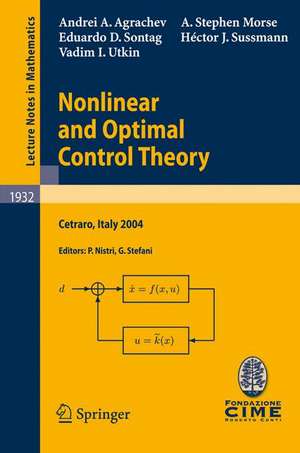
Nonlinear and Optimal Control Theory
Autor Andrei A. Agrachev, A. Stephen Morse, Eduardo D. Sontag, Hector J. Sussmann, Vadim I. Utkin Editat de Paolo Nistri, Gianna Stefanien Limba Engleză Paperback – 28 mar 2008
Preț: 475.31 lei
Puncte Express: 713
Carte tipărită la comandă
Livrare economică 05-19 decembrie
Livrare prin curier în România Termenul estimat este afișat lângă disponibilitate.
Transport gratuit pentru acest produs Plată online sau ramburs, în funcție de opțiunile comenzii.
Retur gratuit în 14 zile Comandă securizată și suport în română.
Specificații
ISBN-13: 9783540776444
ISBN-10: 3540776443
Pagini: 376
Ilustrații: XIV, 360 p. 78 illus.
Dimensiuni: 155 x 235 x 21 mm
Greutate: 0.57 kg
Ediția:2008
Editura: Springer
Locul publicării:Berlin, Heidelberg, Germany
ISBN-10: 3540776443
Pagini: 376
Ilustrații: XIV, 360 p. 78 illus.
Dimensiuni: 155 x 235 x 21 mm
Greutate: 0.57 kg
Ediția:2008
Editura: Springer
Locul publicării:Berlin, Heidelberg, Germany
V-ar putea interesa
-
 The Designer's Guide to VHDLPeter J. Ashenden-34%Preț: 375.93 lei572.56 lei
 -
 The Computer and the BrainJohn Von NeumannPreț: 113.01 lei
 -
 Introduction ModelicaFritzson-8%Preț: 452.76 lei492.13 lei
 -
 Optimal Estimation of Dynamic SystemsJohn L. Crassidis-18%Preț: 1494.88 lei1823.02 lei
 -
 Mathematical Control TheoryEduardo D. Sontag-15%Preț: 515.66 lei606.66 lei
 -
 Perturbation Analysis of Optimization ProblemsJ.Frederic Bonnans-18%Preț: 1341.26 lei1635.67 lei
 -
 Stochastic Networked Control SystemsSerdar Yüksel-18%Preț: 995.63 lei1214.17 lei
 -
 Stochastic Networked Control SystemsSerdar Yüksel-18%Preț: 909.87 lei1109.60 lei
 -
 -18%Preț: 918.59 lei1120.23 lei
 -
 Modeling and Control of Discrete-Event Dynamic SystemsBranislav Hrúz-15%Preț: 471.15 lei554.30 lei
 -
 Introducing ChaosIwona AbramsPreț: 64.56 lei
 -
 Model-Based Control of Networked SystemsEloy Garcia-15%Preț: 675.30 lei794.47 lei
 -
 Introduction to Time-Delay Systems: Analysis and ControlEmilia Fridman-46%Preț: 513.77 lei945.44 lei
Public țintă
ResearchCuprins
Geometry of Optimal Control Problems and Hamiltonian Systems.- Lecture Notes on Logically Switched Dynamical Systems.- Input to State Stability: Basic Concepts and Results.- Generalized Differentials, Variational Generators, and the Maximum Principle with State Constraints.- Sliding Mode Control: Mathematical Tools, Design and Applications.
Textul de pe ultima copertă
The lectures gathered in this volume present some of the different aspects of Mathematical Control Theory. Adopting the point of view of Geometric Control Theory and of Nonlinear Control Theory, the lectures focus on some aspects of the Optimization and Control of nonlinear, not necessarily smooth, dynamical systems. Specifically, three of the five lectures discuss respectively: logic-based switching control, sliding mode control and the input to the state stability paradigm for the control and stability of nonlinear systems. The remaining two lectures are devoted to Optimal Control: one investigates the connections between Optimal Control Theory, Dynamical Systems and Differential Geometry, while the second presents a very general version, in a non-smooth context, of the Pontryagin Maximum Principle. The arguments of the whole volume are self-contained and are directed to everyone working in Control Theory. They offer a sound presentation of the methods employed in the control and optimization of nonlinear dynamical systems.