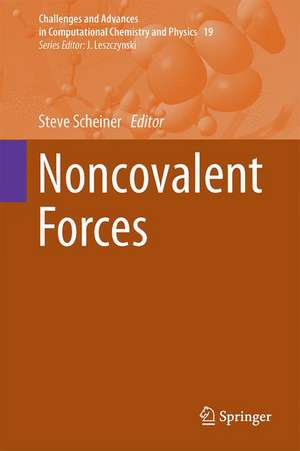
Noncovalent Forces: Challenges and Advances in Computational Chemistry and Physics, cartea 19
Editat de Steve Scheineren Limba Engleză Hardback – 6 mai 2015
Observăm cu interes modul în care Noncovalent Forces reușește să sintetizeze un domeniu vast prin prisma interdisciplinarității, conectând chimia cuantică și computațională cu aplicații directe în farmacologie și știința materialelor. Volumul, editat de Steve Scheiner, reprezintă al 19-lea titlu din prestigioasa serie Challenges and Advances in Computational Chemistry and Physics, oferind o perspectivă tehnică asupra forțelor care guvernează recunoașterea moleculară. Considerăm că această lucrare completează perspectiva oferită de Non-Covalent Interactions in the Synthesis and Design of New Compounds de Abel M. Maharramov. În timp ce volumul lui Maharramov se concentrează pe rolul acestor forțe în sinteza organică și anorganică, Noncovalent Forces adaugă o rigoare computațională sporită, explorând stadiul actual al metodelor teoretice necesare pentru a categorisi interacțiunile în regimuri intermediare. Notăm, de asemenea, o legătură conceptuală cu Hydrogen Bonding - New Insights de Slawomir Grabowski, însă volumul de față extinde analiza dincolo de punțile de hidrogen clasice, către legături de tip pnicogen, calcogen sau tetrel. Poziționată în contextul operei editorului, această carte extinde cercetările prezentate în lucrarea sa anterioară, Hydrogen Bonding. Dacă acea ediție se concentra strict pe natura fundamentală a legăturii de hidrogen prin calcule cuantice, noul volum lărgește cadrul analitic pentru a include forțe mai exotice, precum legăturile de dihidrogen și interacțiunile care implică radicali. Structura cărții urmărește o progresie logică a intensității forțelor: începe cu interacțiunile ionice puternice, trece prin complexitatea legăturilor de halogen și pnicogen, și culminează cu forțele slabe, precum cele specifice gazelor rare. Această organizare permite cercetătorului să navigheze rapid între fundamentele teoretice și studiile de caz privind cooperativitatea la nivel supramolecular.
Din seria Challenges and Advances in Computational Chemistry and Physics
- 18%
 Preț: 915.13 lei
 - 18%
 Preț: 938.86 lei
 - 24%
 Preț: 1403.36 lei
 - 24%
 Preț: 1143.34 lei
 - 18%
 Preț: 1187.48 lei
 - 18%
 Preț: 1762.21 lei
 - 18%
 Preț: 2017.58 lei
 - 18%
 Preț: 1181.56 lei
 - 18%
 Preț: 1198.26 lei
 - 24%
 Preț: 2223.85 lei
 - 18%
 Preț: 1193.41 lei
 - 18%
 Preț: 2411.64 lei
 - 18%
 Preț: 2416.34 lei
 - 18%
 Preț: 1087.26 lei
 - 18%
 Preț: 1081.55 lei
 - 18%
 Preț: 755.90 lei
 - 18%
 Preț: 925.28 lei
 - 18%
 Preț: 1756.30 lei
 - 18%
 Preț: 1071.02 lei
 - 15%
 Preț: 622.11 lei
 - 18%
 Preț: 1062.83 lei
 - 18%
 Preț: 1079.51 lei
 - 24%
 Preț: 1247.17 lei
 - 18%
 Preț: 1072.55 lei
 - 24%
 Preț: 1249.45 lei
 - 24%
 Preț: 1257.03 lei
 - 18%
 Preț: 1773.44 lei
 - 24%
 Preț: 2123.87 lei
 - 18%
 Preț: 1751.31 lei
 - 18%
 Preț: 1175.96 lei
 - 18%
 Preț: 1764.35 lei
Preț: 1366.04 lei
Preț vechi: 1665.91 lei
-18%
Carte tipărită la comandă
Livrare economică 03-17 iulie
Specificații
ISBN-10: 3319141627
Pagini: 540
Ilustrații: VIII, 532 p. 256 illus., 200 illus. in color.
Dimensiuni: 160 x 241 x 35 mm
Greutate: 0.97 kg
Ediția:2015
Editura: Springer
Colecția Challenges and Advances in Computational Chemistry and Physics
Seria Challenges and Advances in Computational Chemistry and Physics
Locul publicării:Cham, Switzerland
V-ar putea interesa
-
 Quantum Theory: A Very Short IntroductionJohn Polkinghorne-22%Preț: 53.44 lei68.51 lei
 -
 Bonding and Structure of Molecules and SolidsD. G. Pettifor-24%Preț: 355.67 lei466.31 lei
 -
 -27%Preț: 513.67 lei698.89 lei
 -
 The Lost Elements: The Periodic Table's Shadow SideMarco Fontani-15%Preț: 356.39 lei418.58 lei
 -
 Molecular Quantum MechanicsPeter W. Atkins-19%Preț: 480.47 lei593.17 lei
 -
 Quantum Mechanics: Theory and ExperimentMark Beck-25%Preț: 846.72 lei1135.90 lei
 -
 Molecular Symmetry and Group TheoryAlan VincentPreț: 306.86 lei
 -
 Unimolecular ReactionsWendell Forst-9%Preț: 802.81 lei882.21 lei
 -
 Discovering ChemistryFrank Weinhold-8%Preț: 550.88 lei598.79 lei
 -
 Molecular Electronic-Structure TheoryJeppe Olsen-19%Preț: 543.21 lei670.63 lei
Public țintă
ResearchDe ce să citești această carte
Această resursă este esențială pentru cercetătorii din chimia computațională și designul de medicamente. Cititorul câștigă o înțelegere profundă a metodelor cuantice aplicate în predicția structurilor cristaline și a stabilității moleculare. Este o recomandare certă pentru cei care doresc să stăpânească nuanțele forțelor intermoleculare dincolo de legătura de hidrogen clasică, beneficiind de un aparat teoretic de ultimă oră.
Despre autor
Steve Scheiner este un reputat specialist în chimie cuantică și profesor a cărui activitate s-a concentrat pe studiul forțelor intermoleculare. În calitate de editor al acestui volum din seria Challenges and Advances in Computational Chemistry and Physics, el aduce o vastă experiență în utilizarea metodelor computaționale pentru a elucida structura electronică. Lucrările sale anterioare, precum Hydrogen Bonding, au pus bazele înțelegerii modului în care simulările numerice pot accesa suprafețe de energie potențială inaccesibile prin metode experimentale, transformându-l într-o figură centrală în chimia teoretică contemporană.
Descriere scurtă
Cuprins
Notă biografică
Education
B.S. (Chemistry) City College of New York
May, 1972
A.M. (Chemistry) Harvard University
May, 1974
Ph.D. (Chemical Physics) Harvard University