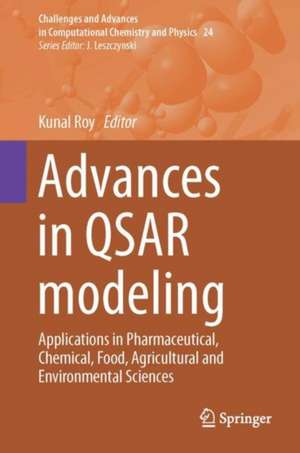
Advances in QSAR Modeling: Challenges and Advances in Computational Chemistry and Physics, cartea 24
Editat de Kunal Royen Limba Engleză Hardback – 7 iun 2017
The book covers theoretical background and methodology as well as all current applications of Quantitative Structure-Activity Relationships (QSAR). Written by an international group of recognized researchers, this edited volume discusses applications of QSAR in multiple disciplines such as chemistry, pharmacy, environmental and agricultural sciences addressing data gaps and modern regulatory requirements. Additionally, the applications of QSAR in food science and nanoscience have been included – two areas which have only recently been able to exploit this versatile tool.
This timely addition to the series is aimed at graduate students, academics and industrial scientists interested in the latest advances and applications of QSAR.
Din seria Challenges and Advances in Computational Chemistry and Physics
- 18%
 Preț: 956.93 lei
 - 18%
 Preț: 969.78 lei
 - 24%
 Preț: 1403.36 lei
 - 18%
 Preț: 1403.45 lei
 - 24%
 Preț: 2223.85 lei
 - 18%
 Preț: 1231.27 lei
 - 18%
 Preț: 2416.34 lei
 - 18%
 Preț: 1161.67 lei
 - 18%
 Preț: 1124.27 lei
 - 18%
 Preț: 790.73 lei
 - 18%
 Preț: 966.99 lei
 - 18%
 Preț: 1119.32 lei
 - 15%
 Preț: 646.61 lei
 - 18%
 Preț: 1110.16 lei
 - 24%
 Preț: 1067.72 lei
 - 24%
 Preț: 1182.84 lei
 - 24%
 Preț: 1247.17 lei
 - 24%
 Preț: 1051.18 lei
 - 24%
 Preț: 1249.45 lei
 - 24%
 Preț: 1298.74 lei
 - 24%
 Preț: 1170.36 lei
Preț: 2411.64 lei
Preț vechi: 2941.02 lei
-18%
Puncte Express: 3617
Carte tipărită la comandă
Livrare economică 18 noiembrie-02 decembrie
Livrare prin curier în România Termenul estimat este afișat lângă disponibilitate.
Transport gratuit pentru acest produs Plată online sau ramburs, în funcție de opțiunile comenzii.
Retur gratuit în 14 zile Comandă securizată și suport în română.
Specificații
ISBN-13: 9783319568492
ISBN-10: 3319568493
Pagini: 568
Ilustrații: X, 555 p. 132 illus., 71 illus. in color.
Dimensiuni: 160 x 241 x 36 mm
Greutate: 1.01 kg
Ediția:1st edition 2017
Editura: Springer
Colecția Challenges and Advances in Computational Chemistry and Physics
Seria Challenges and Advances in Computational Chemistry and Physics
Locul publicării:Cham, Switzerland
ISBN-10: 3319568493
Pagini: 568
Ilustrații: X, 555 p. 132 illus., 71 illus. in color.
Dimensiuni: 160 x 241 x 36 mm
Greutate: 1.01 kg
Ediția:1st edition 2017
Editura: Springer
Colecția Challenges and Advances in Computational Chemistry and Physics
Seria Challenges and Advances in Computational Chemistry and Physics
Locul publicării:Cham, Switzerland
V-ar putea interesa
-
 -11%Preț: 531.89 lei598.12 lei
 -
 -26%Preț: 919.44 lei1243.23 lei
 -
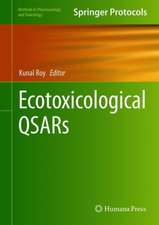 Ecotoxicological QSARsKunal Roy-5%Preț: 1470.57 lei1547.97 lei
 -
 -5%Preț: 1950.55 lei2053.21 lei
 -
 -18%Preț: 945.22 lei1152.71 lei
 -
 -5%Preț: 1582.37 lei1665.65 lei
 -
 Cobalt: Occurrence, Uses & PropertiesYamato Kobayashi-26%Preț: 1224.43 lei1664.08 lei
 -
 Preț: 383.27 lei
 -
 Protein ModellingAndrew Gamble-15%Preț: 627.06 lei737.72 lei
 -
 The DV-X¿ Molecular-Orbital Calculation MethodTomohiko Ishii-15%Preț: 653.43 lei768.75 lei
 -
 A Primer on QSAR/QSPR ModelingKunal RoyPreț: 431.51 lei
 -
 Quantum Dynamics and Laser Control for PhotochemistryMatthieu Sala-15%Preț: 651.99 lei767.05 lei
 -
 The Quantum GambleJan C. A. Boeyens-15%Preț: 700.11 lei823.66 lei
 -
 Preț: 483.53 lei
 -
 -15%Preț: 615.52 lei724.14 lei
 -
 Molecular Solid State PhysicsGeorge G. HallPreț: 383.03 lei
 -
 Research in Atomic StructureS. Fraga-15%Preț: 636.47 lei748.79 lei
 -
 -15%Preț: 635.39 lei747.52 lei
 -
 Potential Energy SurfacesAlexander F. Sax-15%Preț: 641.11 lei754.26 lei
 -
 Orbitals in ChemistrySatoshi Inagaki-18%Preț: 1824.32 lei2224.78 lei
 -
 -15%Preț: 640.69 lei753.76 lei
 -
 Preț: 377.32 lei
 -
 -9%Preț: 709.47 lei779.63 lei
 -
 Life of a ScientistRobert S. MullikenPreț: 293.98 lei
 -
 Dynamics During Spectroscopic TransitionsErnst LippertPreț: 410.62 lei
 -
 Crystal Fields for Transition-Metal Ions in Laser Host MaterialsClyde A. MorrisonPreț: 368.79 lei
 -
 -15%Preț: 644.00 lei757.65 lei
 -
 Four Weeks - The BeginningKunal RoyPreț: 169.76 lei
 -
 Group Theory Applied to ChemistryArnout Jozef Ceulemans-22%Preț: 417.45 lei538.33 lei
Cuprins
Performance parameters and validation practices in QSAR modeling.- Towards interpretable QSAR models.- The use of topological indices in QSAR and QSPR modeling.- The Maximum Common Substructure (MCS) search as a new tool for SAR and QSAR.- The universal approach for structural and physico-chemical interpretation of QSAR/QSPR models.- Generative Topographic Mapping approach.- Monte Carlo methods for solution of tasks in Environmental Sciences.- QSAR in Environmental Research.- QSAR applications for environmental chemical prioritization: Biotransformation of chemicals.- QSAR modeling in environmental risk assessment: application to the prediction of pesticide toxicity.- Counter propagation artificial neural network (CP ANN) models for prediction of carcinogenicity of non congeneric chemicals for regulatory uses.- Strategy for identification of critical nanomaterials properties linked to biological impacts: interlinking of experimental and computational approaches.- QSAR/QSPR modeling inthe design of drug candidates with balanced pharmacodynamics and pharmacokinetic properties.- Molecular modeling of food chemicals as potential bioactive compounds.- On application QSARs in Food and Agricultural Sciences: History and Recent Developments.
Notă biografică
Prof. Dr. Kunal Roy is a Professor of the Drug Theoretics and Cheminformatics Laboratory, Department of Pharmaceutical Technology Jadavpur University, Kolkata India. He was previously a Marie Curie International Incoming Fellow and Commonwealth Academic Staff Fellow at the University of Manchester, UK. Prof. Roy has published over 240 articles in peer reviewed journals, two books, one edited book as well as ten book chapters.
Textul de pe ultima copertă
The book covers theoretical background and methodology as well as all current applications of Quantitative Structure-Activity Relationships (QSAR). Written by an international group of recognized researchers, this edited volume discusses applications of QSAR in multiple disciplines such as chemistry, pharmacy, environmental and agricultural sciences addressing data gaps and modern regulatory requirements. Additionally, the applications of QSAR in food science and nanoscience have been included – two areas which have only recently been able to exploit this versatile tool.
This timely addition to the series is aimed at graduate students, academics and industrial scientists interested in the latest advances and applications of QSAR.
Caracteristici
An interdisciplinary overview of recent advances in methodology and all areas of QSAR applications Includes traditional and non-traditional applications of QSAR found in Food Science and Nanoscience Of interest to experimentalists as well as theoreticians Includes supplementary material: sn.pub/extras