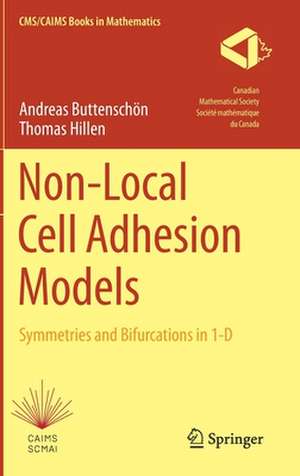
Non-Local Cell Adhesion Models: CMS/CAIMS Books in Mathematics, cartea 1
Autor Andreas Buttenschön, Thomas Hillenen Limba Engleză Hardback – 10 iun 2021




Preț: 751.73 lei
Preț vechi: 916.74 lei
-18%
Puncte Express: 1128
Carte tipărită la comandă
Livrare economică 07-21 decembrie
Livrare prin curier în România Termenul estimat este afișat lângă disponibilitate.
Transport gratuit pentru acest produs Plată online sau ramburs, în funcție de opțiunile comenzii.
Retur gratuit în 14 zile Comandă securizată și suport în română.
Specificații
ISBN-13: 9783030671105
ISBN-10: 3030671100
Pagini: 160
Ilustrații: VIII, 152 p. 35 illus., 15 illus. in color.
Dimensiuni: 160 x 241 x 15 mm
Greutate: 0.36 kg
Ediția:1st ed. 2021
Editura: Springer
Colecția CMS/CAIMS Books in Mathematics
Seria CMS/CAIMS Books in Mathematics
Locul publicării:Cham, Switzerland
ISBN-10: 3030671100
Pagini: 160
Ilustrații: VIII, 152 p. 35 illus., 15 illus. in color.
Dimensiuni: 160 x 241 x 15 mm
Greutate: 0.36 kg
Ediția:1st ed. 2021
Editura: Springer
Colecția CMS/CAIMS Books in Mathematics
Seria CMS/CAIMS Books in Mathematics
Locul publicării:Cham, Switzerland
Cuprins
Introduction.- Preliminaries.- The Periodic Problem.- Basic Properties.- Local Bifurcation.- Global Bifurcation.- Non-local Equations with Boundary Conditions.- No-flux Boundary Conditions.- Discussion and future directions.
Recenzii
“Modelers who wish to use similar approaches in their modeling will find this a good source of base information, as well as a valuable guide for initiating similar analyses for their own models. Analysts wishing to expand our understanding … will find this book a fine building block. It could also prove a useful resource for graduate students looking for potential projects … . this monograph is an admirable attempt … and hopefully will inspire significant further study.” (Kevin Painter, SIAM Review, Vol. 64 (1), March, 2022)
Textul de pe ultima copertă
This monograph considers the mathematical modeling of cellular adhesion, a key interaction force in cell biology. While deeply grounded in the biological application of cell adhesion and tissue formation, this monograph focuses on the mathematical analysis of non-local adhesion models. The novel aspect is the non-local term (an integral operator), which accounts for forces generated by long ranged cell interactions. The analysis of non-local models has started only recently, and it has become a vibrant area of applied mathematics. This monograph contributes a systematic analysis of steady states and their bifurcation structure, combining global bifurcation results pioneered by Rabinowitz, equivariant bifurcation theory, and the symmetries of the non-local term. These methods allow readers to analyze and understand cell adhesion on a deep level.
Caracteristici
Presents the first ever application of abstract bifurcation theory to a non-local problem Includes leading research on pattern formation of non-local models Describes in detail the development of basic properties of nonlocal adhesion models Defines biological non-local boundary conditions