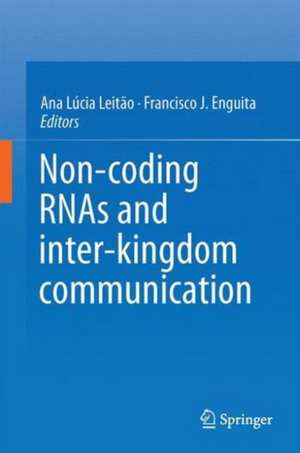
Non-coding RNAs and Inter-kingdom Communication
Editat de Ana Lúcia Leitão, Francisco J. Enguitaen Limba Engleză Hardback – 9 aug 2016
Subliniem valoarea aplicată a acestui volum prin studiile de caz detaliate, de la mecanismele prin care bacteriile Streptomyces își semnalizează prezența, până la rolul ARN-urilor mici în formarea chisturilor la Azotobacter vinelandii. Considerăm că forța acestei lucrări rezidă în capacitatea de a transforma concepte teoretice complexe în exemple biologice concrete, precum interacțiunea fascinantă dintre Wolbachia și țânțari sau modul în care C. elegans reacționează la stimulii ARN din mediul înconjurător. Descoperim aici o perspectivă integrată asupra comunicării inter-regnuri, un domeniu care redefinește înțelegerea noastră despre simbioză și patogenie. Volumul este organizat riguros în două părți fundamentale. Prima parte se concentrează pe interacțiunile bacteriene și virale cu diferite gazde, explorând „materia întunecată” a manipulării microbiene și relația simbiotică dintre microbiota intestinală și expresia genelor umane prin intermediul microARN-urilor. A doua parte extinde analiza către organismele eucariote, abordând evoluția rapidă a căilor ncRNA la insecte și comunicarea ipotetică prin ARN mic între plante și mamifere. Această structură progresivă ghidează cititorul de la mecanisme moleculare fundamentale la implicații sistemice complexe. Această lucrare completează perspectiva oferită de Roles of Host Gene and Non-coding RNA Expression in Virus Infection, adăugând o dimensiune mult mai largă care depășește sfera virală pentru a include regnul fungic, protozoarele și interacțiunile complexe plantă-animal. În timp ce alte titluri, precum Small RNAs:, se concentrează pe strategii generale de descoperire și validare, volumul coordonat de Ana Lúcia Leitão și Francisco J. Enguita pune accentul pe funcția de mesager a ARN-ului necodant în medierea relațiilor funcționale dintre specii complet diferite.
Preț: 984.66 lei
Preț vechi: 1200.80 lei
-18%
Carte disponibilă
Livrare economică 10-24 noiembrie
Specificații
ISBN-10: 3319394940
Pagini: 260
Ilustrații: VIII, 251 p. 42 illus., 33 illus. in color.
Dimensiuni: 160 x 241 x 19 mm
Greutate: 0.55 kg
Ediția:1st ed. 2016
Editura: Springer
Locul publicării:Cham, Switzerland
V-ar putea interesa
-
 -18%Preț: 980.83 lei1196.14 lei
 -
 Use of Microbes for the Alleviation of Soil Stresses, Volume 1Mohammad Miransari-15%Preț: 662.81 lei779.78 lei
 -
 Mollicutes: Molecular Biology and PathogenesisGlenn F. Browning-9%Preț: 1328.91 lei1460.35 lei
 -
 Applications of Molecular Microbiological MethodsTorben L Skovhus-9%Preț: 1381.61 lei1518.25 lei
 -
 Campylobacter Ecology and EvolutionSamuel K. Sheppard-9%Preț: 1344.05 lei1476.98 lei
 -
 Preț: 376.81 lei
 -
 Bacteria-Metal InteractionsDaad Saffarini-15%Preț: 658.85 lei775.11 lei
 -
 Environmental Microbial BiotechnologyLala Behari Sukla-18%Preț: 989.88 lei1207.17 lei
 -
 Metal Response in Cupriavidus metalliduransGuy VandenbusschePreț: 378.17 lei
 -
 Handbook of Arbuscular Mycorrhizal FungiTancredo Souza-18%Preț: 960.03 lei1170.76 lei
 -
 Handbook of the ProtistsJohn M. Archibald-18%Preț: 5863.79 lei7150.96 lei
 -
 -8%Preț: 466.39 lei506.95 lei
 -
 Microbial PhenazinesSudhir Chincholkar-18%Preț: 982.74 lei1198.47 lei
 -
 Microbes at WorkHeribert Insam-18%Preț: 1191.27 lei1452.77 lei
 -
 -15%Preț: 474.38 lei558.10 lei
 -
 Die Biotechnologie-IndustrieJulia Schüler-15%Preț: 514.43 lei605.22 lei
 -
 Mining The Genomes Of ActinomycetesJohannes Amon-8%Preț: 425.10 lei462.06 lei
 -
 Potentiel thérapeutique de peptides antimicrobiens équinsMargot Schlusselhuber-19%Preț: 613.80 lei757.77 lei
 -
 Preț: 375.25 lei
 -
 La Fungicultura y El Desarrollo Sostenible En La Orinoquia Colombiana: Descifrando Las Claves del OlvidoJairo Ricardo Hernández NiñoPreț: 313.99 lei
 -
 Preț: 376.08 lei
 -
 Advances in Endophytic ResearchVijay C. Verma-18%Preț: 1284.17 lei1566.05 lei
 -
 Laboratory Manual of BiochemistryR. S. Sengar-8%Preț: 584.55 lei635.38 lei
De ce să citești această carte
Această carte este esențială pentru cercetătorii și studenții avansați în microbiologie și biologie moleculară care doresc să înțeleagă cum comunică organismele la nivel molecular. Cititorul câștigă o viziune de ansamblu asupra modului în care ARN-ul necodant dictează succesul unei infecții sau stabilitatea unei simbioze, oferind argumente solide pentru viitoare aplicații terapeutice și biotehnologice în controlul patogenilor.
Despre autor
Volumul este editat de Ana Lúcia Leitão și Francisco J. Enguita, specialiști recunoscuți în domeniul geneticii și microbiologiei moleculare. Francisco J. Enguita activează în cadrul Institutului de Medicină Moleculară din Lisabona, având o expertiză vastă în studiul ARN-urilor necodante și al mecanismelor de reglare genică. Colaborarea lor pentru acest volum publicat de Springer reflectă o abordare multidisciplinară, reunind contribuții de la experți internaționali pentru a cartografia noile roluri ale moleculelor de ARN la peste șase decenii de la primele teorii despre codul genetic.
Descriere scurtă
Cuprins
Notă biografică
Caracteristici
Enriches readers’ understanding of the interactions between organisms belonging to different kingdoms
Offers a unique, state-of-the-art compilation of ideas on new roles of non-coding RNAs
Includes supplementary material: sn.pub/extras