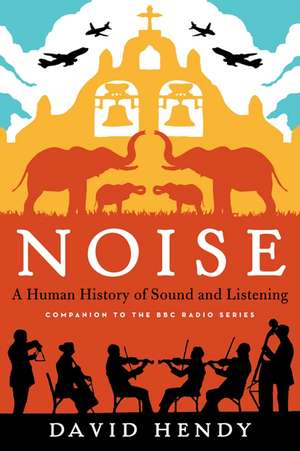
Noise: A Human History of Sound and Listening
Autor David Hendyen Limba Engleză Paperback – 25 aug 2014
| Toate formatele și edițiile | Preț | Express |
|---|---|---|
| Paperback (2) | 71.54 lei 3-5 săpt. | +30.27 lei 6-12 zile |
| Profile – 13 feb 2014 | 71.54 lei 3-5 săpt. | +30.27 lei 6-12 zile |
| HarperCollins Publishers – 25 aug 2014 | 90.49 lei 3-5 săpt. |
Preț: 90.49 lei
Puncte Express: 136
Preț estimativ în valută:
15.99€ • 18.55$ • 13.95£
15.99€ • 18.55$ • 13.95£
Carte disponibilă
Livrare economică 26 martie-09 aprilie
Specificații
ISBN-13: 9780062283085
ISBN-10: 0062283081
Pagini: 400
Dimensiuni: 135 x 203 x 16 mm
Greutate: 0.3 kg
Editura: HarperCollins Publishers
Colecția Ecco
ISBN-10: 0062283081
Pagini: 400
Dimensiuni: 135 x 203 x 16 mm
Greutate: 0.3 kg
Editura: HarperCollins Publishers
Colecția Ecco
V-ar putea interesa
-
 The Victorian HouseJudith FlandersPreț: 117.05 lei
 -
 Aristocracy: A Very Short IntroductionWilliam Doyle-22%Preț: 52.81 lei67.54 lei
 -
 Life On Air: A History of Radio FourDavid Hendy-16%Preț: 105.41 lei125.67 lei
 -
 -18%Preț: 166.83 lei203.78 lei
 -
 By Steppe, Desert, and Ocean: The Birth of EurasiaBarry Cunliffe-22%Preț: 167.91 lei215.98 lei
 -
 Despotism, Social Evolution, and Differential ReproductionLaura L. BetzigPreț: 456.80 lei
 -
 Public Service BroadcastingDavid HendyPreț: 195.05 lei
 -
 Making Arms in the Machine AgeJames J. FarleyPreț: 226.82 lei
 -
 Brazil: The Troubled Rise of a Global PowerMichael ReidPreț: 127.48 lei
 -
 A Little History of ArchaeologyBrian FaganPreț: 86.18 lei
 -
 Radio in the Global AgeDavid HendyPreț: 215.51 lei
 -
 Che's Chevrolet, Fidel's OldsmobileRichard SchweidPreț: 206.84 lei
 -
 BaseballGeorge VecseyPreț: 110.36 lei
 -
 Harlan Miners SpeakMembers of the National Committee for the DefensePreț: 223.12 lei
 -
 To Rise in DarknessAldo A Lauria-SantiagoPreț: 276.85 lei
 -
 Treatise on Slavery: Selections from De Instauranda Aethiopum SaluteAlonso de Sandoval-12%Preț: 111.16 lei125.77 lei
 -
 Victorian CityJudith FlandersPreț: 225.43 lei
 -
 Historically Black Colleges and UniversitiesCharles L. BetseyPreț: 444.04 lei
 -
 The CrowdGustave LebonPreț: 51.79 lei
 -
 Before the PharaohsJulian Maxwell HeathPreț: 138.61 lei
 -
 -20%Preț: 59.78 lei75.09 lei
 -
 -27%Preț: 852.30 lei1167.54 lei
 -
 The Making of HomeJudith FlandersPreț: 103.49 lei
 -
 Vigor MortisKate Berridge-34%Preț: 83.86 lei127.03 lei
 -
 Global Labour HistoryJan Lucassen-27%Preț: 791.41 lei1084.11 lei
 -
 Abstract ExpressionismBarbara Hess-36%Preț: 68.12 lei106.80 lei
Notă biografică
Recenzii
As social history it's hard to beat
David Hendy reconstructs the acoustic environments of our ancestors and contemporaries in words, conjuring them to life for the mind's ear. Brilliant and thought-provoking - curl up somewhere noisy and enjoy!
Fascinating. Noise is something to shout about
Praise for the radio series: 'A strange and lovely series ... Hendy found the roots of human language in the sounds and rhythms of bodies, our heartbeats, breathing, walking'
Highly enjoyable and thought-provoking ... Hendy does a great job of reconstructing a whole range of long-gone sound worlds - and, importantly, he makes clear what is assumption, what is fact and what is guesswork, while still presenting his descriptions in an evocative way.
David Hendy reconstructs the acoustic environments of our ancestors and contemporaries in words, conjuring them to life for the mind's ear. Brilliant and thought-provoking - curl up somewhere noisy and enjoy!
Fascinating. Noise is something to shout about
Praise for the radio series: 'A strange and lovely series ... Hendy found the roots of human language in the sounds and rhythms of bodies, our heartbeats, breathing, walking'
Highly enjoyable and thought-provoking ... Hendy does a great job of reconstructing a whole range of long-gone sound worlds - and, importantly, he makes clear what is assumption, what is fact and what is guesswork, while still presenting his descriptions in an evocative way.
Descriere
Descriere de la o altă ediție sau format:
Prehistoric drummers used natural acoustics to recreate natural sound. In classical Europe, orators turned the human voice into a lyrical instrument. In Buddhist temples, the icons' ears were exaggerated to represent their spiritual power. This book explores the role of sound, noise and listening in 100,000 years of human history.