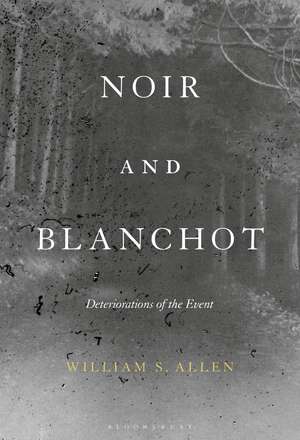
Noir and Blanchot: Deteriorations of the Event
Autor Dr William S. Allenen Limba Engleză Hardback – 23 ian 2020
What emerges from this investigation is the complex manner in which these works disrupt the experience of time and the event and in doing so expose an entirely different mode of material expression.
Preț: 613.50 lei
Preț vechi: 910.52 lei
-33%
Puncte Express: 920
Carte tipărită la comandă
Livrare economică 23 noiembrie-07 decembrie
Livrare prin curier în România Termenul estimat este afișat lângă disponibilitate.
Transport gratuit pentru acest produs Plată online sau ramburs, în funcție de opțiunile comenzii.
Retur gratuit în 14 zile Comandă securizată și suport în română.
Specificații
ISBN-13: 9781501358913
ISBN-10: 150135891X
Pagini: 194
Dimensiuni: 152 x 229 x 15 mm
Greutate: 0.45 kg
Editura: Bloomsbury Publishing
Colecția Bloomsbury Academic
Locul publicării:New York, United States
ISBN-10: 150135891X
Pagini: 194
Dimensiuni: 152 x 229 x 15 mm
Greutate: 0.45 kg
Editura: Bloomsbury Publishing
Colecția Bloomsbury Academic
Locul publicării:New York, United States
V-ar putea interesa
-
 -18%Preț: 102.00 lei123.96 lei
 -
 The Curator of SilenceJude NutterPreț: 176.12 lei
 -
 Medieval Number SymbolismVincent Foster HopperPreț: 84.89 lei
 -
 DelphiMichael ScottPreț: 145.47 lei
 -
 The Step Not BeyondMaurice BlanchotPreț: 241.50 lei
 -
 The Complete Short Stories of Ambrose BierceAmbrose BiercePreț: 172.34 lei
 -
 Sisters of SalomeToni BentleyPreț: 112.44 lei
 -
 Blues for a Black Cat and Other StoriesBoris VianPreț: 81.54 lei
 -
 Faux PasMaurice BlanchotPreț: 213.51 lei
 -
 Hand to HandJean-Louis ChrétienPreț: 283.25 lei
 -
 Depreciating AssetsJessica Vaughn-16%Preț: 124.96 lei148.93 lei
 -
 Art in NatureTove Jansson-19%Preț: 57.73 lei70.91 lei
 -
 The Spiritual CityPhilip SheldrakePreț: 280.93 lei
 -
 The Sinful Path to HeavenVaughn Jessica VaughnPreț: 73.23 lei
 -
 ArtmachinesAnne Sauvagnargues-17%Preț: 174.15 lei208.89 lei
 -
 WomanarchyKhurt KhavePreț: 63.69 lei
 -
 The Snail with the Right HeartMaria Popova-32%Preț: 93.50 lei136.56 lei
 -
 Disintegration of the Atom and Petersburg WintersGeorgy Ivanov-17%Preț: 157.73 lei189.91 lei
 -
 Blanchot and the Moving ImageCalum WattPreț: 103.71 lei
 -
 The Politics of FriendshipJacques DerridaPreț: 100.10 lei
 -
 Book of the PeonyGaspar OrozcoPreț: 93.26 lei
 -
 Earth Absolute & Other TextsLorand GasparPreț: 107.54 lei
Cuprins
Acknowledgements
List of Abbreviations
1. Dark Time
2. Ruptures and Deviations
3. Chiaroscuro
4. Between Deaths
5. Damnation
6. Rewriting History
Notes
Index
List of Abbreviations
1. Dark Time
2. Ruptures and Deviations
3. Chiaroscuro
4. Between Deaths
5. Damnation
6. Rewriting History
Notes
Index
Recenzii
It is tempting to respond to dark times with the light of optimism. But as William S. Allen shows in Noir and Blanchot, this is to fall into the trap of darkness. In a pathbreaking exploration of using darkness to forge a way out of darkness, Allen brings together two unlikely allies - film noir and Maurice Blanchot - to disrupt the prevailing dark times.
Georges Bataille had compared Maurice Blanchot with the main character of Invisible Man, but nobody had dared pairing the elusive writer with film noir. Noir and Blanchot accomplishes this daring hermeneutic feat: it makes sense to read Death Sentence wedged between Double Indemnity and Vertigo. Not only are all three underpinned by Hegelian negation of negation, but also the Gothic features of Blanchot's narratives stand out. Thanks to Allen's brilliant insight, Blanchot appears less as a French Kafka than as a literary Béla Tarr.
William S. Allen once again shows himself to be an expert guide through the complexities of Blanchot's thought. In limpid and elegant prose, Noir and Blanchot engages an expansive range of references whose common element is the darkness of an age - an age that is still ours - in which existence goes on in the disaster of extreme alienation. Allen's prismatic readings of Blanchot show us as never before how to enter thinking into that darkness.
Georges Bataille had compared Maurice Blanchot with the main character of Invisible Man, but nobody had dared pairing the elusive writer with film noir. Noir and Blanchot accomplishes this daring hermeneutic feat: it makes sense to read Death Sentence wedged between Double Indemnity and Vertigo. Not only are all three underpinned by Hegelian negation of negation, but also the Gothic features of Blanchot's narratives stand out. Thanks to Allen's brilliant insight, Blanchot appears less as a French Kafka than as a literary Béla Tarr.
William S. Allen once again shows himself to be an expert guide through the complexities of Blanchot's thought. In limpid and elegant prose, Noir and Blanchot engages an expansive range of references whose common element is the darkness of an age - an age that is still ours - in which existence goes on in the disaster of extreme alienation. Allen's prismatic readings of Blanchot show us as never before how to enter thinking into that darkness.
Notă biografică
William S. Allen (PhD, University of Warwick) is an independent researcher at the University of Southampton, UK, and the author of the following books: Ellipsis: Of Poetry and the Experience of Language after Heidegger, Hölderlin, and Blanchot(2007); Aesthetics of Negativity: Blanchot, Adorno, and Autonomy (2016); Without End: Sade's Critique of Reason(Bloomsbury, 2018); Blanchot and the Outside of Literature (Bloomsbury, 2019); and, Noir and Blanchot: Deteriorations of the Event (Bloomsbury, 2020).