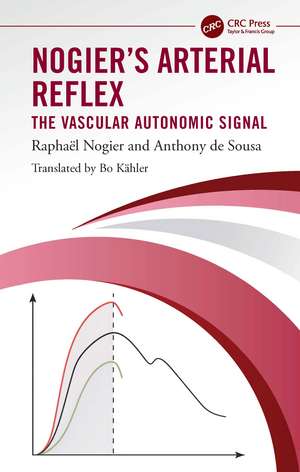
Nogier's Arterial Reflex: The Vascular Autonomic Signal
Autor Raphaël Nogier Traducere de Bo Kähler Autor Anthony de Sousaen Limba Engleză Paperback – 21 aug 2026
Through detailed methods, measurements, and tests, the authors present RAC as a simple yet powerful diagnostic approach, capable of unlocking the complexities of the neurovegetative system. By emphasizing direct clinical observation over technology, this work reaffirms the importance of intuition, empathy, and the art of medicine.
Whether you are a medical professional, a student, or simply curious about the intersection of science and the art of medicine, Nogier's Arterial Reflex invites you to explore a transformative perspective on health and healing.
Preț: 582.28 lei
Preț vechi: 704.44 lei
-17% Precomandă
Puncte Express: 873
Carte nepublicată încă
Doresc să fiu notificat când acest titlu va fi disponibil:
Se trimite...
Specificații
ISBN-13: 9781041272779
ISBN-10: 1041272774
Pagini: 320
Ilustrații: 376
Dimensiuni: 156 x 234 mm
Ediția:1
Editura: CRC Press
Colecția CRC Press
ISBN-10: 1041272774
Pagini: 320
Ilustrații: 376
Dimensiuni: 156 x 234 mm
Ediția:1
Editura: CRC Press
Colecția CRC Press
Public țintă
Professional Practice & DevelopmentCuprins
Part 1: A new medical approach
Chapter 1 - Introduction and background
Chapter 2 - The RAC, general considerations
Chapter 3 - The neuro-vegetative system (autonomic system) Organ function
Chapter 4 - Practical aspects of taking the RAC
Chapter 5 - Physiological aspects of the RAC
Chapter 6 - Experimental aspects
Part 2: Paul Nogier's progression
Chapter 7 - Paul Nogier’s five main stages of research on the use of the RAC
Chapter 8 - Use of colour filters Photoemission Photoreception Areas Frequencies
Part 3: Index of sympathetic reactivity
Chapter 9 - The white light test
Chapter 10 - The RAC exhaustion phenomenon: dental foci and pathological scars
Part 4: Overview of Paul Nogier’s classical techniques
Chapter 11 – Introduction
Chapter 12 - Instruments used for measurements with the pulse response
Chapter 13 - Initial stages of examination in pulse assisted auriculotherapy
Chapter 14 - Detection of ear points with the RAC
Chapter 15 - Analysis of the reactive quality of a point
Chapter 16 - Pulse reactions to mechanical pressure applied to the skin
Chapter 17 - Transfers of information and ear borders
Chapter 18 - Techniques using colour stimuli
Chapter 19 - Overview of the concept of phases
Chapter 20 - Introduction to fundamental frequencies
Chapter 21 - Areas of the ear and fundamental frequencies
Chapter 22 - Other techniques based on fundamental frequencies
Chapter 23 - Evaluation of a drug substance
Chapter 24 - The RAC applied to smoking withdrawal
Part 5: More recent techniques
Chapter 25 - The photogram
Chapter 26 - Symmetry, laterality and tragus. The case of multiple sclerosis
Chapter 27 - Food hypersensitivities and the RAC
Chapter 28 - Use of the RAC in miscellaneous pathologies
Part 6: RAC and Dental Practice
Chapter 29 - The RAC applied to dentistry: A brief introduction to auriculo-dental practice
Chapter 1 - Introduction and background
Chapter 2 - The RAC, general considerations
Chapter 3 - The neuro-vegetative system (autonomic system) Organ function
Chapter 4 - Practical aspects of taking the RAC
Chapter 5 - Physiological aspects of the RAC
Chapter 6 - Experimental aspects
Part 2: Paul Nogier's progression
Chapter 7 - Paul Nogier’s five main stages of research on the use of the RAC
Chapter 8 - Use of colour filters Photoemission Photoreception Areas Frequencies
Part 3: Index of sympathetic reactivity
Chapter 9 - The white light test
Chapter 10 - The RAC exhaustion phenomenon: dental foci and pathological scars
Part 4: Overview of Paul Nogier’s classical techniques
Chapter 11 – Introduction
Chapter 12 - Instruments used for measurements with the pulse response
Chapter 13 - Initial stages of examination in pulse assisted auriculotherapy
Chapter 14 - Detection of ear points with the RAC
Chapter 15 - Analysis of the reactive quality of a point
Chapter 16 - Pulse reactions to mechanical pressure applied to the skin
Chapter 17 - Transfers of information and ear borders
Chapter 18 - Techniques using colour stimuli
Chapter 19 - Overview of the concept of phases
Chapter 20 - Introduction to fundamental frequencies
Chapter 21 - Areas of the ear and fundamental frequencies
Chapter 22 - Other techniques based on fundamental frequencies
Chapter 23 - Evaluation of a drug substance
Chapter 24 - The RAC applied to smoking withdrawal
Part 5: More recent techniques
Chapter 25 - The photogram
Chapter 26 - Symmetry, laterality and tragus. The case of multiple sclerosis
Chapter 27 - Food hypersensitivities and the RAC
Chapter 28 - Use of the RAC in miscellaneous pathologies
Part 6: RAC and Dental Practice
Chapter 29 - The RAC applied to dentistry: A brief introduction to auriculo-dental practice
Notă biografică
Raphaël Nogier, born in 1953, is a physician in Lyon, France, where he has practiced auriculotherapy exclusively since 1985. Author of several books on auriculotherapy and on nutrition, he has taught in twenty-five countries, mainly in Germany, Scandinavia, Italy, the USA, Algeria, South America, New Zealand and Japan. He has participated in several meetings organised by the World Health Organization for the standardization of the nomenclature and practice of auriculotherapy. He belongs to the French medical school for which semiology remains the irreplaceable framework of the art of diagnosis in medicine.
Anthony de Sousa, born in 1943, is a physician in Geneva, Switzerland and has been practising auriculotherapy since 1983. He trained at the GLEM (Lyon Group for Medical Studies) from 1979 and collaborated with Paul Nogier in his research group in Lyon until 1996. He has been teaching RAC techniques for more than 30 years at the GLEM and at the AGMAR () (French Swiss Acupuncture Association) in Geneva and has also had the opportunity¬ to teach in Australia, New Zealand and Norway. He was an expert at the WHO meeting (World Health Organization) on auriculotherapy in 1990 in Lyon.
Anthony de Sousa, born in 1943, is a physician in Geneva, Switzerland and has been practising auriculotherapy since 1983. He trained at the GLEM (Lyon Group for Medical Studies) from 1979 and collaborated with Paul Nogier in his research group in Lyon until 1996. He has been teaching RAC techniques for more than 30 years at the GLEM and at the AGMAR () (French Swiss Acupuncture Association) in Geneva and has also had the opportunity¬ to teach in Australia, New Zealand and Norway. He was an expert at the WHO meeting (World Health Organization) on auriculotherapy in 1990 in Lyon.
Descriere
Through detailed methods, measurements, and tests, the authors present RAC as a simple yet powerful diagnostic approach, capable of unlocking the complexities of the neurovegetative system. By emphasizing direct clinical observation over technology, this work reaffirms the importance of intuition, empathy, and the art of medicine.