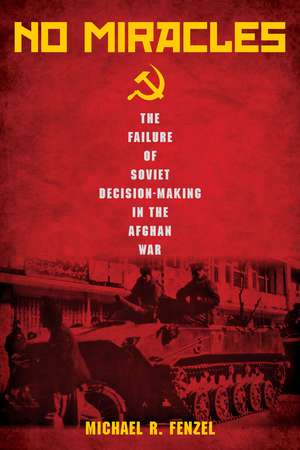
No Miracles: The Failure of Soviet Decision-Making in the Afghan War
Autor Michael Fenzelen Limba Engleză Hardback – sep 2017
The Soviet experience in Afghanistan provides a useful perspective on today's events in the region. Gorbachev decided in 1985 that a withdrawal should happen as soon as possible. The senior leadership of the Soviet Union became aware that their strategy was unraveling, their operational and tactical methods were not working, and the sacrifices they were demanding from the Soviet people and military were unlikely to produce the results they hoped for. They persisted nonetheless, and it took the Soviets another four years to get out.
In No Miracles, Michael Fenzel explains why and how that happened, as viewed from the center of the Soviet state. From that perspective, three sources of failure stand out: poor civil-military relations; repeated and rapid turnover of Soviet leadership; and the perception that Soviet global prestige and influence were inexorably tied to the success of the Afghan mission. The cost of delay was high for Moscow and, now, the cost of delaying withdrawal is similarly high for the United States. The Soviet case is instructive for policymakers and suggests that speeding up plans for withdrawal and preventing engagement in another conflict might be strongly considered.
In No Miracles, Michael Fenzel explains why and how that happened, as viewed from the center of the Soviet state. From that perspective, three sources of failure stand out: poor civil-military relations; repeated and rapid turnover of Soviet leadership; and the perception that Soviet global prestige and influence were inexorably tied to the success of the Afghan mission. The cost of delay was high for Moscow and, now, the cost of delaying withdrawal is similarly high for the United States. The Soviet case is instructive for policymakers and suggests that speeding up plans for withdrawal and preventing engagement in another conflict might be strongly considered.
Preț: 493.61 lei
Nou
Puncte Express: 740
Preț estimativ în valută:
87.36€ • 102.45$ • 76.60£
87.36€ • 102.45$ • 76.60£
Carte tipărită la comandă
Livrare economică 26 ianuarie-09 februarie 26
Preluare comenzi: 021 569.72.76
Specificații
ISBN-13: 9780804798181
ISBN-10: 0804798184
Pagini: 192
Dimensiuni: 152 x 229 x 20 mm
Greutate: 0.41 kg
Editura: Stanford University Press
Colecția Stanford Security Studies
ISBN-10: 0804798184
Pagini: 192
Dimensiuni: 152 x 229 x 20 mm
Greutate: 0.41 kg
Editura: Stanford University Press
Colecția Stanford Security Studies
V-ar putea interesa
-
 Understanding General DeterrenceS. Quackenbush-15%Preț: 662.65 lei779.59 lei
 -
 Multinational FederationsMichael BurgessPreț: 270.67 lei
 -
 Pragmatism in International RelationsHarry Bauer-15%Preț: 411.58 lei484.20 lei
 -
 Preț: 159.64 lei
 -
 International Environmental Agreements: An IntroductionSteinar Andresen-15%Preț: 405.80 lei477.42 lei
 -
 Preț: 246.14 lei
 -
 Maritime PiracyRobert HaywoodPreț: 347.81 lei
 -
 The Security Governance of Regional OrganizationsEmil J. KirchnerPreț: 419.72 lei
 -
 Preț: 254.87 lei
 -
 Preț: 220.16 lei
 -
 Preț: 201.56 lei
 -
 Maya Roads: One Woman's Journey Among the People of the RainforestMary Jo McConahayPreț: 105.76 lei
 -
 Uncertain Worlds: World-systems Analysis in Changing TimesImmanuel Wallerstein-18%Preț: 1329.01 lei1620.76 lei
 -
 Preț: 157.18 lei
 -
 -14%Preț: 258.56 lei301.42 lei
Notă biografică
Michael R. Fenzel is an active duty Colonel in the U.S. Army, currently serving as a Senior Military Fellow at the Council on Foreign Relations. He most recently served as the commander of the 3rd Brigade Combat Team and then chief of staff for the 82nd Airborne Division at Fort Bragg, North Carolina. He is the Chairman of the Council for Emerging National Security Affairs (CENSA), a life-member of the Council on Foreign Relations, and a former member the National Security Council Staff in the White House.