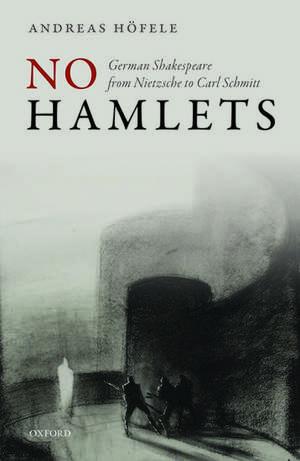
No Hamlets: German Shakespeare from Nietzsche to Carl Schmitt
Autor Andreas Höfeleen Limba Engleză Hardback – 14 iul 2016
Preț: 743.62 lei
Preț vechi: 1078.10 lei
-31%
Puncte Express: 1115
Carte tipărită la comandă
Livrare economică 26 noiembrie-02 decembrie
Livrare prin curier în România Termenul estimat este afișat lângă disponibilitate.
Transport gratuit pentru acest produs Plată online sau ramburs, în funcție de opțiunile comenzii.
Retur gratuit în 14 zile Comandă securizată și suport în română.
Specificații
ISBN-13: 9780198718543
ISBN-10: 0198718543
Pagini: 346
Ilustrații: 17 black and white illustrations
Dimensiuni: 161 x 241 x 23 mm
Greutate: 0.65 kg
Editura: OUP OXFORD
Colecția OUP Oxford
Locul publicării:Oxford, United Kingdom
ISBN-10: 0198718543
Pagini: 346
Ilustrații: 17 black and white illustrations
Dimensiuni: 161 x 241 x 23 mm
Greutate: 0.65 kg
Editura: OUP OXFORD
Colecția OUP Oxford
Locul publicării:Oxford, United Kingdom
V-ar putea interesa
-
 Novels of the Eighteen-FortiesKathleen Tillotson-19%Preț: 282.63 lei349.83 lei
 -
 -32%Preț: 1284.04 lei1895.42 lei
 -
 War Stories and PoemsRudyard Kipling-18%Preț: 70.91 lei86.75 lei
 -
 Words Alone: Yeats and his InheritancesR. F. Foster-15%Preț: 111.39 lei131.61 lei
 -
 -31%Preț: 994.20 lei1447.28 lei
 -
 -21%Preț: 366.92 lei465.46 lei
 -
 -17%Preț: 211.64 lei255.34 lei
 -
 Dive Deeper: Journeys with Moby-DickGeorge Cotkin-16%Preț: 219.68 lei262.06 lei
 -
 -32%Preț: 478.54 lei705.67 lei
 -
 -11%Preț: 368.70 lei415.15 lei
 -
 Novel Judgements: Legal Theory as FictionWilliam P. MacNeilPreț: 311.83 lei
 -
 Elizabeth Barrett Browning's Aurora LeighMichele C Martinez-17%Preț: 178.80 lei215.30 lei
 -
 Preț: 90.31 lei
 -
 York Notes Companions: Victorian LiteratureBeth PalmerPreț: 89.94 lei
 -
 Preț: 64.20 lei
 -
 In Byron's FootstepsTessa de Loo-19%Preț: 57.30 lei71.14 lei
Recenzii
In taking this long view, Höfele rectifies any misconceptions we might have that 'right-wing Shakespeare' is purely a phenomenon of the Second World War, and in doing so he sheds fascinating light on less familiar aspects of German history in relation to right-wing politics and ideals and Shakespeare's role within these ... The position of Shakespeare comes full circle, from serving anti-democratic, racist, and fundamentalist causes, only to re-emerge as a powerful force in the midst of liberating and forward-thinking voices. Shakespeare, Hamlet, and to some extent Othello, thus become the keys to understanding German history, psyche, and identity in this powerful study. Höfele's work has all the potential to become an instant classic, a standard work for academics and teachers alike.
I cannot remember reading so compelling, important and revelatory a Shakespeare book as this one ... This is a wonderfully, indeed movingly well-written book but the quality which particularly singles out No Hamlets is its intellectual and moral honesty.
Höfele tells a remarkable story about the way Shakespeare provides imaginative resources for some of the most challenging and troubling thought of the modern era ... also very much engaged with current conversations in early modern studies.
I cannot remember reading so compelling, important and revelatory a Shakespeare book as this one ... This is a wonderfully, indeed movingly well-written book but the quality which particularly singles out No Hamlets is its intellectual and moral honesty.
Höfele tells a remarkable story about the way Shakespeare provides imaginative resources for some of the most challenging and troubling thought of the modern era ... also very much engaged with current conversations in early modern studies.
Notă biografică
Andreas Höfele is Professor of English at Munich University. He is the author of Stage, Stake, and Scaffold: Humans and Animals in Shakespeare's Theatre (OUP, 2011) which won the 2012 Roland H. Bainton Prize for Literature. His publications in German include books on Shakespeare's stagecraft, late nineteenth-century parody, and Malcolm Lowry, as well as six novels. He served as President of the German Shakespeare Society from 2002 to 2011.