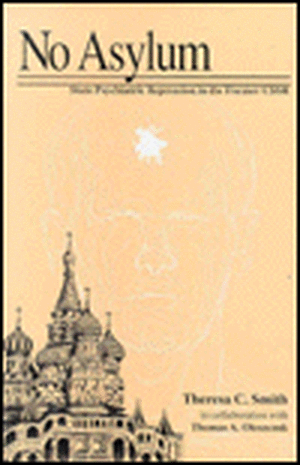
No Asylum
Autor Theresa C Smith, Thomas Oleszczuken Limba Engleză Hardback – dec 1996
There is little doubt that the Soviet state frequently hospitalized healthy individuals, either involuntarily or voluntarily admitted by relatives and others, for political activity or religious observance. All too frequently, political activists would come down with acute cases of asymptomatic psychiatric conditions that were purported to require detainment and heavy medication. Forced hospitalizations took place on a scale corresponding to the activity level of the dissident movement. In No Asylum: State Psychiatric Repression in the former USSR, Theresa C. Smith and Thomas A. Oleszczuk offer the first detailed quantitative study of psychiatric abuses in the USSR, based on more than 700 well-substantiated individual cases.
Preț: 606.07 lei
Preț vechi: 787.10 lei
-23%
Puncte Express: 909
Carte tipărită la comandă
Livrare economică 30 mai-13 iunie
Specificații
ISBN-13: 9780814780619
ISBN-10: 081478061X
Pagini: 304
Dimensiuni: 144 x 222 x 29 mm
Greutate: 0.49 kg
Ediția:New.
Editura: NYU Press - IPS
ISBN-10: 081478061X
Pagini: 304
Dimensiuni: 144 x 222 x 29 mm
Greutate: 0.49 kg
Ediția:New.
Editura: NYU Press - IPS
V-ar putea interesa
-
 InjusticeClive Stafford SmithPreț: 129.35 lei
 -
 -28%Preț: 500.82 lei695.38 lei
 -
 The Death Penalty in Contemporary ChinaS. Trevaskes-15%Preț: 620.69 lei730.22 lei
 -
 Restorative Justice: Ideas, Values, DebatesGerry Johnstone-15%Preț: 440.59 lei518.35 lei
 -
 Discipline and PunishMichel FoucaultPreț: 98.09 lei
 -
 Preț: 126.38 lei
 -
 Ancient FarmingPeter J. Reynolds-33%Preț: 44.27 lei65.83 lei
 -
 Preț: 113.26 lei
 -
 -19%Preț: 79.66 lei98.12 lei
 -
 FBI & Detainee Abuse?Jeremy A Pierson-30%Preț: 1627.06 lei2333.63 lei
 -
 BroadmoorCharlie Bronson-20%Preț: 98.80 lei123.80 lei
 -
 Life in StrangewaysAlan Lord-27%Preț: 55.24 lei75.47 lei
 -
 Banged Up!David Leslie-17%Preț: 59.74 lei71.55 lei
 -
 Cesare BeccariaHostettlerPreț: 236.20 lei
 -
 A Good Man InsidePhillips WillPreț: 89.39 lei
Textul de pe ultima copertă
If No Asylum: State Psychiatric Repression in the Former USSR, Theresa C. Smith and Thomas A. Oleszczuk offer the first detailed account of psychiatric abuses in the USSR, based on more that 700 well-substantiated individual cases, presenting incontrovertible evidence that these abuses did occur. Comparing the diagnostic methods adopted by most countries with those of the Soviet Union, Smith and Oleszczuk identify ways in which Soviet practice differed from that of other countries who used psychiatric diagnosis for political reasons. They argue that healthy people in the USSR were not detained idiosyncratically or occasionally but systematically, at predictable times. Detentions followed behavior critical of the government, religious observances, and actions advocating prohibited causes. Forced hospitalizations took place on a scale corresponding to the activity level of the dissident movement. Concluding with a chapter on developments under Gorbachev and Yeltsin, Smith and Oleszczuk maintain that although politically-motivated psychiatric detentions virtually ceased as the Soviet Union fragmented, it is too early to write an epitaph for psychiatric abuse.