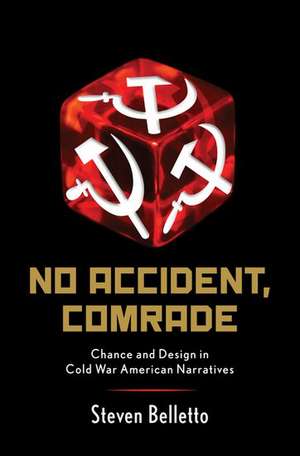
No Accident, Comrade: Chance and Design in Cold War American Narratives
Autor Steven Bellettoen Limba Engleză Hardback – 19 ian 2012
Preț: 660.42 lei
Preț vechi: 959.79 lei
-31%
Puncte Express: 991
Carte tipărită la comandă
Livrare economică 27 noiembrie-08 decembrie
Livrare prin curier în România Termenul estimat este afișat lângă disponibilitate.
Transport gratuit pentru acest produs Plată online sau ramburs, în funcție de opțiunile comenzii.
Retur gratuit în 14 zile Comandă securizată și suport în română.
Specificații
ISBN-13: 9780199826889
ISBN-10: 0199826889
Pagini: 224
Ilustrații: 4 illustrations
Dimensiuni: 239 x 160 x 23 mm
Greutate: 0.43 kg
Editura: Oxford University Press
Colecția OUP USA
Locul publicării:New York, United States
ISBN-10: 0199826889
Pagini: 224
Ilustrații: 4 illustrations
Dimensiuni: 239 x 160 x 23 mm
Greutate: 0.43 kg
Editura: Oxford University Press
Colecția OUP USA
Locul publicării:New York, United States
V-ar putea interesa
-
 A Little LearningEvelyn Waugh-26%Preț: 58.19 lei78.69 lei
 -
 A Little OrderEvelyn Waugh-27%Preț: 56.38 lei77.20 lei
 -
 Stories about Stories: Fantasy and the Remaking of MythBrian Attebery-11%Preț: 372.26 lei420.19 lei
 -
 The Oxford Handbook of Global ModernismsMark Wollaeger-28%Preț: 388.08 lei541.29 lei
 -
 George Oppen and the Fate of ModernismPeter Nicholls-21%Preț: 301.50 lei379.96 lei
 -
 -31%Preț: 802.43 lei1168.06 lei
 -
 -31%Preț: 803.02 lei1168.41 lei
 -
 Young John McGahern: Becoming a NovelistDenis Sampson-17%Preț: 250.97 lei302.75 lei
 -
 -13%Preț: 289.30 lei330.76 lei
 -
 F. Scott Fitzgerald: The Great Gatsby/Tender is the NightNicolas TredellPreț: 177.89 lei
 -
 More Lives than OneJenny WilliamsPreț: 114.84 lei
 -
 Ulysses and UsDeclan KiberdPreț: 94.37 lei
 -
 Lesley Blanch: Inner Landscapes, Wilder ShoresAnne Boston-26%Preț: 53.20 lei71.63 lei
 -
 Seamus HeaneyAndrew MurphyPreț: 252.69 lei
 -
 Unruly Penelopes and the Ghosts. Narratives of English CanadaEva Darias-Beautell-19%Preț: 551.43 lei680.77 lei
 -
 Ornithologies of DesireTravis V MasonPreț: 471.46 lei
 -
 The Boxer & The Goal KeeperAndy MartinPreț: 147.12 lei
Descriere
No Accident, Comrade argues that chance became a complex yet conflicted cultural signifier during the Cold War, when a range of thinkers--politicians, novelists, historians, biologists, sociologists, and others--contended that totalitarianism denied the very existence and operation of chance in the world. This contention often worked by claiming that the Soviet system perpetrated a vast fiction on its population, a fiction made visible by the Soviet view that there is no such thing as chance or accident, only manifestations of historical law (hence the refrain from which the title is taken: 'It was no accident, Comrade,' which encapsulates a popular American understanding of Marxism). By reading a wide swath of the era's novels, Steven Belletto explains how the association of chance with democratic freedom and the denial of chance with totalitarianism circulated in Cold War culture. He shows how writers innovated strategies for dealing with and incorporating chance, which allowed them to theorize the ever-changing relationship between the individual and the state during a largely rhetorical conflict. Indeed, by emphasizing the Cold War's narrative quality--that is, by viewing it as a rhetorical field--this book likewise argues that pressure was put on fictional narratives in general, and that if we attune ourselves to the uses of chance in such material, we can understand how the Cold War encouraged new relationships between aesthetics and politics.
Recenzii
One of the most useful and effective aspects of No Accident, Comrade is that it suggests connections within quite a disparate body of fiction.
Notă biografică
Steven Belletto is Assistant Professor of English and chair of the American Studies program at Lafayette College.
Cuprins
- Chapter One: Chance, Narrative, and the Logic of the Cold War
- Chapter Two: Aesthetic Responses to Political Fictions: Pynchon and the
- Violence of Narrative Chance
- Chapter Three: The Zemblan Who Came in from the Cold: Nabokov's Cold War
- Chapter Four: Accidents Going Somewhere to Happen: African-American
- Self-Definition at Mid-Century
- Chapter Five: The Game Theory Narrative and the Myth of the
- National Security State
- Chapter Six: Their Country, Our Culture: The Persistence of the Cold War
- Coda: Cold War Meaning
- Bibliography
- Index