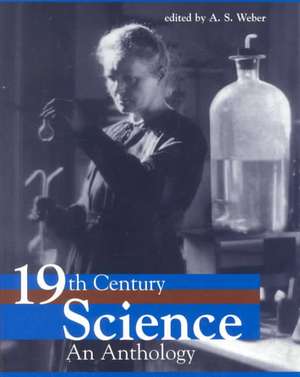
Nineteenth-Century Science: An Anthology
Editat de A.S. Weberen Limba Engleză Paperback – 10 mar 2000
The anthology will be of interest to the general reader who would like to explore in detail the scientific, cultural, and intellectual development of the nineteenth-century, as well as to students and teachers who specialize in the science, literature, history, or sociology of the period. The book provides examples from all the disciplines of western science-chemistry, physics, medicine, astronomy, biology, evolutionary theory, etc. The majority of the entries consist of complete, unabridged journal articles or book chapters from original 19th-century scientific texts.
Preț: 349.83 lei
Preț vechi: 460.47 lei
-24%
Puncte Express: 525
Carte disponibilă
Livrare economică 05-19 noiembrie
Livrare prin curier în România Termenul estimat este afișat lângă disponibilitate.
Transport gratuit de la 400.00 lei Plată online sau ramburs, în funcție de opțiunile comenzii.
Retur gratuit în 14 zile Comandă securizată și suport în română.
Specificații
ISBN-13: 9781551111650
ISBN-10: 1551111659
Pagini: 500
Dimensiuni: 178 x 229 x 24 mm
Greutate: 0.84 kg
Editura: BROADVIEW PR
Colecția Broadview Press
Locul publicării:Peterborough, Canada
ISBN-10: 1551111659
Pagini: 500
Dimensiuni: 178 x 229 x 24 mm
Greutate: 0.84 kg
Editura: BROADVIEW PR
Colecția Broadview Press
Locul publicării:Peterborough, Canada
V-ar putea interesa
-
 The Upright ThinkersLeonard MlodinowPreț: 116.25 lei
 -
 Galileo's Finger: The Ten Great Ideas of SciencePeter Atkins-17%Preț: 77.96 lei94.25 lei
 -
 Great Minds: Reflections of 111 Top ScientistsBalazs Hargittai-19%Preț: 380.54 lei467.19 lei
 -
 Nicolas-Louis De La Caille, Astronomer and GeodesistIan Stewart Glass-29%Preț: 537.87 lei752.27 lei
 -
 Preț: 165.86 lei
 -
 -20%Preț: 359.83 lei452.13 lei
 -
 Understanding Inconsistent SciencePeter Vickers-14%Preț: 622.13 lei723.41 lei
 -
 Crucible of Science: The Story of the Cori LaboratoryJohn H. Exton-28%Preț: 505.11 lei705.90 lei
 -
 -22%Preț: 205.97 lei263.09 lei
 -
 Complexity and the Arrow of TimeCharles H. LineweaverPreț: 286.67 lei
 -
 GeometrySerge LangPreț: 464.80 lei
Recenzii
Nineteenth-Century Science is a science anthology which provides over 30 selections from original 19th-century scientific monographs, textbooks and articles written by such authors as Charles Darwin, Mary Somerville, J.W. Goethe, John Dalton, Charles Lyell and Hermann von Helmholtz. The volume surveys scientific discovery and thought from Jean-Baptiste Lamarck’s theory of evolution of 1809 to the isolation of radium by Marie and Pierre Curie in 1898. Each selection opens with a biographical introduction, situating each scientist and discovery within the context of history and culture of the period. Each entry is also followed by a list of further suggested reading on the topic. A broad range of technical and popular material has been included, from Mendeleev’s detailed description of the periodic table to Faraday’s highly accessible lecture for young people on the chemistry of a burning candle.
The anthology will be of interest to the general reader who would like to explore in detail the scientific, cultural, and intellectual development of the nineteenth-century, as well as to students and teachers who specialize in the science, literature, history, or sociology of the period. The book provides examples from all the disciplines of western science-chemistry, physics, medicine, astronomy, biology, evolutionary theory, etc. The majority of the entries consist of complete, unabridged journal articles or book chapters from original 19th-century scientific texts.
“Weber has given us the best anthology of nineteenth-century science available. Drawing on a wide variety of rich sources, from Paley to Dalton, Lyell, Chambers, Combe, Darwin, Pasteur, Helmholtz, Huxley, and Curie, among others, Weber opens a window onto the fascinating world of nineteenth-century science.” — Bernard Lightman, Professor of Humanities, York University, and author of Victorian Science in Context (University of Chicago Press).
The anthology will be of interest to the general reader who would like to explore in detail the scientific, cultural, and intellectual development of the nineteenth-century, as well as to students and teachers who specialize in the science, literature, history, or sociology of the period. The book provides examples from all the disciplines of western science-chemistry, physics, medicine, astronomy, biology, evolutionary theory, etc. The majority of the entries consist of complete, unabridged journal articles or book chapters from original 19th-century scientific texts.
“Weber has given us the best anthology of nineteenth-century science available. Drawing on a wide variety of rich sources, from Paley to Dalton, Lyell, Chambers, Combe, Darwin, Pasteur, Helmholtz, Huxley, and Curie, among others, Weber opens a window onto the fascinating world of nineteenth-century science.” — Bernard Lightman, Professor of Humanities, York University, and author of Victorian Science in Context (University of Chicago Press).
Cuprins
List of illustrations
Acknowledgements
Introduction
Index of Topics
Acknowledgements
Introduction
- BENJAMIN BANNEKER
Benjamin Banneker’s Pennsylvania Almanack, 1783
Banneker’s New-Jersey Almanac, 1795 - XAVIER BICHAT
Physiological Researches on Life and Death - WILLIAM PALEY
Natural Theology - ERASMUS DARWIN
The Temple of Nature - JOHN DALTON
A New System of Chemical Philosophy - JEAN-BAPTISTE LAMARCK
Zoological Philosophy - JOHANN WOLFGANG GOETHE
Theory of Colours - ALEXANDER VON HUMBOLDT
The Island of Cuba - CHARLES BABBAGE
Reflections on the Decline of Science in England - CHARLES LYELL
Principles of Geology - MARY FAIRFAX SOMERVILLE
On the Connexion of the Physical Sciences - THEODOR SCHWANN
Microscopical Researches - NIKOLAI IVANOVICH LOBACHEVSKY
Geometrical Researches on the Theory of Parallels - ROBERT CHAMBERS
Vestiges of the Natural History of Creation - GEORGE COMBE
The Constitution of Man - WILLIAM WHEWELL
The Philosophy of the Inductive Sciences - HERBERT SPENCER
Social Statics - AUGUSTE COMTE
The Positive Philosophy - CHARLES ROBERT DARWIN
Origin of Species
Descent of Man - LOUIS PASTEUR
“Infusorian Animalcules Living Without Free Oxygen”
“Experiments Related to Spontaneous Generation” - MICHAEL FARADAY
Chemical History of a Candle - FRIEDRICH MAX MÜLLER
The Science of Language - HERMANN VON HELMHOLTZ
“On the Conservation of Force” - JAMES CLERK MAXWELL
“A Dynamical Theory of the Electromagnetic Field” - CLAUDE BERNARD
Introduction à I’étude de la médecine expérimentale - JOSEPH LISTER
“On the Antiseptic Principle in the Practice of Surgery” - SIR FRANCIS GALTON
Hereditary Genius - JOHN TYNDALL
The Belfast Address - WILLIAM THOMSON, LORD KELVIN
“Review of Evidence Regarding the Physical Condition of the Earth” - DMITRII IVANOVICH MENDELEEV
“The Periodic Law of the Chemical Elements” - WILLIAM JAMES
The Principles of Psychology - THOMAS HENRY HUXLEY
Evolution and Ethics - WILHELM CONRAD RÖNTGEN
“On a New Kind of Rays” - MARIE SKLODOWSKA CURIE
“The Discovery of Radium” - GEORGE WASHINGTON CARVER
Feeding Acorns - ALFRED RUSSEL WALLACE
“On the Tendency of Varieties to Depart Indefinitely from the Original Type”
The Wonderful Century
Index of Topics