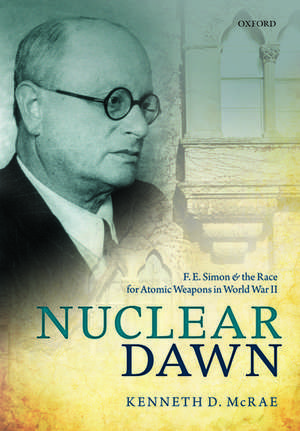
Nuclear Dawn: F. E. Simon and the Race for Atomic Weapons in World War II
Autor Kenneth D. McRaeen Limba Engleză Hardback – 20 mar 2014
Preț: 359.83 lei
Preț vechi: 452.13 lei
-20%
Puncte Express: 540
Carte tipărită la comandă
Livrare economică 10-15 decembrie
Livrare prin curier în România Termenul estimat este afișat lângă disponibilitate.
Transport gratuit de la 400.00 lei Plată online sau ramburs, în funcție de opțiunile comenzii.
Retur gratuit în 14 zile Comandă securizată și suport în română.
Specificații
ISBN-13: 9780199687183
ISBN-10: 0199687188
Pagini: 314
Ilustrații: 24 b/w illustrations
Dimensiuni: 175 x 243 x 21 mm
Greutate: 0.75 kg
Editura: OUP OXFORD
Colecția OUP Oxford
Locul publicării:Oxford, United Kingdom
ISBN-10: 0199687188
Pagini: 314
Ilustrații: 24 b/w illustrations
Dimensiuni: 175 x 243 x 21 mm
Greutate: 0.75 kg
Editura: OUP OXFORD
Colecția OUP Oxford
Locul publicării:Oxford, United Kingdom
V-ar putea interesa
-
 -30%Preț: 1194.14 lei1707.35 lei
 -
 Nuclear Facilities: A Designer's GuideBill Collum-24%Preț: 753.29 lei997.60 lei
 -
 -11%Preț: 379.91 lei428.90 lei
 -
 -15%Preț: 510.66 lei600.78 lei
 -
 -15%Preț: 436.12 lei513.08 lei
 -
 The Mining Valuation HandbookRudenno-8%Preț: 482.12 lei524.04 lei
 -
 Uranium MiningTamara ThompsonPreț: 200.43 lei
 -
 Preț: 330.56 lei
 -
 Gold Production from Beginning to EndMariusz SkoniecznyPreț: 125.24 lei
 -
 -15%Preț: 510.37 lei600.43 lei
 -
 The World Mining Industry: Investment Strategy and Public PolicyRaymond F. MikesellPreț: 347.95 lei
 -
 Science and Its HistoryJoseph Agassi-18%Preț: 1281.47 lei1562.77 lei
 -
 -18%Preț: 1045.70 lei1275.23 lei
 -
 -15%Preț: 641.11 lei754.26 lei
 -
 Nuclear Silk RoadKim Byung-KooPreț: 133.27 lei
 -
 New Scramble for AfricaPadraig R. CarmodyPreț: 174.96 lei
 -
 An Introduction to Uranium MiningEmily K. ThormanPreț: 155.41 lei
 -
 Introduction to Mining Business ProjectsRoger Rumbu-23%Preț: 715.38 lei929.07 lei
 -
 An Insider's Guide to the Mining Sector, 2nd editionMichael Coulson-16%Preț: 231.62 lei274.20 lei
 -
 Mining CapitalMichael SeegerPreț: 439.13 lei
 -
 Mining and Selling Radium and UraniumRoger F. Robison-15%Preț: 668.95 lei787.00 lei
 -
 Mining in the Asia-PacificTerry O'Callaghan-15%Preț: 675.76 lei795.00 lei
Recenzii
... a highly readable book ... There is something for all in the book, and physicists will be eager to look further afield for more of Simon's science.
Nuclear Dawn is much more than a biography of Simon [...] Most popular books on the early scientific development of the Allies' nuclear weapons focus so strongly on the Manhattan Project that they underplay the British contributions that did much to get the project off the ground. McRae's book helps to correct this and illuminates several British nuclear scientists who worked in secret fort the governement during the war.
Nuclear Dawn is an invaluable source for historians of the Anglo-American atomic bomb project, especially as it concerns the life of a physicist who deserves to be more clearly remembered.
From Franz Simon of Breslau to Sir Francis Simon of Oxford, this fascinating book recounts the life of a man who moved from being a distinguished German physicist in the science of low temperatures to being an important figure in the early British work on atomic energy. It is written by his son-in-law and based on a large cache of private, professional and official letters, most of which came to light only after the death of Lady Simon in 1999.
A refugee from Nazi Germany, a noted scientist, a pivotal contributor to the atomic bomb projects in the UK and US, Francis Simon lived the extraordinary events of the 20th century. He understood the potential nuclear threat from the Nazis and willingly made the necessary sacrifices to help the Americans and British win the race for the bomb. K. D. McRae's biography of Simon offers a rich narrative of Simon's life as well as fascinating insights into the bomb projects in the five major countries at war and why the Americans and British won.
Nuclear Dawn is much more than a biography of Simon [...] Most popular books on the early scientific development of the Allies' nuclear weapons focus so strongly on the Manhattan Project that they underplay the British contributions that did much to get the project off the ground. McRae's book helps to correct this and illuminates several British nuclear scientists who worked in secret fort the governement during the war.
Nuclear Dawn is an invaluable source for historians of the Anglo-American atomic bomb project, especially as it concerns the life of a physicist who deserves to be more clearly remembered.
From Franz Simon of Breslau to Sir Francis Simon of Oxford, this fascinating book recounts the life of a man who moved from being a distinguished German physicist in the science of low temperatures to being an important figure in the early British work on atomic energy. It is written by his son-in-law and based on a large cache of private, professional and official letters, most of which came to light only after the death of Lady Simon in 1999.
A refugee from Nazi Germany, a noted scientist, a pivotal contributor to the atomic bomb projects in the UK and US, Francis Simon lived the extraordinary events of the 20th century. He understood the potential nuclear threat from the Nazis and willingly made the necessary sacrifices to help the Americans and British win the race for the bomb. K. D. McRae's biography of Simon offers a rich narrative of Simon's life as well as fascinating insights into the bomb projects in the five major countries at war and why the Americans and British won.
Notă biografică
Kenneth D. McRae is Professor Emeritus of Political Science at Carleton University, Ottawa. He has written or edited seven other volumes, including monographs on selected West European democracies (Belgium, Finland, Switzerland) and a volume of readings in the same area.He is a son-in-law of Sir Francis and Lady Simon. For this volume he has had full access to Simon's personal letters, papers, diaries, and event calendars, as well as to the scientific correspondence and documents deposited in the Simon Papers at the Royal Society Library and in the Cherwell Papers at Nuffield College, Oxford.