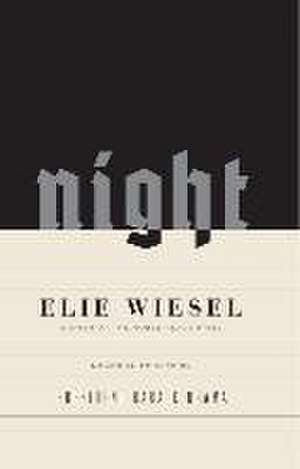
Night
Autor Elie Wieselen Limba Engleză Paperback – 29 sep 2021
Subliniem valoarea istorică și pedagogică a acestei ediții memoriale, care integrează discursul inedit susținut de Elie Wiesel în fața Adunării Generale a ONU, intitulat „Will the World Ever Know”. Această intervenție completează în mod necesar mărturia originală, oferind o perspectivă matură asupra responsabilității colective în fața genocidului. Notăm cu interes includerea prefeței semnate de Barack Obama, care poziționează textul nu doar ca pe un document al trecutului, ci ca pe o „conștiință a lumii” indispensabilă curriculumului de studiu al Holocaustului. Night urmărește parcursul devastator al unui adolescent din Sighet, Transilvania, prin mecanismul dezumanizării de la Auschwitz și Buchenwald. Stilul este de o simplitate tăioasă, refuzând metafora în favoarea faptului brut: moartea mamei și a surorii sale, Tsipora, și agonia tatălui său. Considerăm că forța acestui volum rezidă în onestitatea cu care este descrisă prăbușirea propriei inocențe și a certitudinilor religioase. Această operă centrală a lui Wiesel este extinsă tematic prin lucrări precum The Tale of a Niggun, unde autorul explorează puterea cântecului și a nemuririi în contextul ororii, însă Night rămâne pilonul fundamental al întregii sale bibliografii. În peisajul literaturii despre Shoah, această ediție completează perspectiva oferită de Elie Wiesel de Joseph Berger, adăugând vocea directă și subiectivitatea brută a supraviețuitorului acolo unde biografia lui Berger oferă contextul academic și cronologic. Dacă studiile critice din Approaches to Teaching Wiesel's Night sunt esențiale pentru analiză, textul propriu-zis rămâne sursa primară de o intensitate emoțională inegalabilă, fiind o lectură de referință în seria Penguin Modern Classics.
Preț: 110.90 lei
Carte disponibilă
Livrare economică 15-29 septembrie
Specificații
ISBN-10: 1432876929
Dimensiuni: 140 x 218 x 20 mm
Greutate: 0.35 kg
Ediția:Text mare
Editura: Gale, a Cengage Company
V-ar putea interesa
-
 PEREGRINE PBJ. A. BakerPreț: 106.33 lei
 -
 Death In Venice And Other StoriesThomas Mann-19%Preț: 58.03 lei71.22 lei
 -
 Denying the HolocaustDeborah Lipstadt-31%Preț: 63.35 lei91.70 lei
 -
 The CrucibleArthur MillerPreț: 83.13 lei
 -
 SubmarineJoe Dunthorne-19%Preț: 51.19 lei63.59 lei
 -
 Animal FarmGeorge OrwellPreț: 62.23 lei
 -
 Not Without My DaughterBetty Mahmoody-25%Preț: 53.41 lei71.62 lei
 -
 Death in Venice and Other StoriesThomas MannPreț: 42.00 lei
 -
 -26%Preț: 68.36 lei92.46 lei
 -
 -18%Preț: 81.77 lei100.01 lei
 -
 A Matter of Death and LifeIrvin YalomPreț: 100.99 lei
 -
 Attack on Titan 27Hajime IsayamaPreț: 60.54 lei
 -
 Legion of the DamnedSven Hassel-26%Preț: 57.35 lei77.94 lei
 -
 Wheels of TerrorSven HasselPreț: 78.34 lei
 -
 When Breath Becomes AirPaul KalanithiPreț: 51.55 leiRecomandat
 -
 Man's Search For MeaningViktor E. FranklPreț: 62.55 lei
 -
 Treblinka: A Survivor's MemoryChil Rajchman-28%Preț: 64.95 lei90.43 lei
 -
 The Empty ChairNachman of BreslovPreț: 99.64 lei
 -
 Preț: 77.78 lei
 -
 AJIN: DEMI-HUMAN VOL. 14Gamon SakuraiPreț: 67.79 lei
 -
 -19%Preț: 51.16 lei63.45 lei
 -
 DorfpunksRocko SchamoniPreț: 96.56 lei
 -
 Blue BambooOsamu DazaiPreț: 87.08 lei
De ce să citești această carte
Recomandăm această ediție memorială pentru rigoarea documentară adăugată prin discursul de la ONU și prefața oficială. Cititorul câștigă o înțelegere profundă a impactului uman al Holocaustului, dincolo de cifre statistice. Este o resursă esențială pentru elevi, studenți și oricine dorește să exploreze limitele rezilienței umane și dilemele etice fundamentale ale secolului XX.
Despre autor
Elie Wiesel (1928–2016), născut în Sighet, România, a fost un scriitor american, profesor, activist politic și supraviețuitor al Holocaustului, distins cu Premiul Nobel pentru Pace în 1986. Autor a 57 de cărți, Wiesel și-a dedicat viața rolului de martor al atrocităților naziste, militând neobosit împotriva indiferenței și a opresiunii în întreaga lume. A fost profesor de științe umaniste la Universitatea din Boston și a jucat un rol crucial în înființarea Muzeului Memorial al Holocaustului din Statele Unite, fiind considerat o voce morală universală.
Notă biografică
Descriere scurtă
When Elie Wiesel died in July 2016, the White House issued a memorial statement in which President Barack Obama called him "the conscience of the world." The whole of the president's eloquent tribute serves as a foreword to this memorial edition of Night. "Like millions of admirers, I first came to know Elie through his account of the horror he endured during the Holocaust simply because he was Jewish," wrote the president.
In 1986, when Wiesel received the Nobel Peace Prize, the Norwegian Nobel Committee wrote, "Elie Wiesel was rescued from the ashes of Auschwitz after storm and fire had ravaged his life. In time he realized that his life could have purpose: that he was to be a witness, the one who would pass on the account of what had happened so that the dead would not have died in vain and so the living could learn." Night, which has sold millions of copies around the world, is the very embodiment of that conviction. It is written in simple, understated language, yet it is emotionally devastating, never to be forgotten.
Born in the town of Sighet, Transylvania, Wiesel was a teenager when he and his family were deported to Auschwitz and then Buchenwald. Night is the shattering record of his memories of the death of his mother, father, and little sister, Tsipora; the death of his own innocence; and his despair as a deeply observant Jew confronting the absolute evil of man.
"Never shall I forget that night, the first night in camp, that turned my life into one long night," writes Wiesel. "Never shall I forget . . . even were I condemned to live as long as God Himself." These words are etched into the wall of the Holocaust Memorial Museum in Washington. Far more than a chronicle of the sadistic realm of the camps, Night also addresses many of the philosophical and personal questions implicit in any serious consideration of the Holocaust.
In addition to tributes from President Obama and Samantha Powers, this memorial edition of Night includes the unpublished text of a speech that Wiesel delivered before the United Nations General Assembly on the sixtieth anniversary of the liberation of Auschwitz, entitled "Will the World Ever Know." These remarks powerfully resonate with Night and with subsequent acts of genocide.
Descriere
Elie Wiesel's harrowing first-hand account of the atrocities committed during the Holocaust, Night is translated by Marion Wiesel with a preface by Elie Wiesel in Penguin Modern Classics.
Born into a Jewish ghetto in Hungary, as a child, Elie Wiesel was sent to the Nazi concentration camps at Auschwitz and Buchenwald. This is his account of that atrocity: the ever-increasing horrors he endured, the loss of his family and his struggle to survive in a world that stripped him of humanity, dignity and faith. Describing in simple terms the tragic murder of a people from a survivor's perspective, Night is among the most personal, intimate and poignant of all accounts of the Holocaust. A compelling consideration of the darkest side of human nature and the enduring power of hope, it remains one of the most important works of the twentieth century.
Elie Wiesel (b. 1928) was fifteen years old when he and his family were deported by the Nazis to Auschwitz. After the war, Wiesel studied in Paris and later became a journalist. During an interview with the distinguished French writer, Francois Mauriac, he was persuaded to write about his experiences in the death camps. The result was his internationally acclaimed memoir, La Nuit or Night, which has since been translated into more than thirty languages.
If you enjoyed Night, you might also like Primo Levi's The Periodic Table, also available in Penguin Modern Classics.
'A slim volume of terrifying power'
The New York Times
'To the best of my knowledge no one has left behind him so moving a record'
Alfred Kazin
'Wiesel has taken his own anguish and imaginatively metamorphosed it into art'
Curt Leviant, Saturday Review