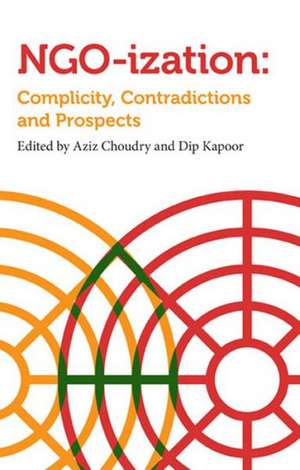
NGOization: Complicity, Contradictions and Prospects
Autor Aziz Choudry, Dip Kapooren Limba Engleză Paperback – 11 iul 2013
NGOization - the professionalization and institutionalization of social action - has long been a hotly contested issue in grassroots social movements and communities of resistance. This book pulls together for the first time unique perspectives of social struggles and critically engaged scholars from a wide range of geographical and political contexts to offer insights into the tensions and challenges of the NGO model, while considering the feasibility of alternatives.
Preț: 170.42 lei
Preț vechi: 192.49 lei
-11%
Puncte Express: 256
Carte tipărită la comandă
Livrare economică 27 noiembrie-11 decembrie
Livrare prin curier în România Termenul estimat este afișat lângă disponibilitate.
Transport gratuit de la 400.00 lei Plată online sau ramburs, în funcție de opțiunile comenzii.
Retur gratuit în 14 zile Comandă securizată și suport în română.
Specificații
ISBN-13: 9781780322575
ISBN-10: 1780322577
Pagini: 250
Dimensiuni: 138 x 216 x 14 mm
Greutate: 0.25 kg
Ediția:New.
Editura: Bloomsbury Publishing
Colecția Zed Books
Locul publicării:London, United Kingdom
ISBN-10: 1780322577
Pagini: 250
Dimensiuni: 138 x 216 x 14 mm
Greutate: 0.25 kg
Ediția:New.
Editura: Bloomsbury Publishing
Colecția Zed Books
Locul publicării:London, United Kingdom
V-ar putea interesa
-
 Dead AidDambisa Moyo-20%Preț: 63.04 lei78.35 lei
 -
 -19%Preț: 81.51 lei100.49 lei
 -
 -16%Preț: 99.88 lei118.83 lei
 -
 -31%Preț: 772.18 lei1122.58 lei
 -
 Preț: 310.37 lei
 -
 -27%Preț: 68.17 lei93.16 lei
 -
 Humanitarian InterventionThomas G WeissPreț: 131.62 lei
 -
 Hope in HellDan BortolottiPreț: 130.52 lei
 -
 -25%Preț: 196.16 lei261.23 lei
 -
 -17%Preț: 215.11 lei259.93 lei
 -
 An Imperfect OfferingJames Orbinski-19%Preț: 98.55 lei121.72 lei
 -
 Carbonnier, G: Humanitarian EconomicsGilles Carbonnier-23%Preț: 229.64 lei297.67 lei
 -
 Engineering in EmergenciesJan DavisPreț: 416.92 lei
Cuprins
Preface by Sangeeta Kamat
Introduction - NGOization: Complicity, Contradictions and Prospects - Aziz Choudry and Dip Kapoor
1. Saving Biodiversity, for Whom and for What? Conservation NGOs, Complicity, Colonialism and Conquest in an Era of Capitalist Globalization - Aziz Choudry
2. Social Action and NGOization in Contexts of Development Dispossession in Rural India: Explorations into the Un-civility of Civil Society - Dip Kapoor
3. NGOs, Indigenous Peoples and the United Nations - Sharon H. Venne
4. From Radical Movement to Conservative NGO and Back Again? A Case Study of the Democratic Left Front in South Africa - Luke Sinwell
5. Philippine NGOs: Defusing Dissent, Spurring Change - Sonny Africa
6. Disaster Relief, NGO-led Humanitarianism and the Reconfiguration of Spatial Relations in Tamil Nadu - Raja Swamy
7. Seven Theses on Neobalkanism and NGOization in Transitional Serbia - Tamara Vukov
8. Peace-building and Violence against Women: Tracking the Ruling Relations of Aid in a Women's Development NGO in Kyrgyzstan - Elena Kim and Marie Campbell
9. Alignment and Autonomy: Food Systems in Canada - Brewster Kneen
Introduction - NGOization: Complicity, Contradictions and Prospects - Aziz Choudry and Dip Kapoor
1. Saving Biodiversity, for Whom and for What? Conservation NGOs, Complicity, Colonialism and Conquest in an Era of Capitalist Globalization - Aziz Choudry
2. Social Action and NGOization in Contexts of Development Dispossession in Rural India: Explorations into the Un-civility of Civil Society - Dip Kapoor
3. NGOs, Indigenous Peoples and the United Nations - Sharon H. Venne
4. From Radical Movement to Conservative NGO and Back Again? A Case Study of the Democratic Left Front in South Africa - Luke Sinwell
5. Philippine NGOs: Defusing Dissent, Spurring Change - Sonny Africa
6. Disaster Relief, NGO-led Humanitarianism and the Reconfiguration of Spatial Relations in Tamil Nadu - Raja Swamy
7. Seven Theses on Neobalkanism and NGOization in Transitional Serbia - Tamara Vukov
8. Peace-building and Violence against Women: Tracking the Ruling Relations of Aid in a Women's Development NGO in Kyrgyzstan - Elena Kim and Marie Campbell
9. Alignment and Autonomy: Food Systems in Canada - Brewster Kneen
Recenzii
NGOization brings together voices not often heard in academia. This is a must read for anyone who is concerned about the future of democracy and wants to learn about the struggles of communities around the world to reclaim it.
Often conflated with social movements and other formations constituted by and representing the interests of the disempowered, NGOs require critical examination. Choudry and Kapoor have assembled an urgently timely and significant contribution in this regard and is a must-read for students and activists alike, especially in this moment of accelerating and deepening inequalities within and between countries.
While deploying context-specific approaches to theorizing NGOs, social movements, and their complex inter-relations, this insightful and provocative collection demonstrates that it is imperative to analyze NGOs' complicity with capital and coloniality, especially in the current global crisis of neoliberalism. Perhaps most innovative is the argument - advanced by the editors and taken on squarely by richly detailed case studies from an impressive range of world regions - that NGOs are not external to state, market or society. Rather, in the early twenty-first century, they have come to constitute "one more institutional form through which class relations are being contested and reworked." A most welcome addition to the critical literature on NGOization.
Often conflated with social movements and other formations constituted by and representing the interests of the disempowered, NGOs require critical examination. Choudry and Kapoor have assembled an urgently timely and significant contribution in this regard and is a must-read for students and activists alike, especially in this moment of accelerating and deepening inequalities within and between countries.
While deploying context-specific approaches to theorizing NGOs, social movements, and their complex inter-relations, this insightful and provocative collection demonstrates that it is imperative to analyze NGOs' complicity with capital and coloniality, especially in the current global crisis of neoliberalism. Perhaps most innovative is the argument - advanced by the editors and taken on squarely by richly detailed case studies from an impressive range of world regions - that NGOs are not external to state, market or society. Rather, in the early twenty-first century, they have come to constitute "one more institutional form through which class relations are being contested and reworked." A most welcome addition to the critical literature on NGOization.